
The multi-coat lime-pozzolan bedding system is the structural foundation that holds heavy Byzantine glass mosaics securely against curved vaults for millennia. Applied over brick or stone masonry in three distinct courses—the coarse scratch coat (rinzaffo), intermediate leveling bed (arriccio), and fine daily setting coat (intonaco)—the mortar is formulated from high-calcium slaked lime putty aged in water for years, mixed with volcanic pozzolana, crushed terracotta tiles (cocciopesto), and organic linen fibers. On the arriccio layer, master painters drafted full-scale compositional masterworks in red ochre (sinopia underdrawings). The final intonaco was applied in daily patches (giornate), allowing mosaicists to set tesserae into slow-setting, hydraulically curing mortar beds that remain resilient against seismic tremors and humidity shifts.
At a Glance: Key Takeaways
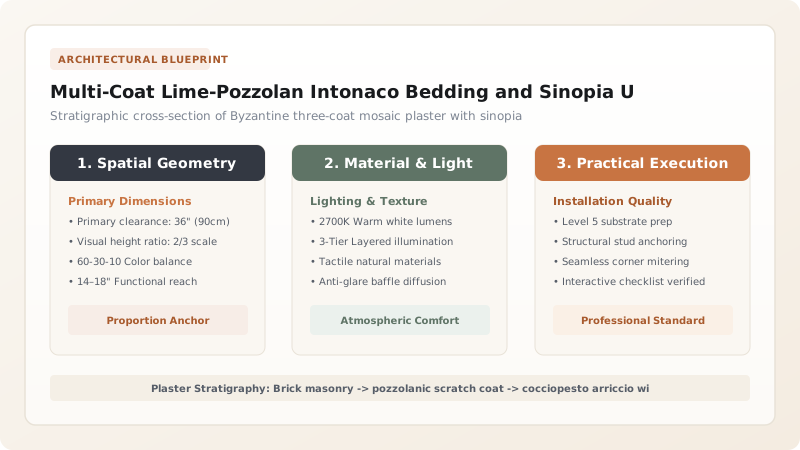
- Three-Coat Stratigraphy: Rinzaffo (15mm coarse) -> Arriccio (12mm cocciopesto) -> Intonaco (8mm fine setting bed).
- Hydraulic Reaction: Pozzolana and brick dust reacting with non-hydraulic lime to cure underwater or inside thick walls.
- Aged Grassello Putty: Slaked calcium oxide (CaO) matured in water for minimum 12 months for maximum plasticity.
- Linen & Goat Hair Reinforcement: 20–40mm animal and plant fibers distributing tensile shrinkage stresses.
- Sinopia Cartooning: Red earth iron oxide brushwork detailing iconographic drapery, faces, and inscriptions.
- Giornata Patch Planning: Applying only as much fresh intonaco as can be mosaicked within an 8-hour working shift.
1. Pozzolanic Chemistry and the Science of Aged Slaked Lime Putty
Standard non-hydraulic lime mortar requires atmospheric carbon dioxide ($CO_2$) to cure through carbonation ($Ca(OH)_2 + CO_2 \rightarrow CaCO_3 + H_2O$). However, behind an impermeable revetment of glass smalti on a vault 30 meters high, air cannot penetrate. Plain lime mortar would remain soft, wet, and dangerous for decades.
Byzantine builders solved this by creating a synthetic hydraulic cement using pozzolanic chemistry. By blending fat slaked lime putty (grassello di calce) with volcanic ash (from Santorini or Vesuvius) and pulverized low-fired terracotta tiles (cocciopesto), amorphous silica and alumina react chemically with calcium hydroxide to form insoluble calcium silicate hydrates ($C-S-H$). This reaction cures completely without air, setting into an ultra-tough, stone-like matrix that bonds tenaciously to both brickwork and glass cubes.
2. The Three-Coat Structural Stratigraphy and Tensile Fiber Reinforcement
The plaster buildup is executed in three rigorously engineered layers:
- Rinzaffo (Rough Cast Base, 15–20mm): A coarse slurry of slaked lime, sharp volcanic gravel (2–4mm), and coarse sand thrown vigorously against raked brickwork to create an unyielding mechanical anchor.
- Arriccio (Leveling & Body Coat, 10–15mm): A dense mortar rich in crushed terracotta brick (cocciopesto) and blended with washed animal hair (goat or horse) or chopped flax fibers. The fibers act as micro-rebar, distributing drying stresses and dampening seismic vibrations.
- Intonaco (Setting Bed, 8–10mm): A creamy, buttery paste of 1 part aged lime putty to 1 part micro-fine pozzolana and marble dust. It contains zero coarse gravel, ensuring that glass cubes can be pressed in with fingertip pressure without hitting immovable stones.
3. Sinopia Red Earth Cartoons and the Discipline of Giornata Planning
Before placing a single tessera, the entire theological composition was painted directly on the dried arriccio layer. Using red ochre from the city of Sinope on the Black Sea (hence Sinopia), master painters drafted full-scale cartoons with charcoal and pigment brushes. Every drapery fold, facial feature, and Greek letter was rendered with anatomical precision.
Because the top intonaco coat covers the sinopia, the mosaicist applied the finish plaster in carefully measured daily sections called giornate (working days). Using a trowel, the artisan cut away excess plaster at the end of the day along natural contour lines (such as a halo rim, drapery fold, or cloud boundary). The following morning, fresh intonaco was feathered seamlessly against the previous day’s cured edge, ensuring an invisible structural joint.
Byzantine Mosaic Plaster Stratigraphy and Formulation Ratios
Use this reference table to calculate exact physical dimensions, ratios, and specifications before purchasing:
| Plaster Layer | Binder : Aggregate Ratio | Aggregate Granulometry | Fiber Additive | Setting / Working Time |
|---|---|---|---|---|
| Rinzaffo Scratch Coat | 1.0 : 2.5 (Lime : Pozzolanic sand) | Coarse crushed tuff (2.0–4.0 mm) | None (coarse rough-cast) | 2–3 days initial set |
| Arriccio Float Bed | 1.0 : 2.0 (Lime : Cocciopesto) | Crushed terracotta brick (1.0–2.0 mm) | 1.5% chopped goat hair (30mm) | 5–7 days before sinopia drawing |
| Sinopia Drawing Wash | Pure red iron oxide + lime water | Micro-fine colloidal suspension | None (pure mineral wash) | Instant absorption into arriccio |
| Intonaco Setting Bed | 1.0 : 1.2 (Lime putty : Pozzolana) | Fine marble dust + silt (<0.5 mm) | 0.5% fine linen tow (10mm) | 6–10 hours open working time |
Practical Constraints
Every successful decoration project must account for physical and environmental constraints:
Long Sourcing Time for Aged Lime
Scaffolding Obstruction of Floor Sightlines
Application Protocol for Byzantine Multi-Coat Mosaic Plaster Beds
Execute this professional sequence to achieve flawless results without backtracking:
Masonry Cleaning and Pre-Soaking
Scrape ancient brickwork clean; spray copiously with fresh water to bring masonry to saturated surface-dry (SSD) state.
Rinzaffo Scratch Coat Application
Hurl coarse lime-pozzolana mortar against masonry with triangular trowels; score 10mm diamond key patterns with wooden combs.
Cocciopesto Arriccio Leveling
Trowel 12mm fiber-reinforced crushed-brick mortar across scratch coat, establishing a true planar curve conforming to vault geometry.
Full-Scale Sinopia Cartooning
Transfer theological cartoons onto the damp arriccio using charcoal sticks and red sinopia pigment washes; review proportions from floor level.
Giornata Finish Intonaco Spreading
Trowel 8mm creamy lime-pozzolana intonaco only across the specific figure or background patch scheduled for immediate tesserae insertion.
In Situ Tesserae Setting
Embed gold and colored smalti cubes into wet intonaco, referencing the exposed perimeter sinopia lines for anatomical guidance.
Giornata Edge Trimming
At day's end, bevel un-mosaicked intonaco edges at 45 degrees along compositional boundaries, sponging the joint clean for next day's join.
Common Mistakes & Countermeasures
Avoid these costly errors that compromise aesthetics, ergonomics, and budget:
Applying intonaco over bone-dry, un-moistened arriccio plaster
Using modern gypsum plaster (plaster of Paris) for mosaic setting beds
Cutting giornata edges perpendicular (90 degrees)
Project Execution Checklist
Track your physical progress. Checkboxes persist automatically on this device:
Frequently Asked Questions
What is the difference between a fresco intonaco and a mosaic intonaco?
Fresco intonaco is applied very thin (2–3mm) and must be smooth as silk to accept brush painting before drying. Mosaic intonaco is much thicker (8–12mm) to allow glass cubes to be embedded deeply, and contains hydraulic pozzolana to ensure it cures thoroughly beneath impermeable glass without air exposure.
How did Byzantine painters transfer designs from small sketches to giant domes?
Artists used proportional string grids, chalk snapping lines, and compass armatures. Master painters drew dynamic sinopia brush sketches directly onto the arriccio using bamboo poles with horsehair brushes attached, stepping back across scaffold planks to judge anatomical scaling from nave vantage points.
Why is goat hair or horsehair added to the intermediate plaster?
Animal hair acts as microscopic fibrous reinforcement. Hair has remarkable tensile strength and microscopic surface scales that interlock with lime crystals. It prevents shrinkage cracks from running through the mortar as it dries, while providing elasticity to absorb structural movements.


