
Detail Guastavino ceiling soffits by laying glazed architectural terracotta tiles in a 45-degree herringbone pattern, framed by a continuous perimeter soldier course. Grout joints with fine-sanded flexible polymer mortar, and reinforce the perimeter springline boundaries with reinforced brick edge stiffeners or structural steel angles to resist localized shear forces.
At a Glance: Key Takeaways
- 45-Degree Herringbone Visual Rhythm: Interlocking rectangular tile geometry that conceals minor structural settling cracks within zigzag joints.
- Ceramic Slip Glazing (*Engobe*): Liquid clay slip glazes fired at 2,000°F providing rich semi-gloss cream, amber, and terracotta finishes.
- Perimeter Soldier Course Borders: A straight perimeter framing course that absorbs diagonal miter cuts cleanly against walls.
- Reinforced Brick Edge Stiffeners: Additional brick courses built along springline edges to stiffen the thin shell against localized point loads.
- Acoustic Sound Diffusion: Angled herringbone tile faces scatter high-frequency vocal flutter echoes in cavernous vaulted dining rooms.
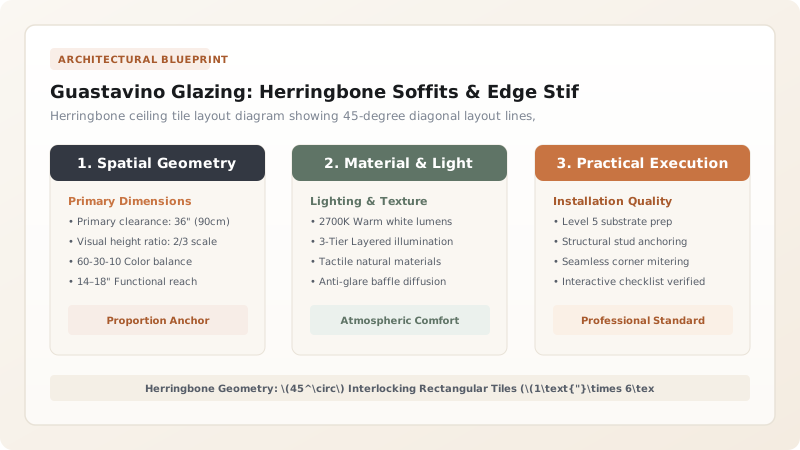
1. Aesthetic Engineering: The 45° Herringbone Pattern & Architectural Glazes
While the upper structural courses of a Guastavino vault are hidden, the exposed Intrados (Soffit) Face is a masterwork of architectural ceramics.
Laying tiles in a 45-Degree Herringbone Pattern serves both aesthetic and structural roles. Aesthetically, the zigzag movement draws the eye across the curved ceiling, creating rich light play across the semi-gloss Ceramic Slip Glaze (*Engobe*). Structurally, the interlocking herringbone pattern prevents long continuous linear joints, ensuring that any micro-cracking is broken up and dissipated across thousands of short staggered seams. Master tile lamination in laminated terracotta tile courses.

2. Structural Detailing: Perimeter Soldier Borders & Springline Edge Stiffeners
Where the diagonal herringbone tiles meet the perimeter walls, cutting hundreds of sharp triangular points directly against rough masonry creates ragged, uneven lines.
Masons always install a Continuous Perimeter Soldier Course (or Header Border) of straight tiles around the entire room edge. The diagonal herringbone tiles terminate cleanly into this border. Behind the scenes, the outer 2 feet of the vault perimeter is reinforced with Solid Brick Edge Stiffener Ribs laid over the extrados, stiffening the thin tile shell where it meets the bearing walls. Master domical vaulting in domical tile vault mechanics and explore the Guastavino vault hub.
Ceiling Tile Glaze & Finish Options
Use this reference table to calculate exact physical dimensions, ratios, and specifications before purchasing:
| Glaze / Surface Finish | Gloss Level & Sheen | Acoustic Reflection | Historic Aesthetic Fit |
|---|---|---|---|
| Semi-Matte Ceramic Engobe Slip (Optimal) | Eggshell / Satin luster | Moderate (Warm acoustic scatter) | Grand Central Terminal / Historic library |
| High-Gloss Ceramic Glaze | High Specular Reflectivity | High (Reflective sound surface) | Subway stations & public transit halls |
| Raw Unglazed Terracotta Bisque | Deep Matte natural clay | Low (Porous sound dampening) | Rustic Mediterranean wine cellars & Tuscan villas |
| Akoustolith Porous Ceramic (Guastavino patent) | Textured ultra-matte | Exceptional (Engineered sound absorption) | Symphony halls & private chapels |
Acid Wash Glaze Etching Destruction
Every successful decoration project must account for physical and environmental constraints:
Cleaning Hardened Mortar Haze with Harsh Muriatic Acid Etching Glazed Tile Faces
Using standard high-concentration muriatic acid to clean mortar haze burns and dissolves delicate ceramic slip glazes, turning lustrous amber tiles into dull, pitted white chalk; strictly clean mortar haze using non-acidic micro-fine abrasive nylon pads and mild 5% sulfamic acid cleaner within 24 hours of grouting.
How to Layout and Install a Glazed Herringbone Vault Soffit
Execute this professional sequence to achieve flawless results without backtracking:
Snap Perpendicular 45-Degree Centerlines on Vault Intrados
Establish true room centerlines; snap crisp chalk lines at 45° diagonal angles across the ceiling vault curve.
Install Perimeter Soldier Course Framing Border
Lay straight tile border around the room springline perimeter, establishing a clean, uniform termination margin.
Dry-Layout Central Herringbone Starter Chevron
Align the first two starter tiles at a 90° right angle on the central diagonal chalk line; verify equal margin to borders.
Tack Herringbone Tiles Working Outward in Symmetrical Waves
Butter tile backs with fast-set plaster or polymer mortar; place tiles alternating left and right in interlocking steps.
Wet-Cut Perimeter Border Miter Fills on Diamond Saw
Measure and cut diagonal termination tiles on water-cooled diamond saw; bed flush against the soldier border.
Pack Joints with Polymer-Modified Fine Sanded Grout
Force architectural colored grout into 3/8" joints with rubber float; strike joints slightly concave with rounded jointer.
Sponge Clean and Buff Glazed Ceramic Tile Faces
Wipe excess grout with damp cellulose sponge; after 2 hours, buff remaining haze with micro-fiber towels to a radiant gloss.
Common Mistakes & Countermeasures
Avoid these costly errors that compromise aesthetics, ergonomics, and budget:
Omitting the Perimeter Soldier Course Border
Project Execution Checklist
Track your physical progress. Checkboxes persist automatically on this device:
Frequently Asked Questions
What is Guastavino 'Akoustolith' tile?
Akoustolith was a patented acoustic tile invented by Rafael Guastavino Jr. in 1914. Formulated from porous volcanic pumice aggregates and Portland cement, it looked like quarried French limestone but possessed an astonishing 60% sound absorption coefficient, eliminating echo in vast churches.


