
Achieving an undetectable, glass-smooth transition between brass divider strips and surrounding terrazzo or marble requires a multi-stage planetary rotary diamond grinding and honing sequence. Beginning with 40/50-grit metal-bond diamond segments under continuous water mist, the floor is leveled to zero lipage, then systematically refined through 100 to 3,000-grit resin-bond pads to create a brilliant, scratch-free mirror luster.
At a Glance: Key Takeaways
- Heavy Metal-Bond Diamond Grinding: 40/50-grit diamond segments under 600+ lb planetary grinders shave down proud brass strips and stone aggregate simultaneously.
- Zero-Lipage Flatness: Eliminates all transition ridges, achieving ANSI A108.02 lipage tolerances under 0.015 inches for zero trip hazard.
- Slurry Vacuum Management: Continuous wet-grinding with dedicated auto-scrubber slurry vacuums prevents brass swarf from staining white marble aggregate.
- Resin-Bond Diamond Honing: Progressive stepping through 100, 200, 400, 800, 1,500, and 3,000 grit eliminates microscopic tooling swirls.
- Chemical Crystallization Buffing: Micro-abrasive oxalic acid or fluorosilicate crystallization compounds yield a high-gloss, slip-resistant museum finish.
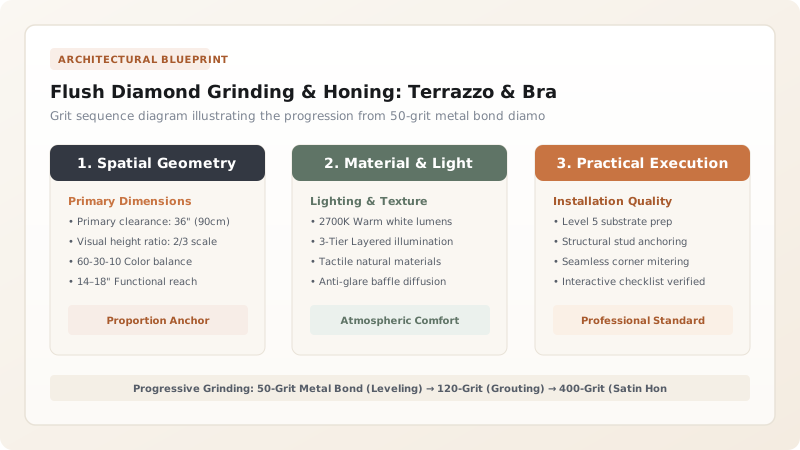
1. Grinding Tribology: Metal-Bond Diamonds & Brass Stock Removal
When terrazzo screed is poured against an architectural brass divider strip, the brass strip is deliberately installed 1/16 inch (1.5mm) higher than the cured floor level. Attempting to level this metal using conventional silicon carbide stones or hand grinders takes days and causes wavy, uneven dishing.
Architectural floor restoration relies on High-Mass Planetary Rotary Grinders (such as HTC 800 or Husqvarna PG 820) weighing 800 to 1,200 pounds. The machine's counter-rotating heads are fitted with Metal-Bond Diamond Segments (30/40 to 60/80 Grit). Diamond particles embedded in a sintered cobalt-bronze matrix shear through both hardened marble aggregate and solid architectural brass simultaneously:
Because the planetary heads distribute immense downward pressure (\(P_{\text{down}}\)) across a wide 32-inch cutting path, the diamond pads shave high metal edges flush without \"bouncing\" or dishing out the softer adjacent terrazzo matrix. Learn about initial layout in our brass-inlaid transitions hub.
2. Wet-Grinding Tribology: Swarf Management & Aggregate Staining
Dry grinding of brass-inlaid terrazzo is strictly prohibited. Dry grinding generates intense frictional heat that expands the brass bar, causing it to delaminate from its epoxy bed and melting the plastic binders of diamond pads. Furthermore, dry grinding creates hazardous airborne respirable crystalline silica and brass dust.
The entire grinding sequence must be executed under Continuous Water Lubrication (Wet Grinding). Water cools the diamond cutting matrix, flushes debris away from the cutting zone, and encapsulates hazardous dust.
However, wet grinding produces a dense slurry containing microscopic brass swarf particles (brass filings). If allowed to dry on white Thassos or Carrara marble aggregate, the copper in the swarf oxidizes rapidly into green copper carbonate, leaving permanent green stains across the luxury floor. The slurry must be continuously vacuumed using heavy-duty squeegee slurry extractors, followed immediately by high-pressure clean water rinses. Contrast with wood routing in our guide on router template channel cutting.
3. The Grouting Cycle & Resin-Bond Diamond Progression
After the initial coarse grind with 60/80-grit metal-bond diamonds achieves perfect planarity, the floor enters the Grouting Cycle. Grinding inevitably opens microscopic air pinholes in the terrazzo matrix. A color-matched Portland cement or clear epoxy grouting paste is squeegeed across the entire floor, filling every microscopic void adjacent to the brass strip.
Once the grout cures (24 to 48 hours), the Resin-Bond Diamond Honing Progression begins:
- 100 to 200 Grit: Cleans off excess surface grouting slurry and removes metal-bond diamond scratch patterns.
- 400 Grit (Matte Hone): Closes the porosity of the terrazzo matrix and produces a soft, uniform cashmere-matte finish on both stone and brass.
- 800 Grit (Satin Lustre): The brass strip begins to glow with a deep, warm golden sheen; aggregate clarity becomes distinctly visible.
- 1,500 to 3,000 Grit (Mirror Polish): Eliminates all micro-scratches, bringing the brass to a flawless reflective mirror finish that flows seamlessly into the glossy terrazzo.
Read about epoxy anchoring in our guide to epoxy anchoring brass bars.
4. Crystallization Buffing & Fluoropolymer Sealing
To lock in the mirror shine and protect against beverage acid staining (wine, citrus, coffee), the honed floor receives a final treatment using a High-Speed Buffing Machine (1,500–2,000 RPM) equipped with natural hogs-hair pads and a fluorochemical penetrating sealer.
For cementitious terrazzo, a micro-crystallization fluid containing magnesium fluorosilicate is buffed into the stone. The chemical reaction converts calcium carbonate in the marble chips into calcium fluoride, boosting surface hardness to Mohs 5 while enhancing the mirror luster of the adjacent brass strip. The finished floor undergoes slip-resistance testing (ANSI A326.3 Dynamic Coefficient of Friction) to verify it exceeds the 0.42 DCOF safety standard for wet luxury interiors. Explore door transitions in our monumental pivot doors guide.
Flush Diamond Grinding & Honing: Terrazzo & Brass Seamless Surfaces Architectural Decision Matrix
Use this reference table to calculate exact physical dimensions, ratios, and specifications before purchasing:
| Architectural Factor | Professional Recommendation | Significance |
|---|---|---|
| Grinding Machine Class | Planetary 3-head counter-rotating grinder (>800 lbs) | Provides sufficient downward head pressure to shear metal and stone coplanar |
| Grinding Mode | Continuous wet-grinding with immediate slurry vacuuming | Prevents diamond pad overheating and eliminates airborne silica and brass swarf |
| Diamond Bond Hardness | Medium-soft bronze bond for marble aggregate and C385 brass | Ensures continuous self-dressing of diamond crystals without metal glazing |
| Finished Surface Flatness | Zero detectable lipage (<0.015" / 0.38mm) | Meets ADA Section 303 accessibility and ANSI A108.02 terrazzo standards |
Execution Blueprint & Craftsmanship Sequence
Execute this professional sequence to achieve flawless results without backtracking:
Phase 1: Initial Metal-Bond Leveling Grind
Wet-grind floor using 40-grit metal bond diamond pads on planetary grinder at 600 RPM (Benchmark: Proud brass strip shaved completely flush; straightedge verifies zero lipage across joint)
Phase 2: Slurry Evacuation & High-Pressure Wash
Vacuum grinding slurry immediately using auto-scrubber; rinse with clean deionized water (Benchmark: Floor 100% clean of dark metal swarf; zero residue trapped in open pores)
Phase 3: Color-Matched Terrazzo Grouting
Squeegee matching cementitious or epoxy grouting paste across floor and allow 24h cure (Benchmark: All micro-pinholes adjacent to brass strip 100% filled and cured hard)
Phase 4: Progressive Resin Diamond Honing
Hone floor stepping through 100, 200, 400, 800, and 1,500-grit resin-bond diamond pads (Benchmark: Previous grit scratch patterns completely removed before progressing to next grit)
Phase 5: 3,000-Grit Polish & Fluoropolymer Sealing
Polish with 3,000-grit pads, apply penetrating fluoropolymer impregnating sealer, and buff with hogs-hair pad (Benchmark: Surface achieves 75+ Gloss Units; brass displays crisp, radiant jewelry reflection)
Common Mistakes & Countermeasures
Avoid these costly errors that compromise aesthetics, ergonomics, and budget:
Dry Grinding Brass Inlay Strips
Skipping Diamond Grit Steps (e.g., Jumping from 120 to 800 Grit)
Allowing Wet Brass Slurry to Dry on White Marble
Using Acidic Marble Crystallizers on Unprotected Brass
Project Execution Checklist
Track your physical progress. Checkboxes persist automatically on this device:
Frequently Asked Questions
How do you avoid creating a dip or depression around the brass strip during grinding?
Keep the heavy planetary grinding machine moving in continuous, overlapping circular passes at a steady walking pace. Never allow the machine to dwell or pivot over the brass strip. Using rigid, flat-faced metal-bond diamond pucks (rather than flexible velcro pads) ensures the machine cuts a true, uncompromising plane.
Can pre-existing terrazzo with brass strips be re-polished without heavy equipment?
Yes. For maintenance or minor scratch removal, floor restoration technicians use variable-speed weighted rotary floor buffers (175 RPM) fitted with flexible diamond-impregnated floor pads (Twister or Monkey Pads) from 400 to 3,000 grit under water mist, restoring factory gloss without stock removal.
Will polished brass divider strips become slippery when wet?
Because standard brass divider strips are relatively narrow (typically 1/8" to 1/4" wide), pedestrian shoes bridge across the metal onto the surrounding slip-resistant terrazzo matrix. When the floor is treated with high-performance penetrating fluoropolymer sealers, overall floor assemblies comfortably exceed ANSI A326.3 wet DCOF safety thresholds.


