
Execute structural bentwood lamination by resawing solid hardwood into thin veneer plies whose thickness (\(t\)) satisfies the bending radius formula \(R \ge 50t\) (e.g., a 6" radius requires plies 1/16" or thinner). Laminate plies with non-creeping Urea-Formaldehyde or structural epoxy adhesive over a rigid MDF mold inside a 28" Hg vacuum press bag.
At a Glance: Key Takeaways
- The 50:1 Radius-to-Thickness Bending Formula: \(R \ge 50t\) prevents external tension wood fibers from splintering and snapping.
- Rigid Non-Creeping Adhesives (Urea-Formaldehyde / Unibond 800): Dries glass-hard, eliminating plastic glue creep and seasonal springback.
- 28" Hg Vacuum Press Bag Clamping: Delivers uniform 1,800 lbs per square foot of atmospheric pressure across 3D complex compound curves.
- Springback Compensation Geometry: Over-bending the mold radius by 3% to 5% accounts for residual internal wood elasticity.
- Grain Direction Alignment: Alternating grain orientation by 90° (bent plywood) increases multidirectional strength; parallel grain (bent lamination) preserves pure wood edge aesthetics.
In-Depth Guides in this Directory
Explore specialized subtopic blueprints, technical dimensions, and execution checklists:
Bending Physics: 50:1 Radius-to-Thickness Ratio (R >= 50t)
Master bentwood engineering physics: the 50:1 radius-to-thickness ratio (R >= 50t), wood fiber tensile strain limits (epsilon < 0.01), neutral axis shifts, and springback math.
Bentwood Glues: Urea-Formaldehyde vs Epoxy Creep Resistance
Master bentwood adhesive chemistry: thermosetting Urea-Formaldehyde resins (Unibond 800) vs 100% solids epoxy, open working times, zero plastic cold-creep, and shear bond strength.
Bending Forms: CNC Ribbed MDF & 28" Hg Vacuum Presses
Master bentwood mold construction: CNC interlocking ribbed MDF bending forms, 30-mil polyurethane vacuum press bags, 28" Hg atmospheric clamping physics (14.7 PSI), and springback compensation.
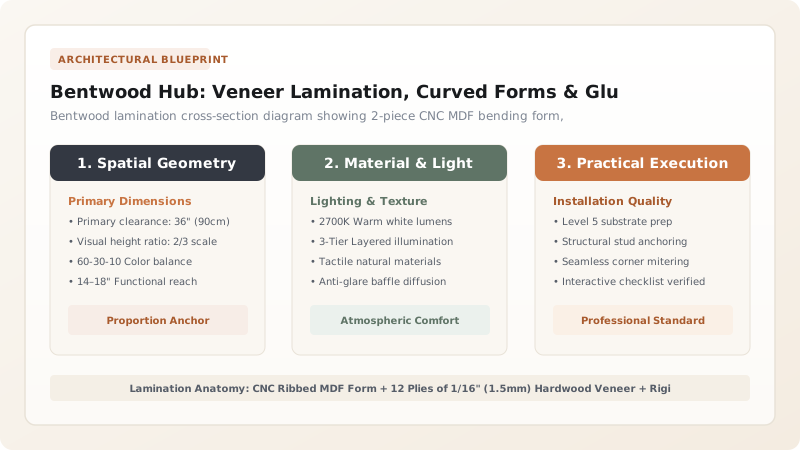
1. Material Physics: The 50:1 Radius-to-Thickness Ratio (\(R \ge 50t\))
Attempting to bend solid 3/4-inch wood results in catastrophic fiber breakage on the outer convex tension face and crushing on the inner concave compression face.
Bentwood Lamination slices wood into thin plies that bend effortlessly without steam. The maximum allowable Veneer Strip Thickness (\(t\)) for a target Bending Radius (\(R\)) is:
$$t \le \frac{R}{50}$$
For a tight 4-inch radius curve, veneer plies must be sliced to 1/16-inch (\(1.5\text{mm}\)) or thinner. Master veneer slicing math in veneer strip thickness and bending radius physics and coordinate with curved architectural framing.

2. Rigid Adhesive Chemistry & Vacuum Press Bag Molds
Standard yellow PVA wood glue remains slightly rubbery when cured, causing the laminated curve to 'creep' and lose its shape over time.
Master glue chemistry in urea-formaldehyde vs epoxy glues and design bending forms in vacuum press bags and MDF forms.
Bentwood Wood Bending Methods Comparison
Use this reference table to calculate exact physical dimensions, ratios, and specifications before purchasing:
| Bending Method | Minimum Safe Radius | Springback Stability | Aesthetic Edge Grain Quality |
|---|---|---|---|
| Bent Laminations (Veneer Plies - Optimal) | Tight (Down to 2" radius) | 100% Stable (Zero creep with urea glue) | 5 / 5 (Looks like solid continuous wood) |
| Solid Steam Bending | Moderate (Requires 10:1 ratio / straight grain) | Moderate (High springback / moisture warp) | 5 / 5 (Solid single timber) |
| Kerf Bending (Kerf-core) | Tight (Internal saw slots) | Poor (Weak structural core / Faceted) | 1 / 5 (Requires edge banding to hide slots) |
| Flexible Bending Plywood (Wiggle Wood) | Ultra-Tight (Down to 1" radius) | Requires rigid veneer face skin | 2 / 5 (Substrate only / Non-structural) |
PVA Glue Creep Springback Constraints
Every successful decoration project must account for physical and environmental constraints:
Standard Yellow PVA Wood Glue Creeping Months Later Losing Curved Shape
Polyvinyl Acetate (PVA) glues are thermoplastic polymers that slowly stretch under constant internal wood tension (cold creep), opening curves by 10%–20% in hot summer weather; strictly use thermosetting rigid glues (Urea-Formaldehyde resin, Unibond 800, or Structural Epoxy) that cure glass-hard.
How to Build a Form and Execute a Bentwood Lamination
Execute this professional sequence to achieve flawless results without backtracking:
Calculate Minimum Ply Thickness for Target Radius
Divide target inside radius by 50 to determine maximum veneer strip thickness (e.g., 6" radius = 0.12" / 1/8" max ply).
Resaw Solid Hardwood into Matching Veneer Strips
Resaw lumber on bandsaw with 3-TPI blade; pass through drum sander to achieve uniform 1/16" (1.5mm) thickness.
Construct Rigid 2-Piece or Vacuum MDF Bending Form
Glue layers of 3/4" MDF together; cut target curve on bandsaw; sand form smooth and wax with paste wax.
Mix Urea-Formaldehyde Resin Adhesive
Blend powdered urea resin glue with water (or mix 2-part Unibond 800); apply evenly with glue roller to both faces of all plies.
Stack Plies onto Form and Insert in Vacuum Press Bag
Place glued ply sandwich onto waxed MDF form; slide assembly into polyurethane vacuum bag and seal end clip.
Draw 28" Hg Vacuum and Maintain for 8 Hours
Activate continuous vacuum pump to pull 28" Hg; let cure under pressure at 70°F+ (21°C) for 8 to 12 hours.
Remove from Bag and Clean Glue Squeeze-Out
Extract curved part; scrape hardened glue beads with carbide card scraper; joint and trim edges to final width.
Common Mistakes & Countermeasures
Avoid these costly errors that compromise aesthetics, ergonomics, and budget:
Using Yellow Titebond PVA Glue for Structural Bentwood Furniture
Project Execution Checklist
Track your physical progress. Checkboxes persist automatically on this device:
Frequently Asked Questions
How do you calculate springback on a bentwood lamination?
Springback is the small amount a laminated curve relaxes when unclamped. When using 12+ thin plies with rigid urea-formaldehyde glue, springback is minimal (typically 2% to 4%). To compensate, over-bend the mold by 3% tighter than the final desired radius.


