
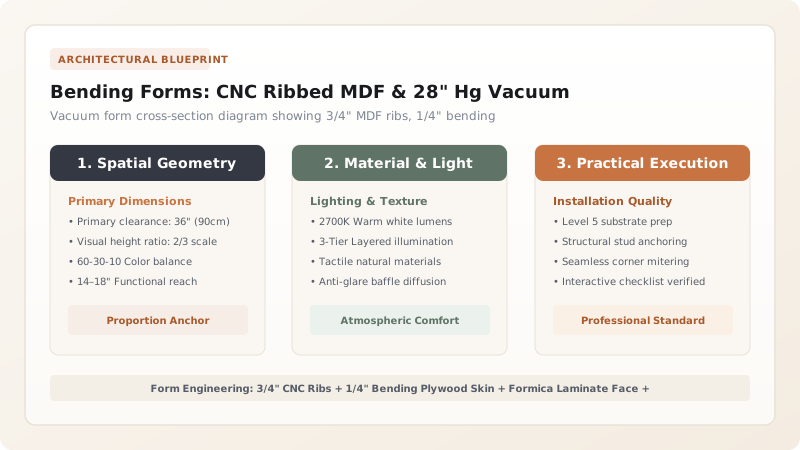
Construct rigid bentwood bending forms using CNC-cut 3/4" MDF internal ribs spaced 3" on center, skinned with two layers of 1/8" bending plywood and surfaced with plastic laminate. Clamp laminations inside a 30-mil seamless polyurethane vacuum bag running an oil-lubricated rotary vane pump pulling 28" Hg (14.7 PSI / 1,800 lbs/sq ft).
At a Glance: Key Takeaways
- Atmospheric Clamping Force (14.7 PSI / 1,800 lbs/sq ft): Eliminates hundreds of mechanical steel bar clamps and localized pressure dents.
- CNC Ribbed Hollow MDF Construction: Reduces mold weight by 60% while providing immense structural resistance to vacuum crushing.
- Plastic Laminate (Formica) Mold Face: Ultra-smooth waxed surface allows glue squeeze-out to pop off effortlessly without damaging form.
- Breather Mesh Air Evacuation Netting: Ensures continuous airflow channels from the farthest mold corner directly to the vacuum stem.
- 3% Springback Compensation Arc: Cutting mold radius 3% tighter than target geometry delivers 100% exact finished curvature.
1. Atmospheric Physics: 28" Hg Vacuum & Clamping Tonnage Math
Using mechanical bar clamps on curved woodwork creates uneven clamping pressure—crushing wood directly under clamp heads while leaving hollow un-glued gaps between clamps.
A Polyurethane Vacuum Press Bag utilizes the weight of the Earth's atmosphere. At sea level, pulling a 28-inch Mercury (\(\text{Hg}\)) Vacuum exerts \(14.2\text{ to } 14.7\text{ PSI}\) (Over \(1,800\text{ lbs per square foot}\)) across every square millimeter of surface area. A 4ft × 2ft curved panel experiences over 7.2 TONS of uniform fluid clamping pressure. Learn glue selection in urea-formaldehyde vs epoxy glues.

2. Mold Engineering: Ribbed MDF, Formica Skin & Breather Mesh
Solid MDF forms are too heavy to lift into vacuum bags. Build molds with 3/4" CNC-Cut Internal Ribs Spaced 3 Inches Apart, skinned with Two Layers of 1/8" Bending Plywood and Covered with Smooth Formica Laminate.
Always lay Synthetic Breather Mesh Netting over the form to prevent the polyurethane bag from choking off vacuum flow. Review veneer thickness in veneer bending physics and explore bentwood lamination hub.
Bending Mold Types Comparison
Use this reference table to calculate exact physical dimensions, ratios, and specifications before purchasing:
| Mold Construction Type | Weight & Handling | Pressure Uniformity | Suitability for Complex 3D Curves |
|---|---|---|---|
| Ribbed CNC MDF + Vacuum Bag (Optimal) | Lightweight (Hollow skeleton) | 100% Uniform Atmospheric (14.7 PSI) | 5 / 5 (Complex compound 3D curves) |
| Two-Piece Male/Female Solid MDF Molds | Extremely Heavy (150+ lbs) | Uneven (Requires 20+ pipe clamps) | 3 / 5 (Simple 2D cylinders only) |
| Solid Polystyrene Foam Core Form | Ultra-lightweight | Moderate (Crushes above 10 PSI) | 2 / 5 (Prototypes only) |
| Laminated Timber Block Mold | Heavy | Good with strap clamps | 3 / 5 |
Vacuum Bag Choking Air Starvation Constraints
Every successful decoration project must account for physical and environmental constraints:
Polyurethane Bag Sealing Directly Against Vacuum Port Choking Evacuation
Smooth vinyl or polyurethane bags seal airtight against the vacuum stem before air is evacuated from the back of the mold, leaving air pockets that result in zero clamp pressure; always run continuous synthetic breather mesh netting from the vacuum stem across the entire length of the form.
How to Build an MDF Bending Form and Run a Vacuum Press
Execute this professional sequence to achieve flawless results without backtracking:
Design 3D Mold with 3% Springback Compensation
Model target curve in CAD; offset inside radius 3% tighter to counteract natural residual springback.
CNC-Route 3/4" MDF Interlocking Internal Ribs
Cut transverse ribs and longitudinal spine stringers; assemble skeleton with glue and 18-gauge brad nails.
Skin Skeleton with Two Layers of 1/8" Bending Plywood
Glue first layer of Italian bending poply onto ribs; stagger seams and glue second 1/8" ply layer with brads.
Apply Formica Plastic Laminate Face and Paste Wax
Contact-cement smooth Formica over skin; apply 2 coats of paste wax so cured glue squeeze-out will not adhere.
Lay Veneer Lamination Bundle onto Form with Breather Mesh
Place glued ply stack onto waxed form; lay synthetic breather mesh over entire assembly.
Slide into 30-Mil Polyurethane Bag and Seal C-Channel Clip
Insert form into seamless polyurethane vacuum bag; slide yellow C-channel locking bar over open bag end.
Evacuate Air to 28" Hg and Inspect Ply Alignment
Start 5-CFM rotary vane vacuum pump; verify gauge reaches 28" Hg; inspect veneer stack through clear bag.
Common Mistakes & Countermeasures
Avoid these costly errors that compromise aesthetics, ergonomics, and budget:
Using Cheap 10-Mil Vinyl Bags for Heavy Furniture Molds
Project Execution Checklist
Track your physical progress. Checkboxes persist automatically on this device:
Frequently Asked Questions
How much vacuum pump capacity (CFM) is needed for a 4x8 furniture vacuum bag?
A 3 to 5 CFM continuous-duty rotary vane vacuum pump (such as Air-Pel or Becker) is ideal. It pulls 28" Hg vacuum in under 90 seconds and can run continuously for 12 hours without overheating.


