
Calculate safe veneer thickness for bentwood lamination using the strain formula \(\epsilon = \frac{t}{2R}\). Because kiln-dried hardwoods fail in tension when elongation exceeds 1.0% (\(\epsilon > 0.01\)), the minimum safe bending radius must be at least 50 times the individual strip thickness (\(R \ge 50t\)).
At a Glance: Key Takeaways
- Outer Fiber Tensile Strain Limit (\(\epsilon \le 1.0\%\)): Hardwood fibers snap when stretched past 1% elastic tensile limit.
- The 50:1 Engineering Rule: \(R \ge 50t\) (For an 8-inch radius curve, maximum strip thickness \(t = 8/50 = 0.16\text{" (approx 1/8")}\)).
- Neutral Axis Shift: Under bending, the zero-strain neutral axis lies at the exact centerline (\(t/2\)) of each individual ply.
- Springback Reduction with Ply Count: Increasing ply count from 6 thick plies to 12 thin plies reduces springback by 75%.
- Drum Sander Precision (\(\pm 0.005\text{"}\)): Uniform thickness across all plies guarantees airtight glue lines without localized pressure gaps.
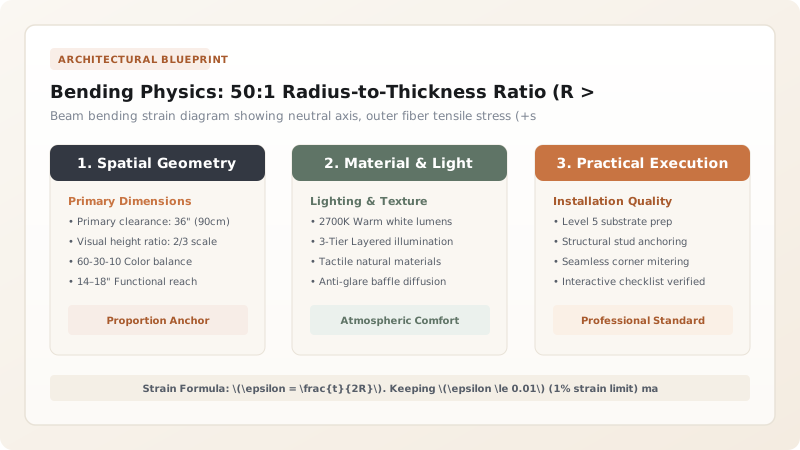
1. Elastic Mechanics: Tensile Strain Limits (\(\epsilon \le 0.01\)) & Radius Formulas
When a strip of wood of thickness \(t\) is bent around a radius \(R\), the outer convex face stretches in tension while the inner concave face compresses.
The maximum strain (\(\epsilon\)) at the outer surface is calculated by:
$$\epsilon = \frac{t}{2R}$$
Because kiln-dried hardwoods fracture when tensile strain exceeds \(1.0\% (0.01)\), we derive the fundamental rule:
$$\frac{t}{2R} \le 0.01 \implies R \ge 50t \quad \text{or} \quad t \le \frac{R}{50}$$
For a tight 3-inch radius curve, each individual ply must be no thicker than \(0.060\text{" (1/16" / 1.5mm)}\). Learn adhesive selection in urea-formaldehyde vs epoxy glues.

2. Ply Count Geometry & Exponential Springback Reduction
Springback is directly proportional to individual ply thickness squared (\(t^2\)).
Laminating twelve 1/16" plies produces a component that is four times more dimensionally stable than six 1/8" plies forming the same 3/4" final thickness. Design molds in vacuum press bags and MDF forms and review bentwood lamination hub.
Target Bending Radius vs Maximum Ply Thickness Matrix
Use this reference table to calculate exact physical dimensions, ratios, and specifications before purchasing:
| Target Inside Radius (R) | Max Ply Thickness (50:1 Rule) | Number of Plies for 3/4" Part | Calculated Outer Fiber Strain |
|---|---|---|---|
| 2" Tight Radius (50mm) | 0.040" (1.0mm / 1/25") | 19 Plies | 1.00% (Maximum safe limit) |
| 4" Medium Radius (100mm) | 0.080" (2.0mm / 5/64") | 10 Plies | 1.00% |
| 8" Gentle Radius (200mm) | 0.160" (4.0mm / 5/32") | 5 Plies | 1.00% |
| 16" Sweeping Arch (400mm) | 0.320" (8.0mm / 5/16") | 2 to 3 Plies | 1.00% |
Bandsaw Resaw Wave Thickness Variation Constraints
Every successful decoration project must account for physical and environmental constraints:
Bandsaw Blade Drift Creating Tapered Veneer Strips Causing Glue Line Gaps
Bandsaw blades wandering create strips that taper from 1/16" to 3/32"; when stacked, thick spots take all clamp pressure while thin spots form hollow un-glued voids; always pass resawn veneers through a dual-drum sander, calipering all four corners to verify ±0.005" thickness uniformity.
How to Calculate, Resaw, and Calibrate Bentwood Plies
Execute this professional sequence to achieve flawless results without backtracking:
Measure Tightest Curve Radius on Master Drawing
Identify sharpest inside curve radius (e.g., \(R = 4.5\text{"}\)).
Calculate Maximum Safe Ply Thickness
Apply 50:1 formula: \(t_{\text{max}} = 4.5 / 50 = 0.090\text{" (approx 3/32")}\).
Determine Number of Plies for Final Part Thickness
For a 3/4" (0.750") finished armrest: \(0.750 / 0.075 = 10\text{ plies}\) at 0.075" thickness.
Resaw Hardwood Boards on Bandsaw with Resaw Fence
Install 1" carbide-tipped Resaw King blade; slice hardwood planks into 0.095" rough leaves.
Calibrate to Final Thickness with Drum Sander
Pass rough leaves through 120-grit drum sander until all plies measure exactly 0.075" (1.9mm) on digital caliper.
Perform Dry Bending Test Over Mold
Stack all 10 dry plies over bending form; verify stack flexes smoothly without snapping outer grain.
Common Mistakes & Countermeasures
Avoid these costly errors that compromise aesthetics, ergonomics, and budget:
Using 1/8" Thick Plies on a Tight 3-Inch Radius
Project Execution Checklist
Track your physical progress. Checkboxes persist automatically on this device:
Frequently Asked Questions
Can you use commercial paper-backed veneer for structural bentwood laminations?
NO. Commercial paper-backed decorative veneers are ultra-thin (0.5mm) with weak paper backing designed for flat panel layups, not structural load-bearing furniture. Always use sawn/resawn hardwood veneer plies (1.0mm–2.5mm).


