
Buon Fresco on Wet Slaked Lime Intonaco represents the purest thermodynamic bond between pigment and architectural substrate. Applied exclusively while the lime plaster is damp, mineral pigments disperse across the open colloidal pore network of calcium hydroxide. As atmospheric carbon dioxide diffuses into the curing mortar, calcium hydroxide converts into crystalline calcite (calcium carbonate), permanently locking the pigment particles within an insoluble, micro-porous mineral matrix.
At a Glance: Key Takeaways
- Lime Putty Aging: Pit-slaked calcium lime (CL90) matured for 12–36 months, reducing particle size to sub-micron hexagonal plates.
- Aggregate Sizing & Porosity: Clean, washed quartz river sand graded to 0.5mm–1.2mm providing optimal tensile tooth.
- The Carbonation Window: Active 6 to 8 hour painting phase before surface crystallization forms an impermeable skin.
- Alkali Chemical Stability: Pigments must withstand pH 12.5 alkalinity without fading, decomposing, or saponifying.
- Optical Refractive Index: Calcite crystals (refractive index 1.58) provide crystalline luminescence to embedded mineral pigments.
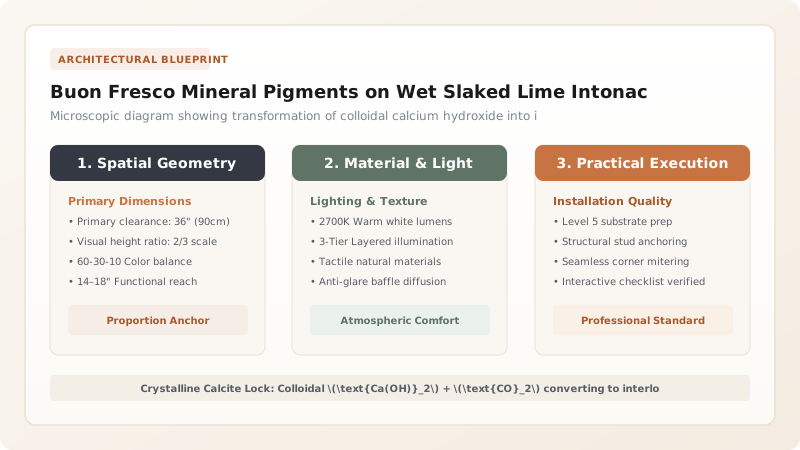
1. Slaked Lime Putty Maturation & Colloidal Rheology
The foundation of true fresco is pit-slaked lime (grassello di calce, CL90), produced by burning high-purity limestone (\(\ge 95\%\ \text{CaCO}_3\)) at 900°C to create quicklime (\(\text{CaO}\)), then slaking it with excess water:
When aged underwater in aging pits for 12 to 36 months, the calcium hydroxide crystals undergo continuous dissolution and re-precipitation. The crystal morphology transforms from bulky agglomerates into ultra-fine sub-micron hexagonal platelets. This grants the lime putty extraordinary plastic lubricity, high water-retention capacity, and smooth troweling qualities essential for exterior intonaco.
2. Aggregate Grading & Intonaco Formulation
The finish plaster coat (intonaco) must balance workability with zero shrinkage cracking. Masons blend aged lime putty with clean, round-grained quartz river sand in a 1:1.5 to 1:2 volume ratio.
Aggregate must be thoroughly washed to eliminate clay or silt fines that would weaken crystal bonding. Sand grains sized between 0.5mm and 1.2mm create a microscopic tooth that holds wet pigment washes while leaving interstitial pore channels through which carbon dioxide can freely penetrate.
3. The 8-Hour Carbonation Window & Painting Mechanics
A buon fresco artist works against a strict chemical clock:
- Initial Absorption (Hours 1 to 3): Plaster is wet; water-based pigment washes sink deeply into the plaster slurry (capillary suction).
- True Fresco Window (Hours 3 to 6): Plaster is firm but damp; brushstrokes glide smoothly as calcium hydroxide solution leaches to the surface, mixing with pigment particles.
- Crystallization Threshold (Hours 7 to 9): A micro-thin glassy film of calcium carbonate begins to form. Pigments applied after this point cannot be absorbed and will flake off upon drying.
Buon Fresco vs Lime Secco vs Modern Silicate Painting
Use this reference table to calculate exact physical dimensions, ratios, and specifications before purchasing:
| Painting Technique | Binder Mechanism | Substrate Moisture State | Vapor Permeability | Outdoor Lifespan in Alps |
|---|---|---|---|---|
| Buon Fresco (True Fresco) | Pure calcite crystal carbonation | Freshly troweled, wet intonaco | Very High (> 35 Perms) | 200 - 400+ Years |
| Fresco a Secco (Dry) | Organic binders (egg tempera, casein) | Dry, cured lime plaster | Moderate (15 - 20 Perms) | 30 - 60 Years (Peels outdoors) |
| Potassium Silicate (Keim) | Chemical silicification (micro-glass) | Dry mineral plaster or stone | High (25 - 30 Perms) | 80 - 120 Years |
| Modern Acrylic Exterior | Polymer coalescence film | Dry drywall / plaster | Low (< 5 Perms) | 10 - 20 Years (Flakes in frost) |
Chemical & Climatic Constraints
Every successful decoration project must account for physical and environmental constraints:
Deionized Water Requirement
Tap water containing chlorine, iron, or sulfates will react with lime, causing efflorescence and color shifting.
Wind Scour Rate
Dry mountain winds can skin over the intonaco in less than 3 hours; protective canvas enclosures are mandatory.
Protocol for Laying and Painting a Giornata of Wet Intonaco
Execute this professional sequence to achieve flawless results without backtracking:
Substrate Pre-Soaking
Saturate the cured arriccio base coat with lime water 2 hours before plastering to stop it from sucking water out of the intonaco.
Intonaco Application
Apply 4mm to 5mm layer of aged lime putty and fine river sand (1:1.8) using a stainless-steel pool trowel.
Float Compaction & Felt Polishing
Float the surface with a wooden float to bring lime cream to the surface; finish lightly with a damp sponge or felt float.
Pounce & Underdrawing
Transfer cartoon using charcoal dust; paint preliminary monochromatic underdrawing (verdaccio) with earth green and ochre.
Chromic Modeling
Build up color values in translucent watercolor-like glazes, working from light highlights to dark shadows.
Bevel Joint Trimming
At end of painting session, slice away excess unpainted intonaco with a scalpel held at 45° along architectural contour lines.
Common Mistakes & Countermeasures
Avoid these costly errors that compromise aesthetics, ergonomics, and budget:
Adding casein, animal glue, or egg yolk to pigments intended for outdoor buon fresco
Over-working the plaster with a steel trowel during late painting stages
Project Execution Checklist
Track your physical progress. Checkboxes persist automatically on this device:
Frequently Asked Questions
Why is true fresco white paint simply lime putty?
In buon fresco, white paint is made from pure aged lime putty mixed with water, known as 'bianco di San Giovanni.' Because it has the exact same chemical composition as the plaster, it integrates seamlessly into the curing wall.
Can buon fresco be touched up after it has dried?
Touch-ups on dry plaster must be done 'a secco' (using reversible mineral potassium silicate or lime-casein). However, for permanent exterior durability, conservators cut away the flawed intonaco section and re-lay fresh wet plaster to paint a new giornata.


