
Preserving exterior buon fresco murals in harsh alpine microclimates requires specialized conservation interventions. Subjected to over 100 annual freeze-thaw cycles, sub-zero snowdrifts, and intense UV exposure, historic plaster suffers from binder dissolution, inter-granular micro-fissuring, and hollow delamination from the stone substrate. Conservation utilizes non-destructive acoustic mapping, nano-lime (calcium hydroxide nanoparticle) re-consolidation, and breathable ethyl silicate grouting to restore cohesion without altering vapor permeability.
At a Glance: Key Takeaways
- Freeze-Thaw Cycling Pathology: Water expansion in plaster pores (9% volumetric increase) shearing intonaco layers.
- Acoustic Sounding Diagnosis: Mapping sub-surface voids and hollow delaminations with soft-tipped phenolic hammers.
- Nano-Lime Consolidation: Sub-micron Ca(OH)₂ particles in alcohol penetrating deep capillaries to rebuild calcite bonds.
- Breathable Micro-Grouting: Injecting pozzolanic hydraulic lime slurries to reconnect detached plaster to masonry.
- Vapor Permeability Protection: Maintaining > 85% water vapor transmission to prevent devastating winter frost entrapment.
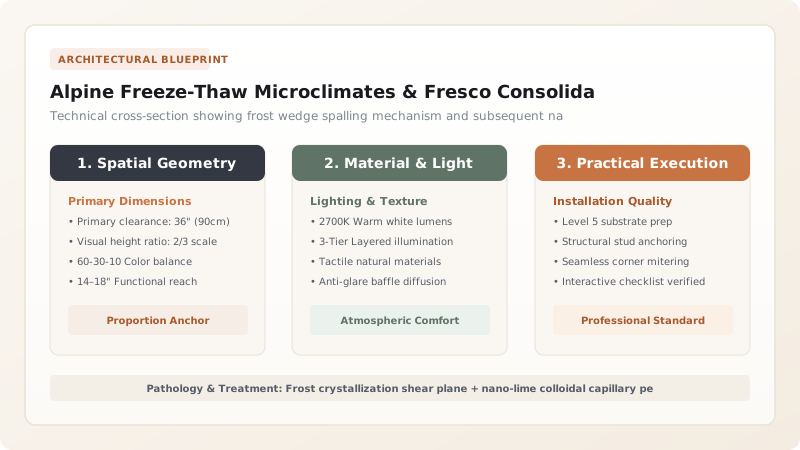
1. Alpine Freeze-Thaw Thermodynamics & Plaster Spalling
The Bavarian alpine microclimate subjects exterior building envelopes to extreme stress. Villages like Garmisch and Oberammergau experience rapid temperature swings, where sunny winter afternoons warm facade surfaces to +12°C, melting roof snow, followed by plummeting nighttime temperatures down to -18°C within six hours.
As liquid water enters the porous plaster, nighttime freezing triggers a 9% volumetric expansion (phase change from liquid water to ice \(\text{I}_h\)). When the capillary pore network reaches critical saturation (>91% water volume), the hydraulic pressure generated during ice crystallization exceeds the tensile strength of weathered lime plaster (typically < 0.5 MPa), fracturing the intonaco along the pigment boundary.
2. Nano-Lime (Nanocalcite) Consolidation Chemistry
Traditional consolidants like ethyl silicate or organic resins often alter the refractive index of fresco pigments, causing irreversible darkening. Modern conservation science developed nano-lime dispersions (Nanorestore / CaLoSiL).
These consist of synthesized calcium hydroxide nanoparticles (50 to 200 nanometers) suspended in isopropyl alcohol or ethanol. Because the particles are smaller than the capillary pore necks of the lime plaster, they penetrate deep into friable intonaco zones. As the alcohol carrier evaporates, the nanoparticles react rapidly with atmospheric carbon dioxide, converting into pure calcite (calcium carbonate) that chemically matches the original historic fresco binder perfectly.
3. Void Mapping & Micro-Injection Grouting
When freeze-thaw cycles cause the intonaco to detach from the base arriccio plaster, hollow voids (blisters) form behind the painting. Left unsupported, wind vibration or ice buildup causes the paint layer to collapse.
Conservators map these hidden voids by gently tapping with phenolic hammers (acoustic sounding). Micro-holes (1.0mm to 1.5mm) are drilled through existing crack lines, and a low-viscosity, non-staining hydraulic lime-pozzolan grout is injected via surgical syringes. The area is gently pressed flat with padded wooden boards until cured, re-establishing structural adhesion to the wall.
Exterior Fresco Consolidation Materials Matrix
Use this reference table to calculate exact physical dimensions, ratios, and specifications before purchasing:
| Consolidation Material | Chemical Class | Penetration Depth | Color / Optical Impact | Reversibility / Retreatability |
|---|---|---|---|---|
| Nano-Lime in Isopropanol | Colloidal Ca(OH)₂ nanoparticles | Deep (5mm - 15mm) | Zero (Identical to original binder) | Fully compatible / Retreatable |
| Ethyl Silicate (TEOS) | Monomeric silicic acid ester | Very Deep (> 20mm) | Slight temporary darkening | Permanent mineral bridge |
| Hydraulic Micro-Grout (PLM-A) | Micronized lime + Pozzolans | Fills hollow voids (> 1mm) | Zero surface exposure | Structural mechanical bond |
| Paraloid B-72 (Prohibited outdoors) | Ethyl methacrylate copolymer | Shallow (Skin effect) | High gloss / Yellows under UV | Unacceptable for exterior facades |
Alpine & Environmental Constraints
Every successful decoration project must account for physical and environmental constraints:
Narrow Weather Windows
Micro-injection grouting and nano-lime treatments require sustained temperatures above 10°C for 14 days without rain.
Scaffolding Overhang Clearance
Alpine chalet roofs feature deep 1.5m timber eaves that complicate scaffold erection and shadow painting areas.
Protocol for Stabilizing and Consolidating a Delaminated Alpine Fresco
Execute this professional sequence to achieve flawless results without backtracking:
Acoustic Void Survey & Mapping
Map hollow areas using acoustic sounding; trace detachment zones onto transparent Mylar sheets.
Japanese Tissue Pre-Facing
Apply Japanese mulberry tissue (washi) over unstable paint flakes using 3% methylcellulose to prevent loss during drilling.
Micro-Drilling & Void Pre-Wetting
Drill 1.2mm access ports in mortar joints; flush void with 50/50 water-ethanol mix to reduce surface tension.
Hydraulic Lime Grout Injection
Slowly inject PLM-A micro-grout through flexible cannula until grout emerges from neighboring relief ports.
Gentle Clamping & Surface Consolidation
Clamp bulging areas gently with padded conservation jacks for 48 hours; apply nano-lime spray to friable paint surfaces.
Tissue Removal & Breathable Weathering
Remove Japanese paper with warm water compresses; verify breathability with Karsten tube water absorption testing.
Common Mistakes & Countermeasures
Avoid these costly errors that compromise aesthetics, ergonomics, and budget:
Injecting epoxy or PVA adhesives behind exterior detached frescoes
Applying film-forming water-repellent siloxanes over un-desalinated fresco surfaces
Project Execution Checklist
Track your physical progress. Checkboxes persist automatically on this device:
Frequently Asked Questions
Can missing sections of an 18th-century fresco be repainted?
In professional heritage conservation, missing sections (lacunae) are not forged. They are integrated using the 'tratteggio' or 'rigatino' technique—delicate vertical watercolor hatching that looks unified from a distance but remains clearly identifiable as a conservation intervention upon close inspection.
How does snow accumulation against a building base damage frescoes?
When snowbanks pile against lower walls, capillary suction draws meltwater high into the plaster. De-icing road salts mixed with street snow accelerate sub-florescence, while direct ice freezing shears off lower trompe-l'œil baseboards, necessitating protective stone plinths.


