
Art Deco architectural metalwork celebrated the sleek elegance of modern metallurgy through white-metal alloys—chiefly Monel metal (67% nickel, 30% copper) and nickel silver (copper-nickel-zinc). Utilized for elevator doors, decorative transoms, radiator grilles, and monumental lobby gates, these alloys were sand-cast or hot-extruded into crisp chevron, sunburst, and ziggurat profiles, buffed to a warm, non-tarnishing champagne-silver satin finish.
At a Glance: Key Takeaways
- Monel Metal Alloy (67% Ni, 30% Cu): A natural ore alloy possessing higher tensile strength than structural steel and absolute immunity to corrosion.
- Nickel Silver (German Silver): Alloy of copper (60-65%), nickel (15-20%), and zinc (15-20%) offering a warm, platinum-champagne architectural luster.
- Sand-Cast & Lost-Wax Detailing: High-relief geometric panels featuring stylized gazelles, lightning bolts, frozen fountains, and stepped chevrons.
- Non-Plated Solid Integrity: Solid alloy throughout; unlike electroplated chrome, it never chips, peels, or blisters under heavy commercial contact.
- Satin Directional Brushing: Finished with 240-grit to 320-grit abrasive belts, producing soft, glare-free directional highlights under lobby lighting.
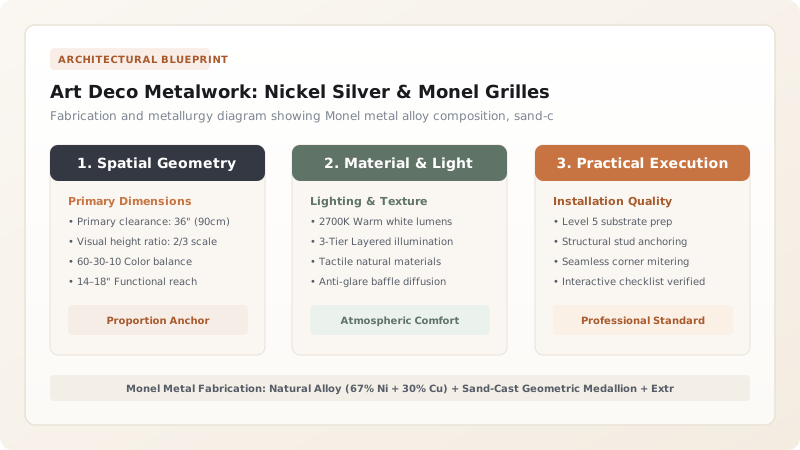
1. Machine Age Metallurgy: Monel Metal & Nickel Silver
In the 1920s, architects sought metals that symbolized modern industrial speed, aviation, and technological triumph. Traditional yellow brass and dark Victorian bronze felt antiquated:
Architects turned to two revolutionary white-metal alloys:
- Monel Metal: Discovered in 1901 by Robert Crooks Stanley at the International Nickel Company (INCO), Monel was refined directly from the naturally mixed copper-nickel sulfide ores of Sudbury, Ontario. It is stronger than structural mild steel, exceptionally tough, and completely immune to tarnishing, industrial sulfur smog, and human perspiration acids.
- Nickel Silver (White Bronze / German Silver): Despite its name, it contains zero silver. It is an alloy of 60-65% Copper, 15-20% Nickel, and 15-20% Zinc. The nickel neutralizes copper's yellow-red tone, producing a luxurious, luminous, pale silvery-platinum hue with a warm, golden undertone.
- Solid Metal vs. Plating: Art Deco master metalworkers (such as Edgar Brandt, René Chambellan, and Donald Deskey) insisted on solid cast and extruded alloys. Electroplated chrome or nickel on mild steel eventually scratches and peels; solid Monel can be rubbed by millions of hands over a century and only gains a richer, deeper luster. Learn setback geometry in stepped ziggurat massing.

2. Foundry Craftsmanship: Sand-Casting & Lost-Wax Modeling
Producing monumental elevator doors and ornamental grilles required combining precision foundry casting with hand-finishing:
- Pattern & Sand Molding: Sculptors sculpted full-scale models in wood or clay. Molds were prepared using fine French molding sand or resin-bonded olivine sand to capture microscopic surface textures without voids.
- High Pouring Temperatures: Monel melts at 1,300°C to 1,350°C (2,370°F to 2,460°F), requiring specialized refractories and induction furnaces. Foundry workers incorporated generous gating systems and risers to prevent shrinkage voids in large flat panels.
- Chasing & Edge Dressing: Once demolded, master metal chasers cut away casting sprues, dressed parted lines with hand files, and chased every crisp 90-degree chevron facet with tungsten-carbide cold chisels. Study terracotta spandrels in polychrome glazed terracotta.
3. Surface Finishes: Satin Texturing & Conservation Maintenance
Art Deco metalwork derived its visual power from the contrast between specular highlights and soft satin fields:
- Directional Satin Finishing: Panels were finished using 240-grit to 320-grit non-woven abrasive wheels or aluminum oxide belts lubricated with mineral oil. The abrasive lines were oriented strictly parallel to the primary architectural axes (e.g., vertical on door stiles, radial on sunburst rays).
- Chemical Infill Relieving: Low-relief backgrounds were treated with mild liver of sulfur or potassium sulfide solutions to darken the recesses to an antique charcoal grey. High-relief geometric chevrons and stylized figures were then buffed bright, creating dramatic graphic depth.
- Microcrystalline Wax Sealing: Never coat historic Monel or nickel silver with modern polyurethane or clear lacquer, which yellows and chips. Conservators seal the clean metal with two coats of microcrystalline wax (Renaissance Wax) buffed with soft flannel cloths, providing invisible protection against skin oils and environmental dirt. Explore the full style in our Art Deco architecture hub.
Art Deco Architectural Metal Alloy Specification Matrix
Use this reference table to calculate exact physical dimensions, ratios, and specifications before purchasing:
| Alloy Type | Chemical Composition | Melting Point (°C) | Tensile Strength (MPa) | Color / Tone | Primary Architectural Application |
|---|---|---|---|---|---|
| Monel 400 Alloy | 67% Ni, 30% Cu, 1.5% Fe | 1,300 - 1,350°C | 550 - 620 MPa | Warm silvery platinum | Heavy entrance doors, exterior grilles, handles |
| Nickel Silver (Alloy C74500) | 65% Cu, 10% Ni, 25% Zn | 980 - 1,020°C | 420 - 480 MPa | Pale champagne silver | Elevator transoms, handrails, lobby trim |
| Cast Architectural Aluminum | Al-Si-Mg (Alloy 356) | 570 - 650°C | 220 - 280 MPa | Bright cool silver | High-altitude exterior spandrels, roof crests |
| Manganese Architectural Bronze | 58% Cu, 39% Zn, 2% Mn | 880 - 920°C | 450 - 520 MPa | Warm golden bronze | Contrasting border bands, floor medallions |
Art Deco Metalwork Fabrication & Conservation Constraints
Every successful decoration project must account for physical and environmental constraints:
Extreme Monel Hardness
Monel work-hardens rapidly during drilling and machining; cutting requires heavy-duty machinery, slow tool speeds, and high-cobalt drill bits.
Galvanic Dissimilar Metal Corrosion
Installing nickel silver or Monel directly against mild structural steel frames in humid lobbies causes galvanic decay; neoprene dielectric isolation is mandatory.
High Scrap Rate in Sand Casting
Large, thin flat panels (thickness < 6mm) are prone to cold-shuts during foundry pouring; scrap rates can exceed 20% on complex geometric designs.
Harsh Cleaner Damage
Commercial janitorial cleaners containing bleach or ammonia permanently stain and discolor copper-nickel alloys, requiring costly re-sanding.
Art Deco Elevator Door Restoration & Wax Buffing Protocol
Execute this professional sequence to achieve flawless results without backtracking:
Hardware Disassembly
Carefully remove door panels, handles, and escutcheons; document casting numbers and orientation marks.
Solvent Degreasing
Strip old encrusted waxes and dirt using a lint-free cotton cloth saturated with odorless mineral spirits in a well-ventilated space.
Mechanical Satin Spot-Finishing
Restore scratched satin areas using Scotch-Brite maroon 320-grit finishing pads, rubbing strictly parallel to existing factory grain lines.
Chemical Relieving (If Applicable)
Apply dilute potassium sulfide with artist brushes into recessed geometric backgrounds to re-establish dark charcoal contrast.
High-Relief Buffing
Lightly buff raised chevron tips and stylized motifs with fine jewelers' rouge on a cotton wheel to restore bright metallic specular highlights.
Microcrystalline Wax Sealing
Apply a thin, uniform coat of Renaissance microcrystalline wax with a horsehair shoe brush; let dry 15 minutes to a light haze.
Flannel Buffing
Buff vigorously with clean, dry cotton flannel cloths to produce a deep, hard, fingerprint-resistant satin luster.
Common Mistakes & Countermeasures
Avoid these costly errors that compromise aesthetics, ergonomics, and budget:
Cleaning Monel or nickel silver with harsh household toilet bowl or glass cleaners containing ammonia
Applying clear gloss spray lacquer over historic satin-finished white metals
Rubbing abrasive pads across the grain of satin-finished metal
Project Execution Checklist
Track your physical progress. Checkboxes persist automatically on this device:
Frequently Asked Questions
Is nickel silver the same as sterling silver or silver-plated metal?
No. Nickel silver contains no real silver whatsoever. It is a solid alloy of copper, nickel, and zinc. The nickel bleaches out copper's red tone, giving the alloy a rich silvery-white color resembling platinum. Because it is solid metal throughout, it never flakes or wears away like silver plate.
Why did Art Deco architects prefer Monel metal for elevator doors?
Elevators in commercial skyscrapers handle tens of thousands of passengers daily. Monel metal possesses exceptional hardness, resists denting from luggage or mail carts, is completely immune to finger perspiration acids, and can be maintained simply with occasional wax buffing.
Can missing Art Deco grilles be reproduced accurately today?
Yes. Historic foundries reproduce original grilles using 3D laser scans of surviving panels, 3D printing pattern positives, and pouring genuine Monel 400 or nickel silver (Alloy C74500) in traditional sand or investment molds.


