
Art Deco Zigzag Moderne (flourishing c. 1925–1940) is an exuberant Machine Age architectural movement born from the 1925 Paris Exposition Internationale des Arts Décoratifs and shaped by New York's 1916 Zoning Resolution. It is defined by stepped ziggurat setback massing, geometric chevrons and sunbursts, vibrant polychrome architectural glazed terracotta spandrel panels, and streamlined white-metal accents fabricated from nickel silver, Monel metal, and cast aluminum.
At a Glance: Key Takeaways
- Ziggurat Setback Massing: Geometric skyscraper envelopes sculpted within mathematical sky exposure planes mandated by 1916 urban zoning codes.
- Polychrome Glazed Terracotta: High-fired ceramic spandrel panels enriched with brilliant cobalt, turquoise, cadmium yellow, and platinum ceramic glazes.
- Machine Age Zigzag Motifs: Rhythmic chevron friezes, radiating sunburst medallions, faceted frozen fountains, and stepped speed-lines.
- White Metal Alloys: Ornate entrance portals and elevator grilles cast in Monel metal (67% Ni, 30% Cu), nickel silver, and polished cast aluminum.
- Tower Crown Illumination: Integrated architectural floodlighting grazing faceted setbacks, transforming building crowns into glowing urban beacons.
In-Depth Guides in this Directory
Explore specialized subtopic blueprints, technical dimensions, and execution checklists:
Stepped Ziggurat Massing: 1916 Zoning Setback Geometry
Technical architectural analysis of Art Deco skyscraper massing: New York 1916 Zoning Resolution, sky exposure planes, tower lot coverage, and ziggurat setbacks.
Polychrome Terracotta: Art Deco Spandrels & Glazes
Technical conservation guide to Art Deco architectural polychrome glazed terracotta: high-fire ceramic frits, stainless anchor retrofits, and rust-jacking prevention.
Art Deco Metalwork: Nickel Silver & Monel Grilles
Technical craftsmanship guide to Art Deco architectural metalwork: Monel metal (67% Ni, 30% Cu), nickel silver casting, lost-wax elevator doors, and satin patinas.
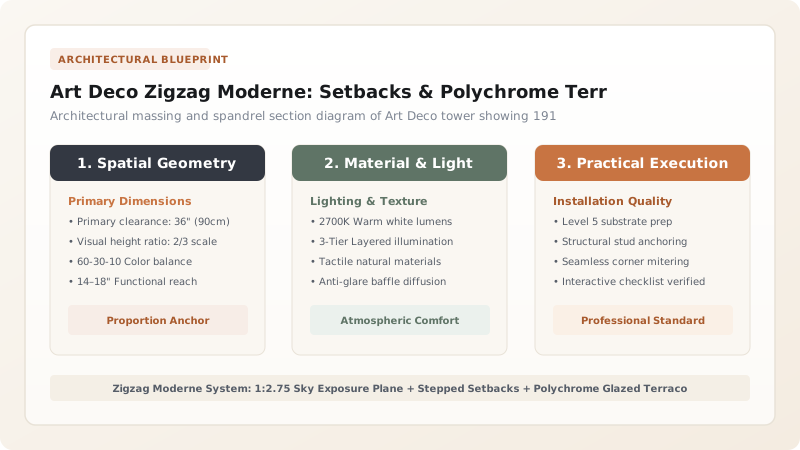
1. The 1925 Paris Exposition & The 1916 Zoning Envelope
Art Deco architecture represents the triumphant fusion of two revolutionary forces: the opulent French decorative luxury of the 1925 Paris Exposition Internationale des Arts Décoratifs et Industriels Modernes and the pragmatic urban zoning laws of metropolitan New York:
- The Death of the Classical Box: Pre-1916 skyscrapers (such as the Equitable Building) rose as sheer vertical monoliths, casting dark canyons over urban streets. The 1916 New York Zoning Resolution changed architecture forever by establishing the Sky Exposure Plane:
$$\text{Setback Slope: } \tan(\theta) = \frac{\Delta H}{\Delta D} \le 2.75$$Buildings could only rise straight up for a distance proportional to street width before stepping back. Architects transformed this legal restriction into the iconic Stepped Ziggurat Silhouette, echoing ancient Babylonian pyramids and Mesoamerican Mayan temples. Learn zoning setback mathematics in stepped ziggurat massing and setback rules.
- The Zigzag Moderne Aesthetic: Departing from the sinuous organic whiplash curves of Art Nouveau, Zigzag Moderne celebrated the dynamism of the Machine Age through sharp 45-degree angles, fractured polygons, lightning bolts, and rhythmic chevrons.

2. Architectural Terracotta: The Ceramic Skyscraper Skin
While masonry piers were clad in smooth Indiana limestone or buff brick, decorative spandrel panels and building crowns erupted in Architectural Glazed Terracotta:
- Hollow-Core Ceramic Blocks: Manufactured by historic firms like the Atlantic Terra Cotta Company and Northwestern Terra Cotta, panels were pressed in plaster molds with internal cellular webs (thickness 30-40mm), yielding lightweight fireproof cladding (\(\rho \approx 1,800\text{ kg/m}^3\)) that imposed minimal dead weight on steel skyscraper frames.
- Polychrome Majolica Frits: Glazes were formulated with heavy metal oxides: cobalt blue, copper turquoise, antimony yellow, and selenium orange. Fired at 1,180°C to 1,220°C (Cone 4 to 6), the vitreous glass glaze fused molecularly to the clay body, creating an impervious, pollution-resistant skin that washed clean with urban rainwater. Study terracotta anchoring in polychrome glazed terracotta spandrel panels.
- Gilding & Platinum Lustre: Iconic buildings (such as the Carbide & Carbon Building in Chicago or the American Radiator Building in New York) incorporated real 24-karat gold leaf or liquid platinum lustres fired over dark black or jade green terracotta.
3. The Machine Age Palette: Nickel Silver, Monel & Aluminum
Art Deco rejected the dark, heavy brass and wrought iron of the Victorian era in favor of sleek, luminous White Metal Alloys:
- Monel Metal & Nickel Silver: Elevator door portals, mail chutes, and entrance grilles were fabricated from Monel (a natural alloy of 67% Nickel and 30% Copper) and Nickel Silver (German Silver, an alloy of copper, nickel, and zinc). These alloys buffed to a warm, platinum-like champagne luster that never tarnished or peeled like chrome plating. Master metalwork casting in nickel silver and Monel metal geometric elevator grilles.
- Cast Aluminum Panels: Pioneered in landmarks like the Chrysler Building and Empire State Building, lightweight sand-cast aluminum spandrel panels resisted sulfurous coal-smoke weathering without rusting.
- Luminous Theatrical Interiors: Skyscraper lobbies were conceived as monumental modern cathedrals. Polished Belgian black marble and French rose stone walls were set with back-lit etched opal glass panels and fluted bronze torchères.
Art Deco Zigzag Moderne Material & Stylistic Matrix
Use this reference table to calculate exact physical dimensions, ratios, and specifications before purchasing:
| Building Element | Dominant Material | Glaze / Metal Alloy Spec | Mounting / Anchoring | Visual Motif | Maintenance Protocol |
|---|---|---|---|---|---|
| Stepped Ziggurat Setback | Buff Brick / Indiana Limestone | Natural stone & velour brick | Steel shelf angles + relief joints | Horizontal speed-lines & corner cuts | Raking & pointing NHL 3.5 mortar |
| Spandrel Accent Panels | Architectural Glazed Terracotta | Polychrome tin-frit vitreous glaze | Stainless Type 316 iron anchors | Chevron zigzags & frozen fountains | Non-acidic chemical detergent wash |
| Entrance Doors & Grilles | Cast Monel Metal / Nickel Silver | 67% Ni, 30% Cu (Monel 400) | Concealed bronze hinge pivots | Geometric sunburst & stylized gazelles | Microcrystalline paste wax buffing |
| Elevator Door Transoms | Sand-Cast Architectural Aluminum | Alzak-anodized or satin buffed | Welded steel channel subframe | Stepped stepped-pyramid fluting | pH-neutral degreaser & lint-free wipe |
Art Deco Architecture & Conservation Constraints
Every successful decoration project must account for physical and environmental constraints:
Terracotta Anchor Corrosion
Mild steel strap anchors used in 1920s terracotta installations rust when water penetrates mortar joints; rusting steel expands 700% ('jacking'), fracturing ceramic blocks.
Custom Ceramic Glaze Matching
Replicating vivid 1920s cadmium yellows and cobalt turquoise glazes requires specialized ceramic chemistry without using toxic banned lead fluxes.
Dissimilar Metal Galvanic Corrosion
Fastening aluminum or nickel-silver grilles directly to mild structural steel creates severe galvanic corrosion; dielectric isolation pads are mandatory.
Complex Scaffolding on Tower Setbacks
Inspecting high-altitude ziggurat setbacks requires suspended mast-climbing work platforms configured to step back with building geometry.
Master Step-by-Step Art Deco Restoration Protocol
Execute this professional sequence to achieve flawless results without backtracking:
Non-Destructive Terracotta Survey
Conduct acoustic hammer-sounding and infrared thermography across all glazed terracotta spandrels to detect sub-surface hollow delamination.
Anchor Extraction & Replacement
Where original mild steel anchors have rusted, core-drill through terracotta mortar joints, extract corroded steel, and install Type 316 stainless steel threaded retrofit pins.
Glazed Ceramic Patching
Repair chipped glaze edges with breathable mineral-based terracotta patch mortars, topping with color-matched fluoropolymer ceramic coatings.
Masonry Setback Flashing
Remove failed tar flashings along all horizontal setback roofs; install fully soldered 20-ounce copper or stainless steel counter-flashings with elastomeric membranes.
Metalwork Cleaning & Deoxidation
Clean tarnished Monel metal and nickel silver entrance grilles using non-abrasive precipitated calcium carbonate slurry in denatured alcohol.
Microcrystalline Wax Protection
Buff cleaned white metal surfaces with two coats of Renaissance microcrystalline wax to seal the metal from airborne atmospheric sulfides.
Architectural Floodlighting Integration
Re-lamp historic setback grazing fixtures with narrow-beam LED projectors (color temp 3000K-3500K) to sculpt geometric ziggurat shadowlines at night.
Common Mistakes & Countermeasures
Avoid these costly errors that compromise aesthetics, ergonomics, and budget:
Cleaning glazed architectural terracotta with harsh hydrofluoric acid
Using magnetic stainless steel or zinc-plated fasteners for terracotta re-anchoring
Polishing Monel or nickel silver with harsh abrasive metal polishes containing ammonia
Project Execution Checklist
Track your physical progress. Checkboxes persist automatically on this device:
Frequently Asked Questions
What is the difference between Zigzag Moderne and Streamline Moderne?
Zigzag Moderne (1925-1930) is vertical, ornate, and energetic, characterized by sharp angles, stepped ziggurats, chevrons, sunbursts, and lavish polychrome ornament. Streamline Moderne (1930-1940) emerged during the Great Depression; it is horizontal, aerodynamic, and austere, featuring rounded corners, porthole windows, glass block, and gleaming chrome.
Why did Art Deco skyscrapers use terracotta instead of carved stone for high-altitude ornament?
Terracotta is cast in reusable plaster molds, making it vastly more cost-effective for repeating geometric panels than hand-carved limestone. Furthermore, its hollow-core structure weighs 40% less than solid stone, dramatically reducing dead loads on the skyscraper's steel skeleton.
What makes Monel metal so unique in Art Deco design?
Monel is a rare 'natural alloy' mined from nickel-copper ore bodies in Sudbury, Ontario. Combining 67% nickel and 30% copper, it is stronger than structural steel, impervious to saltwater and industrial smog corrosion, and polishes to a warm, silvery-platinum luster that defined Machine Age luxury.


