
Architectural polychrome glazed terracotta spandrel panels are hollow-core fired clay blocks manufactured with high-fire vitreous ceramic glazes (1,180°C–1,220°C) displaying brilliant colors (cobalt blue, jade green, sunburst gold, and silver-black). Suspended between skyscraper window tiers using concealed steel anchors and shelf angles, they resist urban industrial smog while imparting bold geometric Machine Age ornament to Art Deco facades.
At a Glance: Key Takeaways
- Hollow Cellular Core: Lightweight fired clay body (30-40mm web thickness) reducing dead load on structural steel frames by 40%.
- Vitreous Majolica Frits: High-fire mineral glazes impermeable to moisture, resistant to atmospheric sulfur dioxide and urban smog.
- Rust-Jacking Failure Mode: Moisture corroding historic carbon steel anchors expands 7x, fracturing irreplaceable historic ceramic faces.
- Stainless Retrofit Pinning: Non-destructive restoration utilizing Type 316 stainless steel helical and threaded pins epoxied into backup masonry.
- Weep Holes & Air Cavity: 6mm bottom weep tubes preventing internal condensation buildup behind glazed ceramic shells.
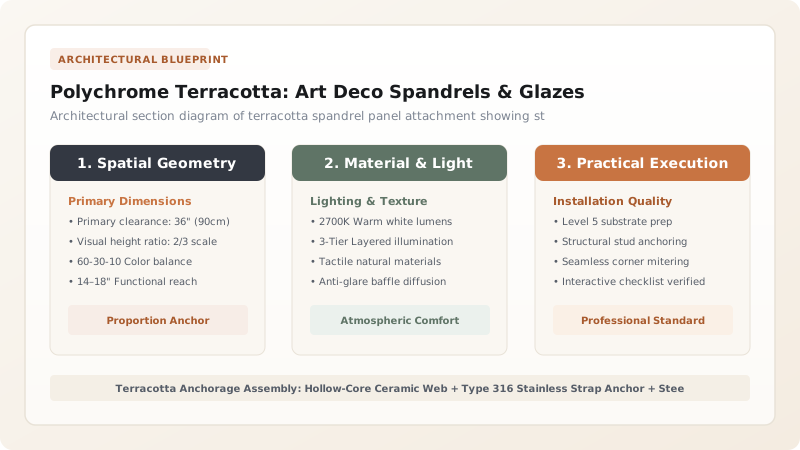
1. Manufacturing Craft: Clay Body Preparation & Vitreous Frits
Between 1925 and 1935, companies like the Atlantic Terra Cotta Company and Gladding, McBean transformed industrial clay production into high art:
Precision ceramic engineering ensured glazes would not craze or peel under severe skyscraper wind chills:
- The Clay Body: Formulated from high-grade refractory ball clay, kaolin, and 15% to 25% grog (pre-fired crushed ceramic fines). Grog reduces drying shrinkage, prevents warpage in large 600mm x 900mm panels, and increases structural green-strength before firing.
- The Plaster Mold Pressing: Sculptors carved master models in plaster or clay. Rubber or multi-piece plaster casing molds were cast from the master. Workers hand-pressed plastic clay into the mold cavity, forming outer walls 35mm thick reinforced by internal intersecting clay partition ribs (webs).
- Cone 5 High Vitrification: Panels were fired in muffle kilns at 1,180°C to 1,220°C. At this peak temperature, the tin-lead-silica frit glaze melts and bonds molecularly into the vitrifying clay body, producing a vitreous, impervious ceramic surface impervious to freeze-thaw spalling. Learn setback massing in stepped ziggurat massing.

2. Anchorage Mechanics: The Rust-Jacking Threat & Stainless Retrofits
The greatest threat to historic Art Deco terracotta facades is the phenomenon known as Rust-Jacking:
- The Original Failure: In the 1920s, terracotta panels were hung from structural steel frame shelf angles using unprotected mild carbon steel strap anchors, J-bolts, and hook ties embedded in porous lime-cement mortar.
- Iron Oxidation Expansion: When rainwater penetrates failed joint mortar, it reacts with the steel:
$$\text{Fe} + \text{O}_2 + \text{H}_2\text{O} \longrightarrow \text{Fe}_2\text{O}_3 \cdot n\text{H}_2\text{O} \implies V_{\text{rust}} \approx 6.0\text{ to } 8.0 \times V_{\text{steel}}$$The expanding iron oxide creates internal bursting pressures exceeding 60 to 100 MPa, fracturing the brittle ceramic webbing and blowing the decorative front face off the building.
- Type 316 Stainless Retrofitting: Modern restoration removes corroded steel without demolishing the facade. Conservators drill narrow 12mm holes through joints or hollow cores, anchoring Type 316 austenitic stainless steel threaded rods with structural epoxy or helical dry-ties into the structural concrete or brick backup. Study decorative interior metalwork in nickel silver and Monel grilles.
3. Cleaning Protocols & Breathable Repointing Science
Cleaning and sealing historic glazed terracotta requires strict chemical discipline:
- The Hydrofluoric Acid Prohibition: Historic building cleaners frequently used hydrofluoric acid (HF) for fast results. HF violently attacks silica (\(\text{SiO}_2\)), etching the glass glaze and destroying its vibrant luster forever. Clean exclusively with non-acidic alkaline restoration cleaners (potassium hydroxide / surfactant blends) followed by a neutralizing freshwater rinse at pressures under 40 bar (600 psi).
- Breathable Mortar Jointing: Joints must never be filled with hard Portland cement or standard silicone sealants that trap water inside the hollow blocks. Use breathable Natural Hydraulic Lime (NHL 3.5) mortar, leaving open 6mm weep holes fitted with insect baffles at the bottom of every spandrel course to drain internal cavity condensation. Explore overall design in our Art Deco architecture hub.
Terracotta Glaze Performance & Restoration Anchor Matrix
Use this reference table to calculate exact physical dimensions, ratios, and specifications before purchasing:
| Glaze / Ceramic Finish | Primary Mineral Flux | Firing Temp (°C) | Durability Rating | Anchor Specification | Approved Cleaning Agent |
|---|---|---|---|---|---|
| Vitreous Gloss Polychrome | Lead-Silica-Tin Frits | 1,180 - 1,220°C | Maximum (Impervious glass) | Type 316 Stainless Strap | pH-neutral surfactant detergent |
| Metallic Gold / Platinum Lustre | Dissolved Precious Metal Resin | 750 - 820°C (Overglaze) | Delicate (Abrasion sensitive) | Internal stainless tie rod | Demineralized water + soft cloth |
| Matte Satin Enamel | Calcium-Barium Feldspar | 1,150 - 1,200°C | Very High (Slightly porous) | Helical 316 Stainless Dry-Tie | Mild potassium hydroxide cleaner |
| Unglazed Buff / Granite Texture | Natural Clay Body / Slag | 1,200 - 1,250°C | High (Vulnerable to soot) | Epoxy-grouted stainless pin | Rotary micro-abrasive pumice wash |
Terracotta Restoration & Fabrication Constraints
Every successful decoration project must account for physical and environmental constraints:
10-12% Kiln Shrinkage in Reproduction
Producing replacement replacement blocks requires building wooden patterns 11% oversized to account for shrinkage during drying and firing.
Hollow Core Cavity Traps
Rainwater leaking through a single cracked joint can fill hollow internal cores across an entire floor, freezing and spalling multiple panels in winter.
Spectrophotometric Glaze Matching
Historic glazes feature subtle mottling and depth impossible to duplicate with single-pigment modern industrial coatings.
Heavy Unit Weight During Setting
Individual spandrel blocks weigh 25kg to 50kg; setting them at 30-story heights requires specialized hoisting suction lifters.
Terracotta Inspection, Re-Anchoring & Glaze Repair Protocol
Execute this professional sequence to achieve flawless results without backtracking:
Comprehensive Facade Survey
Sound every terracotta block with a wooden mallet; hollow or dead thuds indicate internal fracture or anchor failure.
Joint Mortar Raking
Rake out deteriorated mortar to a depth of 30mm using oscillating diamond raking blades, vacuuming debris clean.
Core Drilling for Stainless Anchors
Drill 14mm holes through the joints or pre-drilled unglazed ribs into the structural brick backup.
Stainless Anchor Pin Injection
Insert Type 316 stainless steel threaded rods; inject structural high-modulus epoxy into the backup substrate.
Hollow Core Grouting / Drainage
Inject lightweight, breathable natural hydraulic lime grout into voids, inserting 6mm plastic weep tubes at panel bases.
Mortar Pointing
Repoint joints with breathable NHL 3.5 mortar, tooling joints slightly concave beneath glaze edges.
Low-Pressure Surface Cleaning
Wash glazed faces with pH-neutral restoration detergent using soft natural bristle brushes and low-pressure rinse (< 500 psi).
Common Mistakes & Countermeasures
Avoid these costly errors that compromise aesthetics, ergonomics, and budget:
Washing glazed terracotta with hydrofluoric or muriatic acid cleaners
Sealing terracotta joints with 100% silicone or urethane caulking without weep holes
Leaving corroded carbon steel anchors in place and merely patching the surface
Project Execution Checklist
Track your physical progress. Checkboxes persist automatically on this device:
Frequently Asked Questions
What is the primary difference between terra cotta and standard brick?
Brick is a solid, small modular masonry unit made of coarse clay and fired without glazes. Architectural terracotta is custom-molded into large, hollow-core blocks with internal reinforcing webs, allowing complex sculptural relief, and is coated with vitreous, colorful mineral glazes.
How do conservators replicate missing polychrome Art Deco terracotta panels today?
Specialized architectural ceramics companies take silicone molds from sound original blocks. Sculptors hand-carve oversized clay models (accounting for 10-12% kiln shrinkage), press blocks in plaster molds, match glaze chemistry via trial kiln firings, and fire in computer-controlled kilns.
Why did Art Deco designers choose terracotta over bronze or carved stone for spandrels?
Terracotta was far lighter than stone (reducing steel framing requirements), completely fireproof, impervious to city coal smog, and—most importantly—allowed the brilliant polychrome color palettes (blues, greens, golds) that stone could never provide.


