
Art Deco Metal-Faced Knife Sleds and Fibrous Plaster Casting represent the industrial fabrication technology that powered early 20th-century decorative plasterwork. While classical ornament relied on hand modeling, Art Deco demanded razor-sharp geometric reproducibility. Plaster workshops paired hardened-steel running sleds with fibrous plaster casting—reinforcing thin shells of pure alpha gypsum with woven jute hessian and timber ribs. This allowed multi-meter stepped panels, chevron friezes, and cove troughs to be pre-manufactured off-site and rapidly hung from skyscraper steelwork.
At a Glance: Key Takeaways
- Hardened Steel Knife Blades: Resisting aggregate abrasion to run thousands of meters of crisp 90° geometric setbacks.
- Fibrous Plaster Shells (Staff): 12mm thin gypsum panels reinforced with woven jute hessian canvas.
- Timber & Steel Stiffener Ribs: Embedding timber laths and galvanized steel angles into rear plaster waddings.
- Modular Off-Site Prefabrication: Manufacturing complete lobby ceiling bays in workshop casting beds.
- Rapid Mechanical Hanging: Bolting and wiring pre-cast plaster shells directly to structural ceiling beams.
- Feathered Hairline Joints: Merging pre-cast panels into monolithic continuous surfaces on site.
1. Hardened Steel Knife Sleds: The Geometry of Setbacks
While zinc blades were sufficient for soft residential cornices, monumental commercial Art Deco projects required hardened cold-rolled steel or brass profile plates. Sledding abrasive gypsum over dozens of 90° stepped setbacks rapidly rounds off soft metal corners.
Toolmakers milled the geometric stepped profile into 2.0mm steel plates using mechanical metal shapers. The cutting edge was ground with an acute 30° relief angle and hardened. Mounted to heavy hardwood sleds with dual bronze guide shoes, these industrial sleds extruded miles of crisp, mirror-flat stepped cornices in grand cinema palaces and bank halls.
2. The Chemistry and Anatomy of Fibrous Plaster (Staff)
Traditional solid plaster weighs over 60 kg/m² and cracks easily under tensile flexure. Fibrous plaster solved both problems, reducing weight to under 15 kg/m² while dramatically increasing tensile strength.
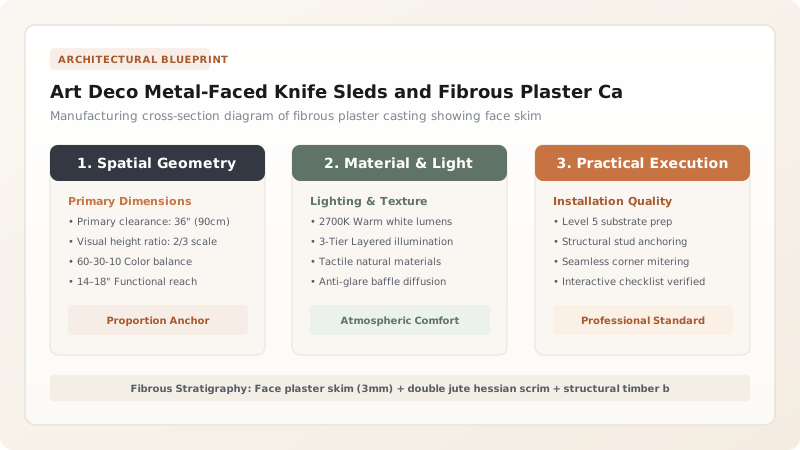
A high-purity casting plaster (alpha-hemihydrate) is poured into the mold to create an ultra-smooth 3mm surface face. Immediately, sheets of open-weave jute hessian (scrim cloth) are laid into the wet plaster. Using ribbed wooden rollers, artisans press the jute fibers into the paste, followed by a second skim of plaster. When set, the long cellulose fibers act exactly like modern carbon fiber, giving the plaster panel immense flexural ductility.
3. The Art of Wadding and Ceiling Suspension
To keep large, thin panels flat and prevent sagging, artisans reinforced the rear face with timber laths or steel square tubing. These ribs are anchored using waddings—loose handfuls of jute fibers dipped into liquid plaster and twisted around the reinforcement battens.
On site, installers hoist the cured modular panels into position beneath the structural ceiling. Galvanized suspension wires or steel rods dropped from the ceiling beams are wrapped around the waddings and twisted tight with pliers. The tight joints between panels are then filled with matching casting plaster and scraped flush with steel joint knives, creating a completely monolithic, seamless expanse.
Fibrous Plaster Panel Specifications vs. Traditional Three-Coat Plaster
Use this reference table to calculate exact physical dimensions, ratios, and specifications before purchasing:
| Performance Property | Pre-Cast Fibrous Plaster (Art Deco Staff) | Traditional In-Situ Solid Plaster | Structural Advantage |
|---|---|---|---|
| Panel Weight (kg/m²) | 12 - 18 kg/m² (Lightweight) | 55 - 75 kg/m² (Heavy) | Reduces structural dead load by 75% |
| Tensile Flexural Strength | High: 8.5 - 12.0 MPa (Jute reinforced) | Low: 1.2 - 2.0 MPa (Brittle) | Resists cracking from building vibration |
| Installation Speed | Rapid: Pre-cast off-site; fast hanging | Slow: 3 wet coats with drying intervals | Accelerates skyscraper construction schedules |
| Geometric Sharpness | Flawless: Molded from precision masters | Variable: Dependent on on-site hand skill | Guarantees identical modular symmetry |
Manufacturing & Logistics Constraints
Every successful decoration project must account for physical and environmental constraints:
Transport Fragility
Pre-cast fibrous plaster panels are long and thin; transport requires dedicated vertical A-frame crating to prevent flex cracks.
Moisture Expansion During Drying
Panels expand slightly during initial set; must be fully cured and dry before hanging to prevent joint buckling.
Protocol for Casting and Suspending a Fibrous Plaster Ceiling Panel
Execute this professional sequence to achieve flawless results without backtracking:
Mold Preparation & Release Waxing
Clean rubber or timber casting mold; apply thin wipe coat of stearic acid and mineral turpentine release agent.
First Face Plaster Pour (The First)
Mix fine alpha casting gypsum; splash 3mm face skim into mold; shake mold vigorously to dislodge surface air bubbles.
Jute Hessian Canvas Embedding
Lay pre-cut open-weave jute hessian canvas over wet face plaster; roll with grooved brass roller until jute is fully saturated.
Second Plaster Skim & Batten Wadding
Pour second 4mm plaster coat; position timber backing battens; wrap plaster-soaked jute waddings around battens to bond to panel.
Heat Set Demolding & Drying
Wait 35 minutes for exothermic crystallization; demold flexible panel; stack vertically on drying racks for 48 hours.
Ceiling Rigging & Joint Blending
Hoist panel to ceiling grid; wire waddings to steel drop rods; pack joint seams with casting plaster; scrape flush with joint plane.
Common Mistakes & Countermeasures
Avoid these costly errors that compromise aesthetics, ergonomics, and budget:
Embedding dry jute hessian canvas directly into plaster without pre-wetting
Using ungalvanized iron wire to suspend fibrous plaster panels
Project Execution Checklist
Track your physical progress. Checkboxes persist automatically on this device:
Frequently Asked Questions
How long do historic fibrous plaster ceilings last?
When kept dry and protected from roof leaks, authentic jute-reinforced fibrous plaster ceilings easily survive for over 100 to 150 years without structural degradation, as proven by hundreds of historic 1920s Art Deco theaters still operating safely today.
Can fiberglass roving replace jute hessian in reproduction Art Deco panels?
Yes. Modern heritage plaster workshops frequently use chopped-strand fiberglass or continuous alkali-resistant glass matting (GRG - Glass Reinforced Gypsum), which increases tensile strength and fire resistance while matching the lightweight versatility of historic jute staff.


