
Art Deco Stepped Chevron Plaster Friezes and Mouldings represent the glamorous, machine-age triumph of early 20th-century decorative plaster craft. Born from the 1925 Paris Exposition Internationale des Arts Décoratifs et Industriels Modernes and reaching monumental expression in the skyscraper lobbies of New York, Chicago, and Miami, Art Deco plaster replaced classical flowing acanthus scrolls with bold geometric energy: ziggurat stepped setbacks, aerodynamic speed lines, radiating sunbursts, and repeating chevrons. Executed via metal-faced knife sleds and fibrous plaster casting, these friezes integrated indirect neon cove lighting and metallic bronze powder patinas.
At a Glance: Key Takeaways
- Machine-Age Geometric Vocabularies: Stepped ziggurats, aerodynamic speed lines, chevrons, and sunburst rays.
- Fibrous Plaster Casting: High-strength casting plaster reinforced with jute hessian canvas for lightweight monumental panels.
- Reverse-Setback Ziggurat Profiles: Running stepped ceiling cornices that conceal indirect electric cove lighting troughs.
- Zinc-Faced Precision Knife Sleds: Running crisp 90° geometric setbacks with zero rounded or sagging arrises.
- Metallic Bronze & Silver Patinas: Cold-dusting molds with bronze, aluminum, and copper powders for a solid-metal appearance.
- Skyscraper Lobby Monumentality: Transforming public entryways into dazzling temples of modern commerce and speed.
In-Depth Guides in this Directory
Explore specialized subtopic blueprints, technical dimensions, and execution checklists:
Art Deco Speed Lines, Sunbursts, and Ziggurat Stepped Profiles
Architectural design analysis of Art Deco ornamentation: aerodynamic reeded speed lines, the celestial sunburst, Mayan-inspired stepped ziggurats, and proportional geometry.
Art Deco Metal-Faced Knife Sleds and Fibrous Plaster Casting
Workshop manufacturing manual for Art Deco plaster: building steel-faced running sleds, casting fibrous plaster panels with jute canvas, and steel frame rigging.
Art Deco Bronze Powder Patinas and Indirect Cove Lighting
Finishing and illumination manual for Art Deco interiors: cold-cast metallic bronze powders, chemical patinas, indirect neon and LED coves, and theatrical lighting.
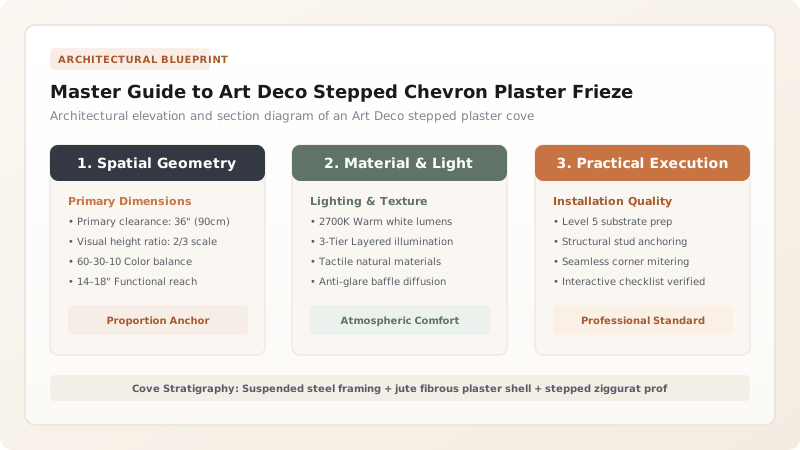
1. From Paris 1925 to the American Skyscraper Style
Art Deco arrived as an exuberant declaration of modern speed, electric power, and industrial optimism following World War I. Originating at the 1925 Paris Exposition, the style discarded the curvilinear floral asymmetry of Art Nouveau and the classical Vitruvian orders of the Beaux-Arts.
In cities like New York (the Chrysler Building and Rockefeller Center) and Los Angeles, architects like Raymond Hood and Ely Jacques Kahn embraced geometric abstraction. Plasterers were tasked with creating dynamic, machine-precise reliefs: ziggurats inspired by pre-Columbian step pyramids, lightning bolts celebrating electric power, and streamlined speed lines symbolizing trains and airplanes.
2. Fabrication Innovations: Fibrous Plaster and Machine Sleds
Art Deco plasterwork could not be built with heavy, wet traditional three-coat mortar; the massive setbacks would sag under their own weight. Instead, artisans relied on fibrous plaster (staff plaster).
High-grade casting plaster was reinforced with woven jute canvas (hessian) and wood lath ribs, creating ultra-thin (10mm to 15mm), lightweight pre-cast ceiling panels capable of spanning multi-meter elevator lobbies. For running straight ziggurat moldings, craftsmen fabricated heavy steel-faced knife sleds whose razor-sharp 90° steps extruded crisp, geometric arrises that looked like extruded aluminum or machined marble.
3. The Theater of Light: Indirect Architectural Coves
The defining technological breakthrough of Art Deco interior architecture was the integration of concealed electric illumination. Rather than suspending central chandeliers that glared into visitors' eyes, architects designed stepped plaster cornices with hidden hollow troughs.
Incandescent bulbs or early neon tubing concealed inside the plaster troughs bounced light upward across the stepped ceiling setbacks. The plaster profiles were calculated to catch and grade the light, casting dramatic rhythmic bands of shadow and illumination that made the ceiling appear to hover weightlessly in mid-air.
Classical Art Deco Plaster Motifs & Geometric Ratios
Use this reference table to calculate exact physical dimensions, ratios, and specifications before purchasing:
| Motif Typology | Geometric Profile | Proportional Ratio | Historical Symbolism | Typical Placement |
|---|---|---|---|---|
| Ziggurat Stepped Setback | Concentric 90° stepped tiers | 1 : 1.5 Step Height to Depth | Ancient Mesopotamian grandeur & modern skyscrapers | Ceiling coves, door pediments, elevator friezes |
| Aerodynamic Speed Lines | Parallel horizontal / vertical reeding | 3 to 5 parallel convex flutes | Locomotive speed, wind-tunnel streamlining | Dado rails, column wraps, corridor bands |
| Radiating Sunburst (Soleil) | Expanding triangular rays from central node | 15° to 30° radial increments | The dawn of a new technological era | Transom grills, elevator door overdoors, medallions |
| Interlocking Chevron | Repeating 60° or 90° V-shaped zigzags | Symmetrical triangular rhythm | Dynamic forward momentum, lightning bolts | Frieze bands, border trim, fireplace surrounds |
Fabrication & Lighting Constraints
Every successful decoration project must account for physical and environmental constraints:
Concealed Lighting Heat Dissipation
Historic incandescent cove lights generated high heat that desiccated plaster; modern LED strips require aluminum heat-sink channels.
Draft Angles in Rubber Molds
Deep 90° stepped ziggurats can lock in molds; patterns must incorporate subtle 0.5° release draft angles.
Protocol for Casting and Installing an Art Deco Fibrous Plaster Frieze
Execute this professional sequence to achieve flawless results without backtracking:
Precision CNC / Hand Model Sculpting
Sculpt original geometric model from dense timber or brass plate; verify razor-sharp 90° ziggurat arrises using engineer's square.
Silicone / Polyurethane Mold Pouring
Pour high-tear polyurethane rubber over model inside timber casting box; allow 24 hours to cure into flexible production mold.
Metallic Bronze Powder Dusting
Dust clean mold cavity with ultra-fine atomized bronze or aluminum powder; blow away excess to leave micro-metallic film.
Fibrous Plaster Laying & Hessian Reinforcing
Pour first 4mm skim of fine casting plaster; immediately lay sheets of open-weave jute hessian; roll into plaster with roller.
Timber Stiffener Wadding & Cure
Wad timber batten ribs to rear of panel using plaster-soaked jute wads; allow 45 minutes for exothermic heat cure; demold panel.
Ceiling Suspension & Joint Feathering
Hoist panel into place on suspended steel framing; screw through wadding ribs; plaster joints tight with fine gauging plaster; burnish.
Common Mistakes & Countermeasures
Avoid these costly errors that compromise aesthetics, ergonomics, and budget:
Rounding the crisp 90° stepped arrises of Art Deco profiles during sanding
Using unreinforced plaster for large stepped ceiling coves
Project Execution Checklist
Track your physical progress. Checkboxes persist automatically on this device:
Frequently Asked Questions
How did 1930s plasterers make plaster look like solid cast bronze or gold?
They practiced 'cold-dusting.' Fine atomized bronze, copper, or brass powders were brushed dry into the mold before pouring the wet plaster. During setting, the plaster bound directly with the metallic particles on the surface. Once demolded and buffed with steel wool, the panel displayed the authentic cool touch, weight, and luster of solid cast metal.
What is fibrous plaster and why was it vital to Art Deco interiors?
Fibrous plaster is a composite material of high-purity casting gypsum reinforced with open-weave jute canvas (hessian). Invented in 1856 by Leonard Desachy, it is lightweight, extremely strong in tension, non-combustible, and can be pre-cast into monumental, thin-shelled architectural panels that are rapidly hoisted and screwed to building framing.


