
Construct architectural gabion stone walls using 9-gauge (3.8mm) or 11-gauge welded wire mesh baskets coated with corrosion-proof Galfan alloy (90% Zinc / 10% Aluminum). Install internal cross-tie stiffener wires every 12 inches to prevent cage bulging, hand-stack flat quarry stones along the visible exterior faces, and fill the internal core with clean 4" to 8" angular drainage rock.
At a Glance: Key Takeaways
- Welded Wire vs Twisted Hexagonal Mesh: Welded wire maintains crisp, razor-sharp architectural geometric lines with zero basket sagging.
- Galfan Alloy Corrosion Protection (ASTM A856): 90% Zinc / 10% Aluminum alloy provides 3x to 5x greater corrosion life than standard hot-dip galvanizing.
- Internal Cross-Tie Diaphragm Stiffeners: Prevents hydrostatic stone pressure from bulging basket faces into rounded pillowed cushions.
- Hand-Stacked Masonry Facing vs Core Fill: Hand-laying flat quarry stone on front faces creates an airtight ashlar finish; bulk crushed rock fills core.
- 100% Free-Draining Gravity Retention: Porous stone matrix eliminates hydrostatic pressure without separate drainage pipes.
In-Depth Guides in this Directory
Explore specialized subtopic blueprints, technical dimensions, and execution checklists:
Galfan Gabion Mesh: 9-Gauge Metallurgy & Tensile Ratings
Master welded wire gabion metallurgy: 9-gauge (3.8mm) high-tensile steel wire (60,000–85,000 PSI), Galfan (90% Zn / 10% Al) ASTM A856 corrosion resistance, and salt spray testing.
Gabion Stiffeners: Tie-Wire Spacing & Diaphragms
Master gabion basket structural assembly: internal diaphragm partitions every 3 feet, 9-gauge corner stiffener hooks, 12" spacing intervals, and spiral binder lacing.
Gabion Stone Facing: Hand-Stacked Ashlar vs Machine Fill
Master architectural gabion stone aesthetics: hand-stacked flat-faced quarry stone ashlar facing, internal machine-filled aggregate cores, angular basalt, and color striations.
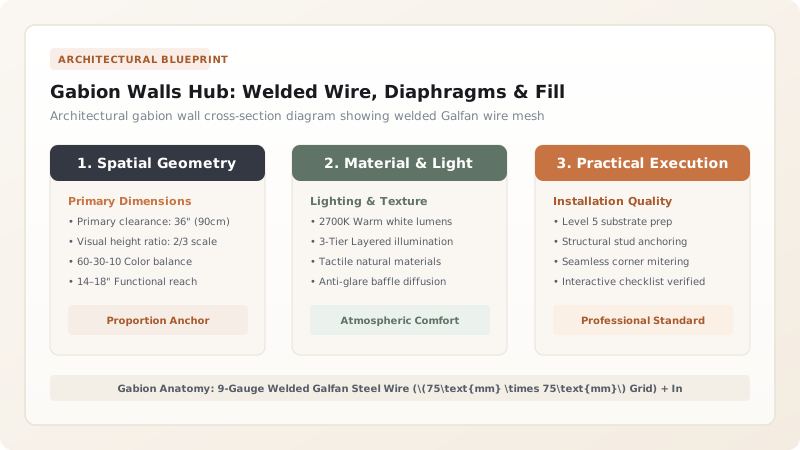
1. Material Metallurgy: Welded Wire Mesh & Galfan (Zn-Al) Alloy Coatings
Traditional civil engineering gabions use flexible twisted hexagonal wire mesh that stretches and sags under load, looking sloppy on modern architectural residences.
Architectural Gabions use Rigid Welded Wire Mesh (3" × 3" / 75mm × 75mm grid) fabricated from 9-gauge (3.8mm) high-tensile carbon steel. The wire is protected with Galfan (Class 100 Zn-Al eutectic alloy conforming to ASTM A856), providing over 75 to 100 years of rust-free outdoor lifespan. Master wire metallurgy in welded wire Galfan mesh ratings and compare with dry-stack stone walls.

2. Anti-Bulging Stiffener Wire Ties & Hand-Stacked Quarry Facing
When heavy rock is dumped into gabion cages, stone weight creates extreme outward lateral pressure against the wire panels.
Install Internal Cross-Tie Stiffeners Every 12 Inches Vertically and Horizontally. Hand-stack flat quarry stones with internal diaphragm stiffeners and tie-wire lacing and master facing aesthetics in hand-stacked quarry facing vs machine fill.
Architectural Gabions vs Civil Engineering Gabions
Use this reference table to calculate exact physical dimensions, ratios, and specifications before purchasing:
| Gabion Basket Type | Wire Grid Structure | Corrosion Coating | Aesthetic Flatness & Sag Resistance |
|---|---|---|---|
| Architectural Welded Wire Gabion (Optimal) | 9-Gauge Welded 3"x3" Grid | Galfan Zn-Al Alloy (ASTM A856) | 5 / 5 (Razor-sharp straight edges / Zero bulge) |
| Twisted Hexagonal Wire Gabion (Civil) | Double-Twisted Hex Mesh (8x10cm) | Standard Hot-Dip Galvanized / PVC | 2 / 5 (Bulges into rounded pillow shapes) |
| Stainless Steel Welded Gabion (Marine) | 9-Gauge 316 Marine Stainless | Solid 316 Stainless Steel | 5 / 5 (Immune to coastal salt spray) |
| Thin Chicken Wire Cage (Avoid) | Uncoated 20-Gauge Wire | Electro-galvanized (Thin) | FAILS: Rusts and ruptures within 1 year |
Missing Internal Stiffener Bulging Basket Constraints
Every successful decoration project must account for physical and environmental constraints:
Omitting Internal Wire Stiffeners Causing Basket Faces to Bulge 4 Inches Outward
Filling gabion baskets without internal cross-ties forces the wire face to bow outward into an unsightly rounded barrel shape; install diagonal corner stiffeners or transverse tie-wires every 12 inches of stone depth, verifying wire panels remain 100% planar with a straightedge while filling.
How to Assemble, Tie, and Fill an Architectural Gabion Wall
Execute this professional sequence to achieve flawless results without backtracking:
Prepare Compacted Aggregate Foundation Trench
Excavate 12" deep trench; compact 6" of crushed road base; level to within 1/8" across wall length.
Unfold and Lace Welded Wire Basket Panels
Join bottom, side, and diaphragm panels using Galfan spiral binders or pneumatic hog-ring C-clips every 4".
Anchor Base Baskets and Interconnect Adjoining Cages
Set baskets in position; lace adjoining cages together with continuous spiral binding wire to form monolithic unit.
Install Internal Cross-Tie Stiffener Hooks at 12" Height
Clip 9-gauge pre-formed tie-wire hooks between front and rear panels to hold walls parallel under stone load.
Hand-Place Flat Quarry Stones Along Visible Front Face
Carefully arrange large flat-faced stones against front wire grid, fitting them tight like an ashlar masonry wall.
Fill Internal Core with 4" to 8" Angular Crushed Rock
Fill core in 12" lifts with clean angular rock; install secondary tier of internal tie-wires; repeat to top.
Lace Top Wire Lid with Spiral Binders
Close top mesh lid tightly over filled rock; lace all four perimeter edges with continuous spiral wire binders.
Common Mistakes & Countermeasures
Avoid these costly errors that compromise aesthetics, ergonomics, and budget:
Dumping Small Gravel (<3") into a 3"x3" Wire Grid Basket
Project Execution Checklist
Track your physical progress. Checkboxes persist automatically on this device:
Frequently Asked Questions
Can gabion walls be used to build outdoor kitchen islands, benches, and fire pits?
Yes! Modern landscape architects frequently use welded wire gabions filled with colored river stone, crushed basalt, or recycled glass rock to construct stunning outdoor kitchen bases, fire pit surrounds, and retaining benches topped with solid hardwood or concrete caps.


