
Achieve high-end architectural aesthetics on gabion walls by hand-stacking premium flat-faced quarry stones (such as dark basalt, granite, or bluestone) tightly against visible exterior wire faces with minimal voids. Fill the hidden internal core with less expensive 4" to 8" machine-placed crushed aggregate, cutting material costs by 50% while maintaining flawless ashlar beauty.
At a Glance: Key Takeaways
- Hand-Stacked Ashlar Front Skin (4"–6" Depth): Flat-faced quarry stones pressed flush against wire grid create a refined masonry facade.
- Economical Machine Core Fill (4"–8" Aggregate): Crushed granite or limestone fills internal volume quickly at 1/3 the cost of premium stone.
- Weather-Resistant Non-Degrading Rock (LA Abrasion <30%): Dense igneous/metamorphic stone (Basalt, Granite, Quartzite) resists freeze-thaw crumbling.
- Zero Voids Along Front Wire Grid: Hand-fitting prevents unsightly dark shadows, gaps, and hollow pockets on exterior surfaces.
- Layered Multi-Colored Geological Strata: Alternating bands of dark basalt and light limestone creates stunning architectural landscape art.
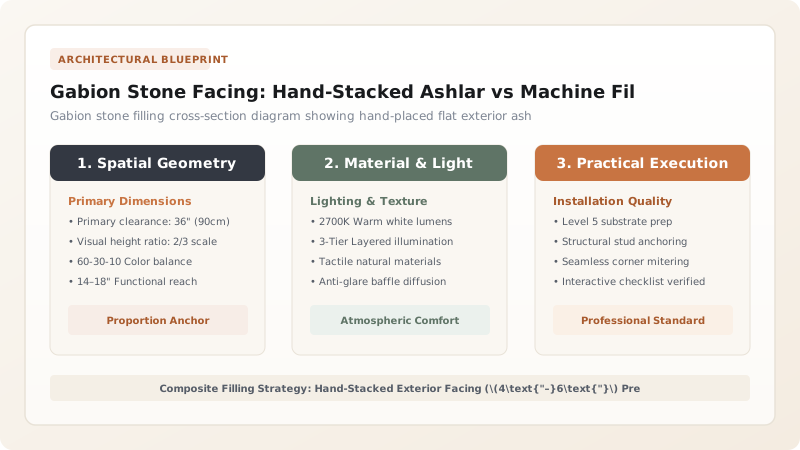
1. Aesthetic Engineering: Hand-Placed Ashlar Facing & Optical Density
When stone is dumped randomly into a gabion from an excavator bucket (*machine fill*), round rocks point at odd angles, leaving 30% open air gaps where the wire grid looks messy and industrial.
Architectural Hand-Stacked Facing treats the front 4 to 6 inches of the basket like dry-stack masonry. Artisans select Flat-Faced Quarry Stones (4" to 8" size), setting them flush against the wire mesh with tight, overlapping joints. Master internal stiffeners in internal diaphragm stiffeners.

2. Mineral Durability: Basalt, Granite & Freeze-Thaw Resistance
Soft sedimentary stones (like shale, soft sandstone, or porous chalk limestone) absorb water, cracking and disintegrating into mud after two winters.
Specify Dense Igneous or Metamorphic Stone (such as Basalt, Granite, or Hard Dolomitic Limestone) with a Los Angeles Abrasion Loss under 30% (ASTM C131) and Water Absorption under 1.0%. Review wire corrosion ratings in welded wire Galfan mesh ratings and explore gabion walls hub.
Gabion Stone Filling Methods Comparison
Use this reference table to calculate exact physical dimensions, ratios, and specifications before purchasing:
| Filling Technique | Labor Time per Cu. Yard | Material Cost Efficiency | Aesthetic Refinement |
|---|---|---|---|
| Hand-Stacked Face + Machine Core (Optimal) | 1.5 to 2.0 Hours | High (50% savings vs all-premium) | 5 / 5 (Luxury Architectural Masterpiece) |
| 100% Hand-Stacked Solid Throughout | 4.0 to 5.0 Hours | Low (Very expensive stone cost) | 5 / 5 (Over-engineered interior) |
| 100% Machine Bucket Dump Fill | 0.2 Hours (12 minutes) | High (Inexpensive bulk stone) | 2 / 5 (Industrial highway rip-rap look) |
| Recycled Concrete Rubble Fill | 0.5 Hours | Very High (Recycled waste) | 2 / 5 (Eco-industrial / Uneven color) |
Friable Shale Slaking Destruction Constraints
Every successful decoration project must account for physical and environmental constraints:
Filling Gabions with Sedimentary Shale That Slakes into Clay Within 24 Months
Soft laminated shale absorbs rainwater, freezing and crumbling into fine clay that washes out through the wire mesh, leaving collapsed hollows in the wall; strictly test stone hardness with a geologist hammer (rock must ring crisply when struck without crumbling).
How to Hand-Stack Facing Stone and Backfill Gabions
Execute this professional sequence to achieve flawless results without backtracking:
Sort Quarry Stone Delivery into Face and Core Piles
Separate flat-faced rectangular stones for exterior display; reserve irregular angular chunks for core fill.
Place First 12-Inch Course of Flat Face Stones
Hand-set flat stones tight against front wire grid, fitting them like puzzle pieces with minimal gaps.
Shovel 4" to 8" Angular Ballast into Internal Core
Fill behind face stones with bulk angular rock, tamping firmly to eliminate internal voids.
Install 9-Gauge Cross-Tie Stiffener Hooks at 12" Mark
Clip internal stiffener wires over rock bed between front and rear panels before proceeding to next lift.
Repeat Hand-Facing and Core Filling for Middle Lift
Hand-stack second 12" face course; backfill core; install second tier of cross-tie hooks at 24" height.
Hand-Level Top Stone Course Flush with Wire Rim
Select flat stones for top surface so the mesh lid closes tight and flat without high point pressure.
Lace Mesh Lid and Wash Stone with Garden Hose
Close and lace wire lid; rinse dust from stones with water to bring out vibrant natural mineral colors.
Common Mistakes & Countermeasures
Avoid these costly errors that compromise aesthetics, ergonomics, and budget:
Placing Rounded River Boulders with No Flat Faces on Front Grid
Project Execution Checklist
Track your physical progress. Checkboxes persist automatically on this device:
Frequently Asked Questions
Can gabion baskets be filled with recycled tumbled glass rocks and illuminated?
Yes! Landscape designers frequently fill gabions with large 4"–6" recycled blue, green, or amber glass cullet. Installing waterproof LED strip lighting inside the center of the cage illuminates the wall with a breathtaking ethereal glow at night.


