
Prevent gabion wall bulging by installing internal vertical diaphragm mesh partitions every 3 feet (1 meter) along the basket length. As rock is placed, install pre-formed 9-gauge diagonal corner stiffeners or transverse cross-tie wires every 12 inches of vertical height (connecting front and rear faces at the 1/3 and 2/3 fill levels).
At a Glance: Key Takeaways
- Internal Diaphragm Partitions (Every 3 Feet): Divides long baskets into rigid 1-meter square structural cells.
- Cross-Tie Hook Tensioners (12" & 24" Heights): Pre-formed 9-gauge hooks bridge front and back wire faces under tension.
- 45° Diagonal Corner Braces: Prevents exposed 90-degree corner panels from splaying open under rock weight.
- Spiral Binding Wire Lacing vs Hog Rings: Continuous spiral coils provide 100% full-length edge capture for heavy load-bearing walls.
- Visual Planar Inspection During Fill: Check front wire panels with a 6-foot aluminum level during filling to guarantee dead-flat faces.
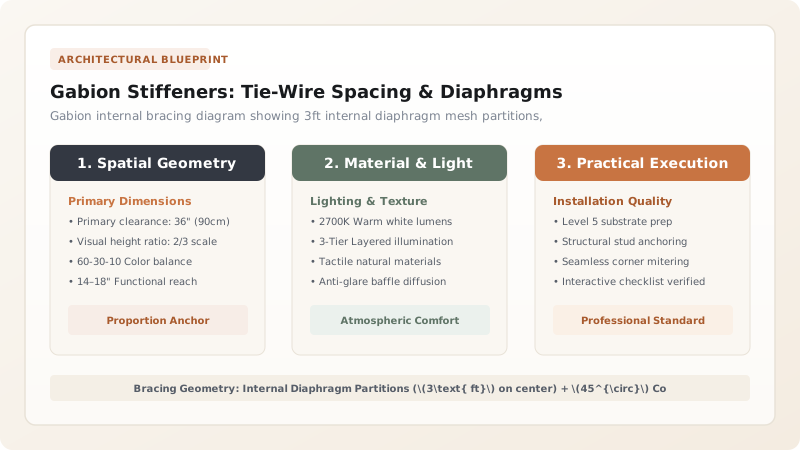
1. Structural Mechanics: 3-Foot Diaphragm Cells & Hydrostatic Rock Thrust
When crushed rock fills a 12-foot continuous gabion cage, stone settling creates extreme outward hydrostatic lateral pressure. Without internal dividers, the wire panels stretch and balloon outward by 4 to 6 inches.
Architectural gabion baskets incorporate Internal Diaphragm Mesh Partitions Every 3 Feet (1 Meter). These vertical dividers isolate rock mass into independent cubic cells, preventing cumulative lateral thrust. Master mesh metallurgy in welded wire Galfan mesh ratings.

2. Pre-Formed Cross-Tie Hooks & Diagonal Corner Braces
As stone is loaded in 12-inch lifts, install Pre-Formed 9-Gauge Cross-Tie Stiffeners connecting front and rear panels at 1/3 height (12") and 2/3 height (24").
On exposed end-caps, install 45-Degree Diagonal Corner Braces across the corner wires to hold a crisp 90° edge. Review stone selection in hand-stacked quarry facing and explore gabion walls hub.
Gabion Internal Stiffener Spacing Matrix
Use this reference table to calculate exact physical dimensions, ratios, and specifications before purchasing:
| Basket Height & Depth | Diaphragm Partition Spacing | Internal Stiffener Tier Count | Stiffeners per Linear Foot |
|---|---|---|---|
| 36" High × 36" Deep (Optimal) | Every 36" (3 ft on center) | 2 Tiers (at 12" and 24" heights) | 2 Stiffeners per cell (4 total per tier) |
| 18" High × 24" Deep (Low wall) | Every 36" (3 ft on center) | 1 Tier (at 9" height) | 2 Stiffeners per cell |
| 72" High × 36" Deep (Tall wall) | Every 36" (3 ft on center) | 5 Tiers (every 12" height) | 4 Stiffeners per tier + Internal Posts |
| No Internal Stiffeners (Avoid) | None | 0 Tiers | FAILS: Cages bulge 4"–6" outward |
Overfilling Before Stiffener Hook Installation Constraints
Every successful decoration project must account for physical and environmental constraints:
Dumping Rock to Top of Cage Before Installing Lower Tier Stiffeners
Once rock is piled past the 12-inch mark, installing internal tie hooks is impossible without digging out tons of stone; strictly fill gabions in precise 12-inch lifts, pausing to hook all internal stiffeners across the rock before adding the next lift.
How to Install Internal Diaphragms and Cross-Tie Stiffeners
Execute this professional sequence to achieve flawless results without backtracking:
Position Diaphragm Panels Every 3 Feet Along Base
Erect vertical diaphragm dividers at 36" intervals; secure bottom edges with spiral binders or C-clips.
Lace Vertical Perimeter Corners with Continuous Spiral Coils
Thread 9-gauge Galfan spiral coils down all vertical corner seams, crimping the ends with pliers.
Fill First 12-Inch Lift of Stone (1/3 Height)
Hand-stack front facing stones and fill core to 12" height; level rock flat across entire cell.
Hook First Tier of Pre-Formed Cross-Tie Stiffeners
Clip 9-gauge stiffener hooks over horizontal front and rear mesh wires, locking them tightly over stone bed.
Install 45° Diagonal Corner Braces on Exposed End Panels
Attach diagonal wire hooks connecting end panel to front and back panels at 45° angle to prevent corner splay.
Fill Second 12-Inch Lift (2/3 Height) and Install Second Tier
Add rock to 24" height; install second tier of cross-ties; verify front face is dead-plumb with level.
Fill Final 12-Inch Lift and Lace Top Lid
Fill top course flush with upper wire rim; fold lid down and lace all perimeter and diaphragm top seams.
Common Mistakes & Countermeasures
Avoid these costly errors that compromise aesthetics, ergonomics, and budget:
Bending Soft Rebar Tie Wire Instead of Using Engineered 9-Gauge Stiffeners
Project Execution Checklist
Track your physical progress. Checkboxes persist automatically on this device:
Frequently Asked Questions
How do you join adjoining gabion baskets together in a continuous wall?
Adjacent gabion cages share a common side panel or are laced together back-to-back using continuous spiral binder coils or pneumatic hog-ring clips every 4 inches along all touching edges, forming a single monolithic structure.


