
Polychrome Metallic Oxide Glaze Brushwork and Glost Firing is the transformative alchemy that infuses Andalusian cuerda seca tiles with their luminous, jewel-like palette. Raw metallic oxides—copper for emerald green, cobalt for sapphire blue, antimony for golden amber, and tin for opaque white—are suspended in high-lead silica glass fluxes. Artisans pool these fluid glazes into cells bounded by manganese resist lines using fine animal-hair quills. Fired in oxidizing kilns at 980°C, the vitreous glass melts and levels, producing thick, translucent pools of color with deep refractive brilliance.
At a Glance: Key Takeaways
- Traditional Four-Color Palette: Copper emerald green, cobalt sapphire, antimony golden-honey, and tin milk-white.
- High-Lead Silicate Flux: Historic lead silicate lowering melting points to 980°C while maximizing optical refractive index.
- Convex Meniscus Pooling: Filling cells with wet glaze until a high surface-tension meniscus forms proud of the resist line.
- Oxidizing Kiln Atmosphere: Guaranteeing brilliant clean oxide hues without the soot-darkening of reduction atmospheres.
- Thermal Expansion Matching: Harmonizing glaze thermal contraction with the underlying terracotta clay body.
- Self-Leveling Glass Vitrification: High surface tension smoothing out all brush strokes into mirror-like enamel.
1. Color Chemistry: The Inorganic Chromophores of al-Andalus
Unlike modern synthetic stains, authentic Hispano-Moresque ceramic colors were derived exclusively from raw mineral ores calcined in ceramic furnaces:
- Emerald Green (Verde Cobre): 2% to 4% copper carbonate (malachite) or copper oxide dissolved in high-lead glaze produces a rich, luminous leaf green.
- Cobalt Blue (Azul Cobalto): As little as 0.5% cobalt oxide or pulverized smalt imparts a deep, piercing oceanic blue that resists high firing temperatures without burning out.
- Honey Amber (Amarillo Melado): 3% to 5% antimony oxide blended with trace red iron oxide yields the iconic golden-amber hue of Sevillian tiles.
- Opaque White (Blanco Estannífero): 8% to 10% tin oxide (cassiterite) creates an opaque, milky white glaze that acts as a visual shield over the red terracotta biscuit.
2. Application Technique: Pooling the Glaze Meniscus
Cuerda seca tiles are never painted with thin watercolor-like brush strokes. If applied too thinly, lead glazes appear watery, splotchy, and fail to obscure the reddish clay biscuit beneath.
Instead, the artisan employs pooling (el estofado). Using an ox-hair or squirrel-hair brush loaded with thick glaze slip, the artisan releases a continuous droplet onto the tile. Guided gently with the tip of the brush, the liquid glaze flows to the edges of the manganese line, where surface tension halts it. The glaze is piled high until it forms a convex meniscus 1.5mm to 2.0mm tall. Upon firing, water evaporates and the glaze settles into a thick, jewel-like glass pool with deep optical refraction.
3. Thermal Engineering: The Glost Firing Protocol
Tiles are loaded into the kiln on refractory clay stilts or tiered shelves (gacetas) to prevent melting glaze from fusing tiles to the kiln floor. Firing proceeds under strict oxidizing atmospheric conditions.
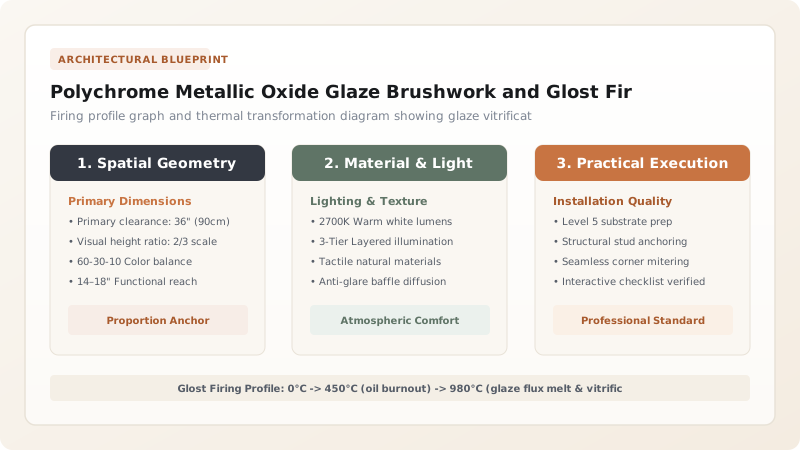
Abundant oxygen must circulate through the kiln to ensure copper remains in its brilliant green Cu2+ state (in a reducing atmosphere, copper turns muddy liver-red) and to ensure total combustion of the organic grease resist binder. The kiln ramps slowly to 450°C for grease burnout, then rises steadily at 100°C/hr to the peak maturation soak at 980°C for 45 minutes, followed by slow cooling to anneal the glass and prevent cooling cracks.
Traditional Andalusian Metallic Oxide Glaze Formulations
Use this reference table to calculate exact physical dimensions, ratios, and specifications before purchasing:
| Color Name | Chromophore Mineral | Concentration (wt %) | Flux Base Composition | Optical Fired Appearance |
|---|---|---|---|---|
| Verde Cobre (Emerald) | Copper Carbonate (CuCO3) | 2.5% - 3.5% | High-lead silicate + silica | Vibrant translucent green; high glass gloss |
| Azul Cobalto (Sapphire) | Cobalt Oxide (CoO) | 0.5% - 1.0% | Alkali-lead borosilicate | Intense deep royal blue; completely lightfast |
| Melado (Honey Amber) | Antimony Oxide + Iron Oxide | 4.0% Sb2O3 + 1.0% Fe2O3 | Lead silicate | Warm golden-amber; high optical refractive depth |
| Blanco Opaco (Milk White) | Tin Dioxide (SnO2) | 8.0% - 10.0% | Lead silicate | Milky opaque white; velvety eggshell luster |
| Manganeso (Boundary) | Manganese Dioxide (MnO2) | 60% in oil base | Zero glaze flux | Dry, matte chocolate-black barrier line |
Health & Precision Constraints
Every successful decoration project must account for physical and environmental constraints:
Lead Toxicity Regulations
Historic lead glazes cannot be used for food vessels; architectural tiles must comply with workplace air-monitoring standards.
Kiln Temperature Uniformity
A temperature differential of just 20°C across the kiln car causes noticeable color shifts in antimony amber glazes.
Master Glazer Protocol for Pooling Glaze and Glost Firing
Execute this professional sequence to achieve flawless results without backtracking:
Glaze Slurry Formulation
Weigh powdered lead-silicate frit, bentonite clay (1%), and metallic oxides; wet-grind in ball mill for 4 hours to achieve sub-micron suspension.
Hydrometer Viscosity Calibration
Measure glaze slip specific gravity with Baumé hydrometer; adjust with clean water to 1.65 g/cm³ for optimal pooling viscosity.
Sequential Glaze Pooling
Pool white glazes first, followed by amber, green, and blue; ensure each compartment fills flush with top of manganese line.
Tile Kiln Stacking
Place dry glazed tiles on refractory cordierite shelves supported by three-point ceramic stilts to prevent foot adhesion.
Grease Burnout Ramp (450°C)
Ramp kiln slowly at 60°C/hr to 450°C with dampers wide open; hold 90 minutes to vent all organic oil fumes.
Vitrification Soak & Annealing
Advance kiln to 980°C; soak 45 minutes to achieve flawless mirror glass leveling; shut dampers and anneal slowly for 24 hours.
Common Mistakes & Countermeasures
Avoid these costly errors that compromise aesthetics, ergonomics, and budget:
Flipping kiln atmosphere into reduction (starving kiln of oxygen) during firing
Applying glazes too thinly with a sweeping dry brush
Project Execution Checklist
Track your physical progress. Checkboxes persist automatically on this device:
Frequently Asked Questions
Why did historical Andalusian potters use lead in their glazes?
Lead oxide (litharge) is the most powerful ceramic flux known in historical technology. It melts at a remarkably low temperature (under 900°C), dissolves high percentages of metallic colorants cleanly, has low surface tension that flows mirror-smooth, and imparts an extraordinarily high refractive index that gives colors deep, diamond-like brilliance.
How do you prevent glazes from crazing (crackling) after firing?
Crazing occurs when the thermal expansion coefficient (COE) of the glaze is higher than the clay biscuit, causing the glaze to contract faster during cooling and crack. Potters prevent this by adding finely ground silica (flint) to the glaze or blending calcium carbonate (chalk) into the clay body to increase biscuit expansion.


