
Manganese Oxide and Linseed Grease Resist Lines form the physicochemical barrier that defines the cuerda seca ceramic process. Composed of pyrolusite manganese dioxide (MnO2) ground with cold-pressed linseed oil, animal fat, or vegetable pitch, this dark paste is drawn onto porous earthenware biscuits with goose quills or specialized lining brushes. Acting as a hydrophobic fence, the oily line physically repels water-based ceramic glazes, confining them within strict geometric cells while converting during glost firing into a permanent, matte carbonaceous-manganese line that visually frames each jewel-toned glaze pool.
At a Glance: Key Takeaways
- Pyrolusite Mineral Base: Natural manganese dioxide providing deep brownish-black refractory pigmentation.
- Lipid Vehicle: Cold-pressed linseed oil or clarified tallow imparting hydrophobic surface tension against water glazes.
- Hydrophobic Contact Angle: Engineering water glaze droplet contact angles > 90° to prevent capillary bridging.
- Goose-Quill Calligraphy: Utilizing cut bird quills to deliver uniform 1mm line widths without spreading.
- Thermogravimetric Burnout: Controlled oxidative vaporization of organic lipids between 350°C and 500°C.
- Mineral Sintering: High-temperature fusion of MnO2 directly into the underlying silicate clay body at 980°C.
1. Petrochemical Formulation: Manganese Meets Lipid Binder
The formulation of the cuerda seca resist line requires precise balance. If the paste is too thick, it drags and creates ragged borders; if too thin, it bleeds into the porous biscuit and fails to establish a tall enough physical dam to hold the glaze.
Master artisans combine 60% finely milled manganese dioxide (pyrolusite) with 40% raw cold-pressed linseed oil or clarified mutton tallow. Manganese dioxide is chosen because it remains refractory at temperatures up to 1,000°C, does not melt into a glossy glass, and imparts an earthy dark brown-to-charcoal black color that provides striking contrast against bright glazes.
2. Interfacial Physics: Why Liquid Glazes Cannot Cross the Line
The operational magic of cuerda seca operates on the fundamental law of interfacial physics: hydrophobic repulsion. Ceramic glaze slips are aqueous suspensions containing water, clay, and finely ground frit with a high surface tension.
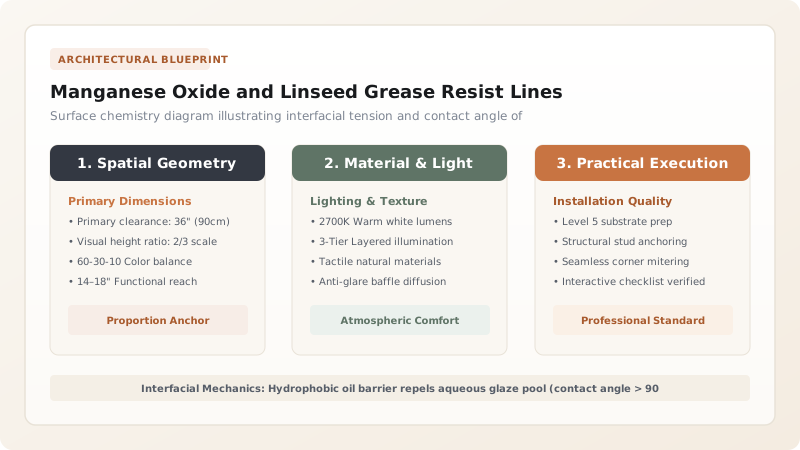
When an aqueous glaze droplet touches the oily manganese line, the contact angle between the water and the lipid molecules exceeds 90°. Rather than wetting the surface and spreading, the glaze is pushed back into the cell by cohesive liquid forces. This allows the ceramicist to load glazes thickly—up to 1.5mm in wet depth—ensuring rich, saturated color after firing without fear of inter-mingling.
3. Thermal Kinetics: The Two-Stage Transformation in the Kiln
During glost firing in a wood or gas kiln, the manganese resist line undergoes a dramatic two-stage chemical transition:
- Organic Pyrolysis (300°C–500°C): The linseed oil or fat oxidizes and burns away, venting out of the kiln flues as carbon dioxide and steam. Because the glazes are still dry powders at this stage, they do not move.
- Solid-State Sintering (900°C–980°C): As the surrounding glazes melt into liquid glass, the manganese particles fuse with the silica and alumina of the terracotta tile, forming a permanent ceramic bond that is flush with or slightly recessed below the glossy glaze pools.
Cuerda Seca Resist Formulation Parameters
Use this reference table to calculate exact physical dimensions, ratios, and specifications before purchasing:
| Formula Component | Material Specification | Weight Ratio (%) | Physical Function | Kiln Behavior |
|---|---|---|---|---|
| Primary Refractory Pigment | Manganese Dioxide (MnO2) 325-mesh | 55% - 65% | Dark black-brown color & refractory skeleton | Solf-state sinters to clay body at 980°C |
| Flux Modifier (Optional) | Red Iron Oxide (Fe2O3) | 5% - 10% | Warms tone to deep chocolate-sepia | Dissolves into perimeter glaze borders |
| Lipid Repellent Vehicle | Raw Cold-Pressed Linseed Oil | 25% - 30% | Hydrophobic barrier against water glazes | Vaporizes completely between 350°C–450°C |
| Viscosity Stabilizer | Venice Turpentine / Pine Resin | 5% - 8% | Imparts brush drag & prevents line spreading | Burns off cleanly leaving zero ash residue |
| Diluent / Thinner | Pure Gum Spirits of Turpentine | As needed | Adjusts flow through quill pen | Evaporates at room temperature within 2 hrs |
Toxicity & Handling Constraints
Every successful decoration project must account for physical and environmental constraints:
Manganese Toxicity
Inhaling dry manganese dioxide dust causes manganism (neurological impairment); powder must be handled strictly under HEPA fume extraction.
Biscuit Moisture Balance
If the terracotta biscuit is too wet, the oil line will not adhere; if bone-dry and dusty, the oil line spreads laterally like ink on blotting paper.
Protocol for Compounding and Applying Manganese Resist Lines
Execute this professional sequence to achieve flawless results without backtracking:
Manganese Pigment Levigation
Grind manganese dioxide in an agate mortar with alcohol; pass through 325-mesh brass sieve to eliminate all coarse particles.
Lipid Vehicle Mulling
Place powder on glass mulling slab; add linseed oil and pine resin; mull vigorously with glass muller for 30 minutes to velvety paste.
Quill Nib Shaping
Cut goose or turkey feather quill at 45° angle with razor; cut 3mm breather slit to regulate ink capillary flow.
Drawing on Porous Bisque
Dip quill into manganese paste; trace charcoal cartoon lines on biscuit in smooth, confident strokes; maintain 1mm line width.
Resist Line Inspection
Inspect lines under magnifying lamp; verify zero breaks or hairline gaps where liquid glazes could breach the cell walls.
Pre-Glaze Ambient Dry
Allow resist lines to air-dry for 12 hours so the resin sets firm to the touch before introducing liquid aqueous glazes.
Common Mistakes & Countermeasures
Avoid these costly errors that compromise aesthetics, ergonomics, and budget:
Using motor oil or mineral oil instead of drying vegetable oils like linseed oil
Drawing resist lines that are too thin (< 0.5mm)
Project Execution Checklist
Track your physical progress. Checkboxes persist automatically on this device:
Frequently Asked Questions
Can wax resist (cera) replace manganese oil resist in traditional cuerda seca?
In modern commercial ceramics, paraffin wax emulsion is often used as a cold resist. However, paraffin wax leaves the boundary line as raw, unglazed, porous terracotta. Authentic historic cuerda seca specifically requires manganese dioxide in the oil, because the manganese fires into a permanent, insoluble dark ceramic line that creates the signature stained-glass graphic style.
Why does the manganese line appear matte while the surrounding colors are glossy?
The glazes surrounding the line contain high percentages of silica and lead flux, which melt into transparent liquid glass at 980°C. The resist line, by contrast, contains refractory manganese dioxide without fluxes; it sinters into a rough crystalline ceramic body rather than a vitreous glass, retaining a distinct non-reflective matte texture.


