
Courtyard Patio Dado Tessellations and Lime Mortar Setting represents the culminating architectural execution of Andalusian tilework. Installed as continuous protective and decorative wainscotings (zócalos) along courtyard patio walls, cuerda seca tiles form complex geometric strapwork (lazo de ocho and lazo de dieciséis) that seamlessly traverse hundreds of individual tiles. Master tile-setters bed each tile in traditional non-hydraulic slaked fat lime mortar mixed with washed river sand and crushed brick dust, ensuring a breathable, flexible substrate that absorbs seasonal wall movements while preventing destructive salt efflorescence.
At a Glance: Key Takeaways
- Lazo Strapwork Tessellation: Islamic geometric interlaces crossing multiple tiles to form unified stars and rosettes.
- Zócalo Wall Proportion: Calibrated to 1.2m–1.8m height, terminating in molded ceramic capping rails (remates).
- Fat Slaked Lime Mortar (Cal en Pasta): Pure calcium hydroxide binder curing by atmospheric carbonation without Portland cement.
- Crushed Terracotta Pozzolan: Fine brick dust (chamota) imparting hydraulic set and moisture breathability to the mortar bed.
- Hairline Jointing (< 1.5mm): Setting tiles with minimal gap to maintain continuous visual strapwork lines.
- Damp-Proofing Protection: Protecting soft brick courtyard walls from rising ground damp and courtyard washwater.
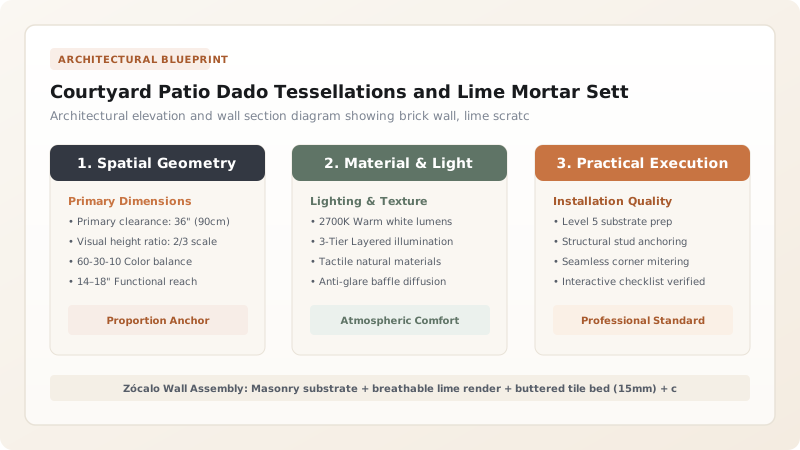
1. Sacred Geometry: Assembling the Infinite Lazo Strapwork
In Islamic art, geometric strapwork (lazo) is not a random decorative flourish; it is a mathematical reflection of cosmic harmony and infinity. In a cuerda seca dado, an eight-pointed star (rueda de ocho) or sixteen-pointed star rarely exists on a single tile.
Instead, the geometry is divided across four, eight, or sixteen adjoining tiles. When installed on the wall, the manganese outline lines of adjacent tiles must align with sub-millimeter precision. If a single tile is tilted by just 1mm, the complex polygonal interlace breaks, destroying the optical illusion of continuous infinite ribbons weaving over and under each other across the courtyard.
2. Masonry Mortars: Why Portland Cement Destroys Historic Tiles
Modern tilers frequently make the catastrophic mistake of setting handmade earthenware tiles with modern Portland cement adhesives. Portland cement cures rigidly with high compressive strength, lacks vapor permeability, and releases soluble alkali salts (potassium and sodium hydroxides).
Traditional Andalusian zócalos are set exclusively in fat slaked lime mortar (cal aérea en pasta). Masons mix aged lime putty with sharp river sand and fine crushed terracotta brick dust (chamota). The crushed brick acts as a natural pozzolan, combining with lime to form flexible calcium silicate hydrates. The mortar breathes freely, allowing ground moisture to evaporate harmlessly without accumulating behind the tiles or pushing them off the wall.
3. The Triad of the Dado: Rodapié, Paño, and Remate
A properly engineered architectural patio dado is composed of three distinct functional tiers:
- Rodapié (Skirting Base): A bottom course of heavy, monochrome terracotta or dark glazed tiles (100mm to 150mm tall) set slightly proud of the wall to withstand ground impact, broom knocks, and standing puddles.
- Paño Central (Main Field): The primary polychrome cuerda seca tessellation field spanning 1.0 to 1.5 meters in height.
- Remate / Moldura (Capping Rail): A projecting molded ceramic molding with an undercut drip groove capping the top of the tiles, preventing rainwater running down the upper stucco wall from entering behind the tile bed.
Andalusian Patio Dado Structural Component Standards
Use this reference table to calculate exact physical dimensions, ratios, and specifications before purchasing:
| Dado Component | Spanish Term | Typical Dimensions (mm) | Glaze / Finish | Functional Role |
|---|---|---|---|---|
| Skirting Base | Rodapié | 140 x 100 x 20 | Monochrome dark cobalt or honey amber | Absorbs broom impact & standing courtyard water |
| Field Tiles | Paño de Azulejos | 140 x 140 x 15 | Polychrome cuerda seca geometric lazo | Primary visual decoration & waterproof wainscot |
| Border Frieze | Cenefa | 140 x 70 x 15 | Running scroll or foliate arabesque | Frames geometric field along top and sides |
| Capping Rail | Remate / Cornisa | 140 x 60 x 35 molded | Molded monochrome green or cobalt glaze | Deflects rain runoff running down upper wall |
| Setting Bed | Mortero de Cal | 15mm - 20mm thick | Fat lime putty + river sand + crushed brick | Flexible, vapor-permeable structural bond |
Substrate & Climatic Constraints
Every successful decoration project must account for physical and environmental constraints:
Rising Ground Damp in Historic Courtyards
Ground moisture carries destructive nitrate salts; walls must have active lime drainage rather than impermeable waterproof coatings.
Handmade Tile Dimension Variations
Hand-pressed tiles vary by +/- 2mm; master setters must modulate hairline joint widths by eye to keep star geometries aligned.
Protocol for Installing an Andalusian Cuerda Seca Patio Dado
Execute this professional sequence to achieve flawless results without backtracking:
Substrate Preparation & Scratch Coat
Rake out brick mortar joints 15mm; wash masonry wall; apply rough scratch coat of hydraulic lime mortar; allow 7 days cure.
Dry Layout & Strapwork Numbering
Lay all tiles out on courtyard floor; align geometric star strapwork across rows; number each tile on rear with pencil.
Tile Pre-Hydration Soaking
Submerge porous earthenware tiles in clean water for 20 minutes; drain until surface-dry to prevent sucking water from mortar bed.
Rodapié Base Curb Alignment
Bed bottom skirting tiles dead level along courtyard floor using stiff lime mortar; establish continuous bottom baseline.
Field Tile Buttering & Beating
Back-butter each tile with 15mm of creamy lime-pozzolan mortar; press onto wall; tap gently with wooden beater block to hairline 1mm joint.
Capping Rail & Lime Grouting
Install molded ceramic remate along top edge; grout all joints with pure slaked lime putty slurry; sponge clean immediately.
Common Mistakes & Countermeasures
Avoid these costly errors that compromise aesthetics, ergonomics, and budget:
Setting dry, unsoaked earthenware tiles directly onto wet lime mortar
Leaving wide (5mm+) grout joints between cuerda seca tiles
Project Execution Checklist
Track your physical progress. Checkboxes persist automatically on this device:
Frequently Asked Questions
How do you clean and maintain historic cuerda seca tiles?
Historic glazed tiles should be cleaned exclusively with clean water and pH-neutral vegetable soap (such as traditional olive oil Castile soap) using soft cotton cloths. Never use modern hydrochloric acid (muriatic acid) or abrasive scouring powders, which etch the delicate lead glass glaze and dissolve the soft lime mortar joints.
What happens if a single tile in an intricate lazo pattern breaks?
Because tiles are bedded in reversible lime mortar, a conservator can carefully drill and chip away the broken tile without vibrating adjacent pieces. A replacement tile can be custom-made, hand-painted with matching cuerda seca glazes, fired, and re-bedded in fresh lime putty with zero damage to the surrounding geometric field.


