
Straw-tempered adobe mud bricks (tibn) for Nubian vaults are lightweight earthen building units engineered for overhead adhesion and crack-free drying. Formulated from sieved clay-rich silt and fermented chopped wheat straw (20% by volume), the mud is molded into thin slabs (240x140x45mm), finger-scored on their faces for mechanical mortar interlock, and sun-cured in desert heat for 14 days.
At a Glance: Key Takeaways
- Thin Slab Profile (45mm thick): Sized thin and lightweight (1.8–2.2 kg) so a single mason can place hundreds of bricks overhead without fatigue.
- Fermented Straw (Tibn) Tempering: Chopped wheat straw (25–50mm length) fermented in wet mud for 48 hours to release binding lignins.
- Finger Score Grooves: Three deep longitudinal channels scored into the wet brick face to lock viscous mortar mechanically.
- Clay-Silt Matrix Balance: 25% to 35% clay binder mixed with 65% to 75% silty sand for high tensile cohesive strength.
- Two-Stage Sun Curing: 3 days flat in drying yards, followed by edge-standing in staggered 'chimney stacks' for 10 days of uniform air drying.
- Zero Kiln Firing Energy: 100% solar cured with near-zero embodied carbon and complete recyclability back into soil.
1. Organic Chemistry: Why Fermented Straw (Tibn) is Essential
Modern builders who attempt to make adobe bricks often simply mix dry straw into wet dirt and cast it immediately. The result is bricks that crack and crumble. The ancient Egyptian master brickmakers followed a biochemical protocol: mud fermentation.
When chopped wheat or barley straw (\(20\%\text{ by volume}\)) is mixed with wet clay mud and allowed to ferment under standing water for 48 to 72 hours, anaerobic bacteria break down cellular plant tissues. This releases tannic acids and organic lignins into the clay slurry:
The organic acids deflocculate the clay platelets, drastically increasing plasticity, reducing drying shrinkage by over \(60\%\), and significantly improving the brick's water resistance upon curing.
2. Gang Molds & The Crucial Finger Scoring Technique
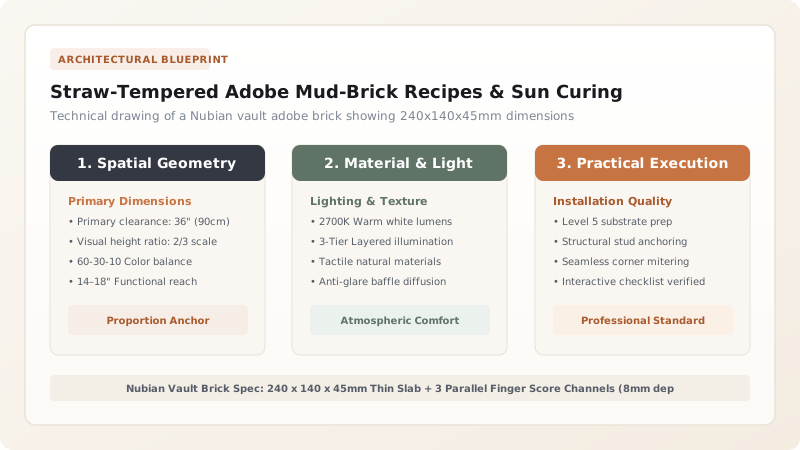
Nubian vault bricks are completely different from standard wall bricks (which are typically 300x150x100mm). Vault bricks are thin slabs: \(240 \times 140 \times 45\text{ mm}\).
Artisans use multi-compartment wooden gang molds dipped in water. Mud is thrown forcefully into the mold to expel air pockets. Before striking off the top with a wet straightedge, the brickmaker drags three fingers down the face of each wet brick, carving three deep longitudinal grooves (\(8\text{ mm}\) deep).
These finger score marks are the secret to overhead adhesion: when the brick is pressed onto the vault arch, the wet clay mortar is forced into the grooves, creating a mechanical dovetail lock that prevents the brick from slipping downward.
3. Sun Curing Cycles: Flat Curing vs. Edge Stacking
Drying adobe bricks under hot desert sun requires careful moisture management to avoid curling and internal stress cracks:
- Days 1 to 3 (Flat Laying): Bricks remain flat on clean sand beds where they were struck from the mold until they stiffen to leather-hard state.
- Days 4 to 14 (Edge 'Chimney' Stacking): Workers turn the bricks onto their long edges, stacking them in open honeycombed triangular columns termed chimney stacks. This allows warm dry breezes to circulate across both faces simultaneously, ensuring balanced moisture loss and zero warping.
Nubian Vault Adobe Brick Formulation & Curing Standards
Use this reference table to calculate exact physical dimensions, ratios, and specifications before purchasing:
| Recipe / Process Parameter | Optimal Egyptian Standard | Testing / Acceptance Criterion | Failure Mode if Neglected |
|---|---|---|---|
| Clay Fraction in Soil | 25% to 35% cohesive clay | Soil forms smooth ribbon > 50mm | Under 20% lacks cohesive bond; over 40% cracks |
| Straw Temper Ratio | 20% to 25% by loose volume | Washed chopped straw 25–40mm | Un-tempered bricks crack in sun within 48h |
| Fermentation Time | 48 to 72 hours submerged | Pungent organic odor, dark slurry | Unfermented mix lacks workability & tensile strength |
| Finished Brick Dimensions | 240 x 140 x 45 mm (± 3mm) | Individual weight 1.8 to 2.1 kg | Heavy bricks (> 2.5 kg) slide off ceiling arches |
| Finger Scoring Depth | Three parallel grooves 8mm deep | Raked along full face length | Smooth bricks lack mortar key and drop |
| Unconfined Compressive Strength | 2.5 to 4.0 MPa (fully cured) | ASTM C67 modified for adobe | Crumbles under arch compressive thrust |
Manufacturing & Weather Constraints
Every successful decoration project must account for physical and environmental constraints:
Sudden Rainstorms
Wet green bricks in the drying yard will dissolve into mud if struck by an unpredicted rainstorm; brickyards must keep plastic tarpaulins on hand to cover drying stacks.
Straw Length Uniformity
Long unchopped straw (> 100mm) will foul the wooden mold compartments and make smooth finger scoring impossible; straw must be pre-chopped on a chaff cutter.
Residual Curing Moisture
Bricks must never be laid in a vault with more than 4% residual moisture; damp bricks lack the capillary suction required for woodless vaulting.
Adobe Mud-Brick Batching & Curing Protocol
Execute this professional sequence to achieve flawless results without backtracking:
Soil Sieving & Pit Digging
Sieve raw silty clay soil through 10mm mesh into a shallow mixing pit, clearing out stones and organic roots.
Straw Addition & Trampling
Add 20% by volume chopped wheat straw (tibn) and water, trampling the mud with bare feet until thoroughly blended.
Fermentation Period
Cover the mud pit with burlap and allow it to ferment for 48 hours to release natural vegetable lignins and tannins.
Gang Mold Casting
Throw handfuls of fermented mud into wet 4-gang wooden molds, packing corners and striking flat with a wooden scraper.
Finger Groove Scoring
Drag three fingers firmly down the face of each wet brick to carve three parallel 8mm-deep mechanical key channels.
Sun Curing & Chimney Stacking
Strip mold immediately; dry flat for 3 days, then stack on edge in open honeycomb stacks for 10 days until dry density exceeds 1,700 kg/m³.
Common Mistakes & Countermeasures
Avoid these costly errors that compromise aesthetics, ergonomics, and budget:
Making vault bricks as thick as wall bricks (75mm to 100mm thick)
Skipping the finger score marks on the brick faces
Using soil with high gravel content (> 5% gravel)
Project Execution Checklist
Track your physical progress. Checkboxes persist automatically on this device:
Frequently Asked Questions
What is 'tibn'?
Tibn is the Arabic term for finely chopped wheat or barley straw produced during traditional threshing. It is the universal fiber reinforcement used across Middle Eastern and North African earth architecture for thousands of years.
Can rice husks or hemp hurds replace wheat straw in adobe bricks?
Yes. Agricultural byproducts like chopped hemp hurds, flax straw, or rice husks work exceptionally well, provided the fibers are chopped to 25–40mm lengths and allowed to ferment in wet mud to release binding tannins.
How do you know when an adobe brick is completely dry and ready for vaulting?
Break a test brick in half with a hammer. If the center core is the same light, uniform color as the outer surface, the brick is fully cured. If the center is dark gray or cool to the touch, residual water remains and more curing is required.


