
Fabricating luxury walk-in humidor linings and cabinetry demands solid 3/4-inch untreated Spanish cedar (Cedrela odorata) tongue-and-groove boards and precision CNC-slotted display shelves. Slotted shelves facilitate 360-degree convection airflow around boxed cigars to prevent moisture stagnation, while stainless steel fasteners and food-safe PVA adhesives preserve pure tobacco flavor.
At a Glance: Key Takeaways
- Untreated Surface Requirement: Raw, unfinished 220-grit sanded Spanish cedar allows natural cellular pores to buffer relative humidity swings.
- Engineered Slotted Shelving: CNC-routed 3/8-inch slots spaced 1.5 inches on-center ensure continuous air movement beneath heavy cigar boxes.
- Quarter-Sawn Grain Stability: Quarter-sawn planks minimize dimensional movement and cross-grain cupping across annual humidity fluctuations.
- Blind Stainless Fastening: Grade 316 stainless steel brads driven through T&G tongues conceal metal fasteners while eliminating rust corrosion.
- Acoustic & Thermal Softness: Low wood density (Janka hardness ~600 lbf) dampens room acoustics and adds supplemental thermal boundary insulation.
1. Cellular Botany: Wood Anatomy & Moisture Sorption Isotherms
Understanding why Spanish Cedar (Cedrela odorata) reigns supreme requires examining its microscopic timber anatomy. Spanish cedar is a ring-porous to diffuse-porous hardwood featuring large, open earlywood vessel pores and thin-walled parenchyma cells.
This open capillary structure gives the wood a remarkable Moisture Sorption Isotherm. At an ambient relative humidity of \(70\%\) and a temperature of \(70^\circ\text{F}\), Spanish cedar reaches an Equilibrium Moisture Content (EMC) of \(13.2\%\):
A typical walk-in humidor lined with 500 board feet of 3/4-inch Spanish cedar holds approximately 45 pounds (5.4 gallons) of pure water vapor absorbed safely inside its cellular walls. If a commercial humidification unit experiences an electrical glitch or compressor trip, this vast botanical sponge releases moisture into the room air, keeping the cigars at safe humidity levels for up to two weeks without power. Explore overall room layout in our walk-in humidor architecture hub.
2. Slotted Shelf Geometry: Eliminating Stagnant Air Boundary Layers
In a humidor containing hundreds of flat-bottomed wooden cigar boxes stacked on shelves, solid un-slotted boards create severe microclimate problems. Air cannot circulate beneath the boxes, trapping stagnant pockets of air where relative humidity can spike above \(78\%\), triggering destructive green fungal mold.
To ensure uniform microclimate distribution, all horizontal shelving tiers must feature CNC-Routed Ventilation Slots:
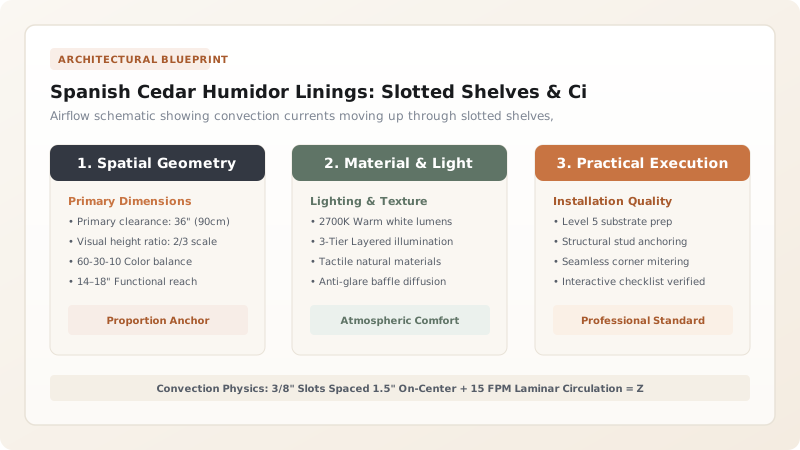
- Slot Dimensions: Width of 3/8 inch (9.5mm), length of 8 to 12 inches, with fully radiused 3/16-inch bullnose edges to prevent scratching delicate varnished cigar boxes.
- Slot Spacing: 1.50 inches on-center, providing an open air area ratio of approximately \(25\%\) across the shelf surface.
- Structural Integrity: By alternating slots with continuous solid wood webs, a 3/4-inch solid Spanish cedar shelf easily supports 80 pounds of heavy cigar boxes without exceeding a deflection limit of \(L/360\).
Learn about humidity delivery systems in our guide to ultrasonic vapor humidification.
3. Grain Selection & Expansion Joinery: Quarter-Sawn vs Flat-Sawn
Spanish cedar exhibits a volumetric shrinkage rate of roughly \(9.0\%\) from green to oven-dry. In a humidor cycling between \(60\%\) and \(72\%\) RH during door entries, flat-sawn planks experience significant tangential movement (\(C_T = 0.0024\)), causing wide boards to cup and buckle against wall studs.
Master cabinetmakers specify Vertical-Grain (Quarter-Sawn) Spanish Cedar. The radial swelling coefficient (\(C_R = 0.0014\)) is roughly half that of flat-sawn lumber. Planks remain dead flat across decades of service.
Cabinet carcasses are assembled using Floating Solid Wood Panels set in mortised stiles and rails with flexible foam space-balls, allowing panels to breathe without splitting frames. Shelf ledgers are slotted to receive stainless steel machine screws through oversized brass washers, permitting smooth cross-grain expansion. Review vapor insulation in our guide on closed-cell vapor envelopes.
4. Surface Prep: Sanding Grits, Grain Popping & Resin Pockets
Because Spanish cedar must never receive chemical stains or film finishes, the final wood preparation determines the sensory experience of the room:
- Rotary Abrasive Sanding: All boards are sanded through progressive grits (80 → 120 → 180 → 220). Never sand finer than 220-grit; ultra-fine abrasives burnish and seal the wood pores, muting natural aroma emission.
- De-Nibbing Grain Raised Fibers: The raw wood is wiped down with distilled water (\"popping the grain\"), allowed to dry for 2 hours, and scuffed lightly with 320-grit non-woven nylon pads to remove raised micro-whiskers.
- Managing Cedar Resin Bleed: Spanish cedar naturally contains internal resin pockets. In warm humidors, resin can occasionally weep to the surface as sticky brown beads. If a resin bead appears, it is crystallized with an aerosol freeze spray and scraped off cleanly with a sharp razor blade, followed by a light rub with pure ethyl alcohol.
Contrast with library cabinetry detailing in our guide to library bookcases and rolling ladders.
Spanish Cedar Humidor Linings: Slotted Shelves & Cigar Aging Architectural Decision Matrix
Use this reference table to calculate exact physical dimensions, ratios, and specifications before purchasing:
| Architectural Factor | Professional Recommendation | Significance |
|---|---|---|
| Lumber Cut | 100% Quarter-sawn (vertical grain) Spanish Cedar | Radial movement coefficient < 0.0015; eliminates cupping and twisting |
| Board Thickness | Nominal 3/4" (19mm) for shelving and wall T&G | Ensures structural load capacity ≥ 80 lbs per 36" span without deflection |
| Shelf Ventilation Ratio | 20% to 25% open slot area | 3/8" wide slots on 1.5" centers; promotes 15 FPM vertical air convection |
| Fastener Metallurgy | Type 316 Marine-Grade Stainless Steel | Immune to acidic cedar extractives (tannins) under continuous 70% RH |
Execution Blueprint & Craftsmanship Sequence
Execute this professional sequence to achieve flawless results without backtracking:
Phase 1: Lumber Acclimatization & Planing
Stack kiln-dried cedar with stickers in conditioned staging area for 7 days; plane to uniform 3/4" thickness (Benchmark: Moisture content verified between 10% and 12% across all boards with pin meter)
Phase 2: Tongue & Groove Profile Milling
Mill 1/4" offset tongue and groove profiles with 1/16" micro-bevel v-grooves on shaper (Benchmark: Sliding fit tolerance; tongue engages groove with smooth finger pressure)
Phase 3: CNC Slotted Shelf Fabrication
Rout 3/8" wide ventilation slots with bullnose roundover bits on 3-axis CNC router (Benchmark: Slot centers accurate ±0.010"; zero chipout or tearout on slot exit shoulders)
Phase 4: Wall Cladding Installation
Blind-nail T&G boards horizontally to wall studs using 316 stainless finish brads (Benchmark: 1/4" perimeter expansion gaps at floor and ceiling; nails 100% concealed in tongues)
Phase 5: Final Sanding & Grain De-Nibbing
Hand-sand all assembled cabinetry with 220-grit paper, vacuum, wipe with deionized water, and de-whisker (Benchmark: Silky smooth touch; zero chemical smells; immediate release of peppery cedar aroma)
Common Mistakes & Countermeasures
Avoid these costly errors that compromise aesthetics, ergonomics, and budget:
Using Zinc-Plated Carbon Steel Nails
Milling Solid Shelves Without Ventilation Slots
Sanding with Ultra-Fine 600-Grit Abrasives
Using Aromatic Red Cedar (Juniperus virginiana)
Project Execution Checklist
Track your physical progress. Checkboxes persist automatically on this device:
Frequently Asked Questions
Can I use Spanish cedar veneer over MDF instead of solid lumber?
While Spanish cedar veneer over moisture-resistant MDF (MR-MDF) can be used for flat cabinet doors, solid lumber is vastly preferred for the room walls and shelves. Solid 3/4-inch lumber provides twenty times the moisture buffering volume of thin 0.6mm veneer, which can delaminate under prolonged 70% RH.
How do you restore the scent of Spanish cedar when it fades after several years?
Over time, dust and surface oxidation can diminish the wood's aroma. Simply scuff the raw wood lightly with clean 220-grit sandpaper or a maroon Scotch-Brite pad, then vacuum away the dust. This exposes fresh unoxidized wood fibers, instantly releasing a burst of rich cedar scent.
Why do slotted shelves have angled tilted display tiers?
Top and eye-level shelves are frequently angled at a 15-degree to 25-degree tilt with a 1-inch solid lip. This displays the ornate lithographic artwork on open cigar boxes toward the viewer while ensuring air continues to sweep across the angled tobacco leaves.


