
Engineering a permanent vapor barrier envelope for a walk-in humidor requires a 6-sided sealed thermal box utilizing 3 inches of 2.0 lb/cu.ft closed-cell spray polyurethane foam (ccSPF). Delivering an R-value of R-21 and a water vapor permeance under 0.8 perms, combined with 6-mil poly retarders and sealed electrical boxes, this assembly prevents outward moisture drive from rotting residential framing.
At a Glance: Key Takeaways
- 2.0 lb/cu.ft Closed-Cell Foam: High-density closed-cell structure acts simultaneously as high R-value insulation (R-7/inch) and Class 1 vapor barrier.
- Six-Sided Sealed Box: Insulation and vapor retarders must encapsulate all four walls, the ceiling, and the concrete or timber subfloor completely.
- Water Vapor Permeance (<0.8 Perms): Eliminates outward moisture diffusion driven by the continuous 0.34 psi vapor pressure gradient.
- Gasketed Air-Sealed Electrical Boxes: Vapor-proof electrical rough-in boxes with silicone cable entry grommets prevent vapor bypass through switches.
- Thermally Broken Glazed Entry Doors: Insulated argon-filled glass units with full perimeter magnetic compression gaskets eliminate glass condensation.
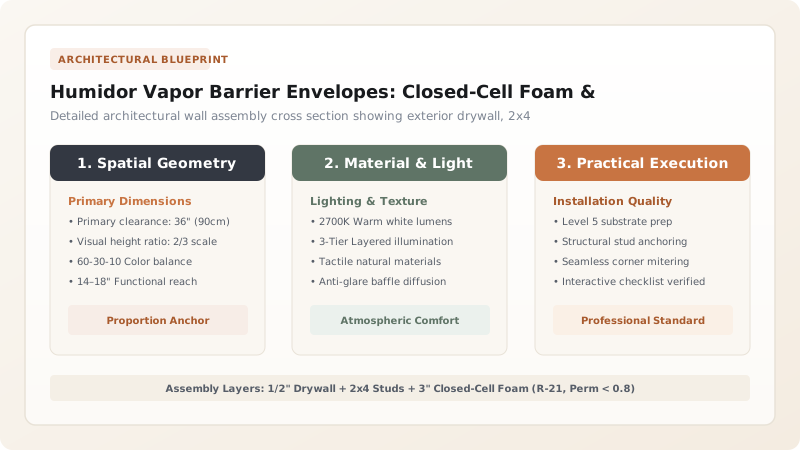
1. Building Physics: Psychrometrics & Outward Water Vapor Drive
Most residential rooms exist in equilibrium with the central HVAC system. In contrast, a walk-in cigar humidor is an artificial microclimate held at \(70^\circ\text{F}\) and \(70\% \text{ RH}\). In winter, when the surrounding house drops to \(68^\circ\text{F}\) and \(25\% \text{ RH}\), the vapor pressure inside the humidor is nearly triple that of the adjacent living space.
Under Fick's Law of Diffusion, water vapor molecules migrate continuously from zones of high vapor pressure to low vapor pressure through building materials:
Where \(W\) is total moisture transmigrated, \(\Delta P_v\) is vapor pressure differential, and \(R_{\text{perm}}\) is vapor flow resistance. Standard residential fiberglass batts and open-cell spray foam have permeance ratings exceeding \(5.0 \text{ to } 50 \text{ perms}\)—they offer virtually zero resistance to water vapor. Moisture penetrates the wall cavity, hits cold exterior sheathing, condenses into liquid water, and causes hidden structural rot within 18 months. Master interior finishes in our guide on Spanish cedar cladding.
2. Material Science: 2.0 lb Closed-Cell Polyurethane Foam (ccSPF)
The only insulation material certified to perform reliably in walk-in humidor envelopes is Medium-Density (2.0 lb/cu.ft) Closed-Cell Spray Polyurethane Foam (ccSPF) (e.g., Demilec Heatlok HFO or BASF WALLTITE).
Closed-cell foam contains over \(90\%\) closed polyhedral cells filled with advanced low-GWP hydrofluoroolefin (HFO) blowing agents:
- Thermal Performance: \(R-6.8 \text{ to } R-7.2 \text{ per inch}\). A 3-inch installation inside a 2x4 stud cavity yields a true \(R-21\) thermal barrier.
- Vapor Retarder Rating: At a thickness of 2.0 inches or greater, ccSPF achieves a certified water vapor permeance of less than \(0.8 \text{ perms}\), meeting the International Building Code definition of a Class II / Class I vapor retarder without needing auxiliary plastic sheeting.
- Structural Rigidity: The dense closed-cell matrix bonds tenaciously to framing studs, increasing wall racking shear strength by up to \(300\%\) and preventing frame deflection.
Learn about active humidity systems in our guide to ultrasonic vapor humidification.
3. Flawless Sealing: Vapor-Proof Rough-Ins & Penetrations
Even the most perfect foam envelope will fail if vapor escapes through electrical switch boxes, recessed lighting fixtures, and plumbing pipe penetrations. In building science, air leaks carry 98 times more moisture into wall cavities than vapor diffusion alone.
All rough-in electrical work inside the humidor must utilize Gasketed Airtight Electrical Boxes (such as Carlon Vapor-Tight boxes). Electrical Romex cables enter through self-sealing elastomeric membranes. Once wiring is pulled, expanding closed-cell aerosol foam (e.g., Great Stuff Pro Gasket) is injected directly into the interior wire entrance collars.
Recessed ceiling lighting must be certified IC-Rated / Air-Tight (ASTM E283) LED housings with sealed silicone lens gaskets, preventing humid room air from escaping into the attic plenum above. Explore our walk-in cigar humidor hub.
4. The Weakest Link: Glazed Entry Doors & Threshold Sealing
In luxury estates, walk-in humidors almost always feature full-lite glass doors so owners and guests can admire the collection from adjacent wine rooms or billiard lounges. However, glass is an extraordinary thermal conductor.
If single-pane glass is installed, the exterior glass surface will chill below the room's dew point (\(T_{\text{dew}} \approx 59.5^\circ\text{F}\) at 70°F/70% RH), causing rivers of condensation to run down the outside glass and pool on the exterior hardwood floor. Glazed humidor portals mandate Double-Pane Low-E Insulated Glass Units (IGUs):
The door frame must incorporate a structural polyamide thermal break (as detailed in our thermally broken steel profiles guide) and continuous silicone compression perimeter bulb seals paired with an automatic bottom drop seal. Contrast with charcuterie curing room requirements in our guide to charcuterie curing rooms.
Humidor Vapor Barrier Envelopes: Closed-Cell Foam & Thermal Isolation Architectural Decision Matrix
Use this reference table to calculate exact physical dimensions, ratios, and specifications before purchasing:
| Architectural Factor | Professional Recommendation | Significance |
|---|---|---|
| Cavity Insulation | 3.0" Medium-Density (2.0 lb) Closed-Cell Polyurethane Foam | R-21 thermal resistance; vapor permeance < 0.8 perms; Class 1 air barrier |
| Sub-Floor Isolation | High-density XPS insulation board + 10-mil poly vapor barrier | Blocks slab moisture vapor emissions up to 15 lbs/1,000 sq ft/24 hr |
| Electrical Rough-In | ASTM E283 certified air-tight gasketed boxes | Air leakage < 0.01 cfm at 75 Pa; prevents moisture channeling into studs |
| Glazed Door Assembly | Thermally broken frame + double-pane argon Low-E glass | Overall door U-factor ≤ 0.28 BTU/(hr·ft²·°F); zero condensation at 70% RH |
Execution Blueprint & Craftsmanship Sequence
Execute this professional sequence to achieve flawless results without backtracking:
Phase 1: Framing & Mechanical Pre-Checks
Frame walls with 2x4 kiln-dried studs; rough in all RO water plumbing and electrical in airtight boxes (Benchmark: Framing square and plumb within 1/8"; all wire penetrations caulked)
Phase 2: Closed-Cell Foam Spray Application
Spray 2.0 lb closed-cell polyurethane foam in two 1.5" lifts across all walls and ceiling (Benchmark: Continuous monolithic foam layer; foam thickness verified with depth probe)
Phase 3: Scraping & 6-Mil Poly Retarder
Scrape proud foam flush to studs, staple 6-mil poly sheet, and tape all seams with acrylic tape (Benchmark: Vapor retarder verified 100% airtight with smoke pen inspection)
Phase 4: Purple Board Drywall Installation
Hang 5/8" mold- and moisture-resistant gypsum board (ASTM C1396) using bugle-head screws (Benchmark: Screws driven flush without tearing paper; joints taped with fiberglass mesh and setting-type mud)
Phase 5: Door Frame & Blower Door Testing
Install thermally broken entry door with dual compression gaskets and perform mini-door depressurization test (Benchmark: Air leakage under 0.05 cfm/ft² at 50 Pa pressure differential)
Common Mistakes & Countermeasures
Avoid these costly errors that compromise aesthetics, ergonomics, and budget:
Using Open-Cell (0.5 lb) Spray Foam
Leaving Uninsulated Gaps Around Recessed Lights
Installing Single-Pane Glass Display Doors
Forgetting to Insulate the Concrete Subfloor
Project Execution Checklist
Track your physical progress. Checkboxes persist automatically on this device:
Frequently Asked Questions
Can I convert an existing residential closet into a walk-in humidor without tearing down drywall?
No. Standard residential closet drywall and fiberglass batts provide zero vapor resistance. If you humidify an unsealed closet to 70% RH, the moisture will migrate into surrounding bedroom walls, causing toxic black mold within 6 to 12 months. The existing drywall must be stripped to studs and rebuilt with closed-cell foam and vapor barriers.
What type of drywall should be installed over the closed-cell foam?
Always install 5/8-inch Type X Mold- and Moisture-Resistant Gypsum Board (commonly called 'Purple Board' or 'Green Board', conforming to ASTM C1396). Standard drywall paper face provides food for fungal growth; mold-resistant boards incorporate antimicrobial additives throughout the gypsum core.
Does closed-cell spray foam off-gas chemicals that will ruin cigar flavor?
Modern fourth-generation closed-cell foams formulated with hydrofluoroolefin (HFO) blowing agents cure to an inert plastic within 24 to 48 hours. After spraying, the room should be ventilated with an exhaust fan for 72 hours. Once the 5/8" purple board and Spanish cedar cladding are installed, there is zero chemical off-gassing into the humidor.


