
Architectural library wall bookcases with rolling ladders combine floor-to-ceiling custom millwork with heavy-duty 1-inch solid brass or steel round track rails. Structural integrity requires continuous 2x6 solid wood blocking behind the upper bookcase fascia to absorb outward climber pullout forces, stopped blind hardwood dados to support shelf spans up to 36 inches under heavy art book loads (L/240 deflection), and weight-activated auto-braking ladder castors.
At a Glance: Key Takeaways
- Continuous 1-Inch Track Rails: Extruded solid architectural brass round rails supported by heavy-duty standoff brackets spaced maximum 32 inches on-center.
- Structural Fascia Stud Blocking: Continuous 2x6 timber backing bolted to wall framing resists the 300+ lb outward horizontal moment exerted by a climbing person.
- Heavy-Book Shelf Deflection (L/240): 3/4" or 1" solid hardwood shelving reinforced with solid wood edge lips supports 50 lbs/sq ft without unsightly sagging.
- Weight-Actuated Braking Wheels: Lower ladder castors compress internal coil springs under climber weight, locking rubber brake pads against the floor.
- Precision Curved Corner Transitions: 90-degree curved brass track sections allow rolling ladders to glide seamlessly across adjacent perpendicular book walls.
In-Depth Guides in this Directory
Explore specialized subtopic blueprints, technical dimensions, and execution checklists:
Rolling Ladder Tracks: Solid Brass Standoff Brackets & Splices
Engineer rolling ladder rails: 1-inch extruded brass round rails, heavy-duty standoff brackets, structural stud blocking, and corner curved radius transitions.
Library Shelf Structural Spans: Deflection Limits & Solid Hardwood Dados
Prevent sagging shelves under heavy art book loads: Sagulator calculations, solid hardwood lipping, stopped blind dados, and vertical carcass divide spacing.
Library Ladder Hardware: Auto-Braking Wheels & Quiet Roller Guides
Explore safety rolling ladder trucks: weight-activated auto-locking rubber castors, Delrin ball-bearing top rollers, quiet glide brackets, and hardwood ladder rungs.
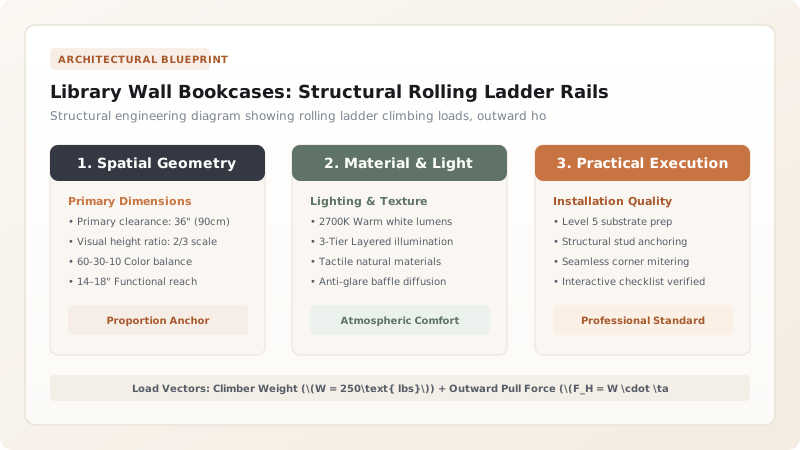
1. Structural Kinematics: Outward Pullout Moments on Ladder Tracks
A rolling library ladder is not simply a vertical shelf accessory; it is a dynamic climbing structure. When a 220-pound person climbs to the top rung of a 10-foot ladder angled at the standard \(12^\circ \text{ to } 15^\circ\) Climbing Angle (\(\theta\)), the ladder acts as an inclined lever arm.
Under this geometry, the climber's downward gravitational dead load (\(W\)) resolves into two distinct structural force vectors:
At \(\theta = 15^\circ\), a 250-pound climber (including books) exerts a continuous outward horizontal pull force (\(F_{\text{horizontal}}\)) of approximately 67 pounds attempting to rip the upper brass track outward away from the bookcase fascia. If the climber leans back or steps dynamically, peak outward shock loads easily exceed 250 to 300 lbf.
Fastening track standoff brackets solely into 3/4-inch decorative veneer plywood will cause catastrophic bracket tear-out and dangerous falls. The bookcase carcass must be backed by Continuous 2x6 Kiln-Dried Solid Timber Structural Blocking tied directly into wall framing studs with 3/8-inch Grade 5 structural lag screws. Learn more in our dedicated deep dive on solid brass ladder track brackets and standoffs.

2. Shelf Span Mechanics: Deflection Limits & The Sagulator Standard
The primary aesthetic and structural hallmark of fine custom library millwork is Dead-Flat, Un-Sagged Shelves. Art books, encyclopedias, and legal volumes represent an immense concentrated load, averaging 40 to 50 pounds per linear foot.
Under architectural millwork standards (AWI Section 10), acceptable shelf deflection is strictly limited to:
Standard 3/4-inch plywood or MDF shelves spanning 36 inches under full book loading will sag more than 0.35 inches—instantly recognizable to the eye and causing books to pinch and jam. To eliminate sagging across spans up to 36 inches:
- Solid Hardwood Carcass Dividers: Vertical divides must be spaced no wider than 32 to 36 inches apart.
- Solid Hardwood Nosings: A 1-1/2\" tall × 3/4\" thick solid hardwood lip glued to the front edge increases the shelf's structural moment of inertia (\(I_x\)) by over \(350\%\).
- Stopped Blind Dados: Shelves are housed in precision 3/8-inch deep blind dados routed into vertical stiles rather than resting on flimsy adjustable metal pins.
Master the exact deflection math in our guide on shelf span deflection limits and structural dados.
3. Rolling Ladder Trucks: Weight-Activated Braking Mechanics
A rolling ladder must slide with effortless fingertip smoothness when unoccupied, yet become rock-solid and immobile the instant a person places their foot on the bottom rung.
This is accomplished using Weight-Actuated Auto-Braking Bottom Roller Trucks (such as systems by Putnam Rolling Ladder or Hafele). Internal tempered steel coil springs inside each wheel assembly keep the soft rubber wheels engaged with the floor while the ladder is unloaded. The ladder glides silently across hardwood or stone flooring on precision sealed ball bearings.
The moment a climber steps onto any rung, their weight compresses the internal springs, lowering the bottom ladder legs 1/4 inch until High-Friction Neoprene Rubber Brake Pads press firmly against the floor. This completely immobilizes the ladder, preventing lateral sliding or runaway rollaways while climbing. Explore wheel hardware in our guide to rolling ladder braking castors.
4. Classical Millwork: Fluted Pilasters & Integrated LED Channels
Monumental library walls gain architectural presence through classical proportioning: heavy base plinths, fluted vertical pilasters, and substantial dentil-carved crown cornices.
Vertical pilasters serve an important concealed technical purpose: they provide hollow architectural chase cavities to route Concealed 24V Class 2 LED Wiring. Micro-channel aluminum extrusions with 45-degree frosted diffusers are routed into the underside of every shelf tier, casting warm \(2,700\text{K}\) (CRI 95+) continuous museum light across book spines without visible glare. Compare with vitrine lighting in our guide to museum-grade art vitrines.
Library Wall Bookcases: Structural Rolling Ladder Rails & Millwork Architectural Decision Matrix
Use this reference table to calculate exact physical dimensions, ratios, and specifications before purchasing:
| Architectural Factor | Professional Recommendation | Significance |
|---|---|---|
| Ladder Track Rail | 1.0" OD Solid Extruded Architectural Brass (C385) | Wall thickness 0.125" or solid bar; resists 300 lb point deflection < 0.05" |
| Upper Structural Blocking | Continuous 2x6 kiln-dried timber bolted to wall studs | Absorbs outward tensile pullout loads ≥ 1,500 lbs |
| Shelf Deflection Standard | AWI Custom Grade: Maximum L/240 deflection | Maintains shelf sag < 1/8" over 36" span under 50 plf book load |
| Lower Ladder Wheels | Weight-activated spring-loaded auto-locking rubber castors | Deploys non-skid neoprene brakes at >30 lbs vertical load |
Execution Blueprint & Craftsmanship Sequence
Execute this professional sequence to achieve flawless results without backtracking:
Phase 1: Wall Framing & Continuous Stud Blocking
Install horizontal 2x6 timber blocking flush with wall studs at target ladder rail elevation (Benchmark: Blocking secured with 3/8" GRK structural screws; verified plumb within 1/16")
Phase 2: Bookcase Carcass Erection
Erect floor-to-ceiling cabinet carcasses, anchor through backing into structural wall blocking (Benchmark: Cabinets plumb across all axes; face frames joined flush with zero lipage)
Phase 3: Solid Hardwood Shelf Dadoing
Rout 3/8" deep stopped blind dados in vertical stiles; glue shelves with solid nosing lips (Benchmark: Joints clamp tight with zero gap; shelf spans verified level across 10-foot run)
Phase 4: Brass Track Rail Alignment & Mounting
Drill pilot holes through fascia into 2x6 blocking; bolt brass standoff brackets with 3" lags (Benchmark: Track rail level verified with laser level; rail splices pinned and polished flush)
Phase 5: Ladder Fitting & Brake Tuning
Mount ladder upper roller guide brackets and tune lower spring-loaded brake castors (Benchmark: Ladder glides with <3 lbs push force; locks instantly when 40 lbs weight applied to first rung)
Common Mistakes & Countermeasures
Avoid these costly errors that compromise aesthetics, ergonomics, and budget:
Screwing Ladder Brackets Solely into Veneer Plywood Fascia
Using Unreinforced 3/4" Shelves on 36-Inch Spans
Installing Hard Plastic Wheels on Finished Wood Floors
Omitting Track End Stops
Project Execution Checklist
Track your physical progress. Checkboxes persist automatically on this device:
Frequently Asked Questions
Can a rolling ladder navigate a 90-degree corner between perpendicular bookcases?
Yes. Specialized rolling ladder systems feature continuous curved track sections (typically with a 12-inch to 18-inch radius) and dual-swivel top roller guides. This allows the ladder to roll smoothly around inside corners from one bookcase wall directly to another without dismounting.
What is the maximum safe height for a residential rolling library ladder?
Standard residential rolling ladders safely reach heights of 10 to 14 feet. For monumental two-story home libraries with 16- to 24-foot ceilings, architects incorporate an intermediate cantilevered reading mezzanine or structural gallery walkway, utilizing two separate rolling ladders for each level.
How do you store a rolling ladder when not in use so it doesn't take up floor space?
Most premium ladder hardware kits feature a 'Dual-Position' or 'Stow-Away' top slide bracket. By lifting the ladder slightly and pushing it toward the bookcase, the ladder pivots from its 15-degree climbing angle into a completely vertical position, resting flush against the bookcase face.


