
Preventing shelf sagging under heavy book loads (40–50 lbs/linear foot) requires limiting clear spans to 32–36 inches and engineering shelves with high moments of inertia. Using 3/4" or 1" Baltic birch plywood cores faced with 1-1/2" tall solid hardwood front nosing lips and housed in 3/8" stopped blind dados limits deflection under the AWI Custom Grade threshold of L/240 (under 1/8" sag).
At a Glance: Key Takeaways
- The Sagulator Deflection Limit: AWI standards mandate maximum deflection under full load of L/240 (0.125" max over a 30" span).
- Solid Hardwood Front Nosing: Gluing a 1-1/2" vertical solid wood face lip boosts shelf stiffness and moment of inertia by over 350%.
- Stopped Blind Dado Housing: 3/8-inch deep dados routed into vertical gable uprights provide continuous mechanical shear support.
- Span Optimization: Limiting unsupported horizontal shelf spans to 32 to 36 inches eliminates visible shelf creep over decades.
- Core Material Superiority: Multi-ply void-free Baltic birch plywood (13-ply for 3/4") outperforms standard particleboard or MDF in flexural modulus.
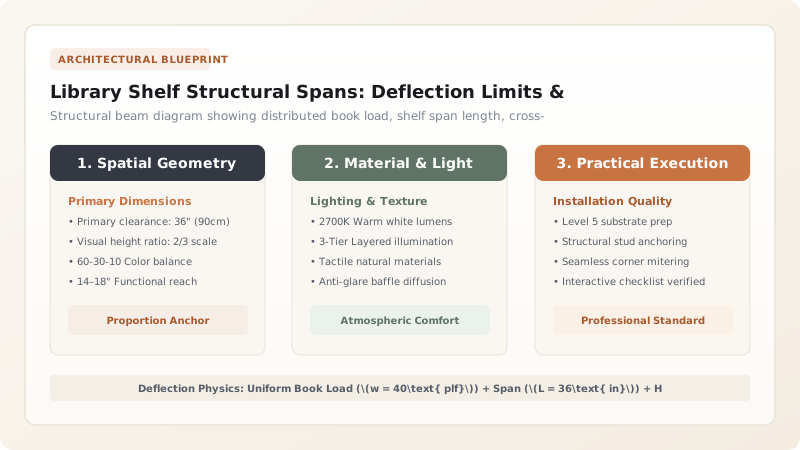
1. Beam Deflection Physics: The Sagulator Formula & Book Loads
When books are placed on a horizontal shelf, they exert a uniform distributed load (\(w\)). Standard hardbound novels weigh approximately 20 to 25 pounds per linear foot, while oversized art monographs, architectural portfolios, and law books weigh 40 to 50 pounds per linear foot (plf).
Under Euler-Bernoulli beam theory, the maximum mid-span deflection (\(\delta\)) of a simply supported shelf of span \(L\) is governed by:
Notice that deflection increases with the Fourth Power of Span Length (\(L^4\))! Increasing a shelf span from 30 inches to 40 inches increases deflection by \(316\%\) under the exact same load. To keep deflection below the architectural threshold of \(L/240\) (approx. 1/8 inch), cabinetmakers must either decrease the span length (\(L\)) or radically increase the cross-sectional moment of inertia (\(I_x\)) and elastic modulus (\(E\)). Learn about track loading in our guide to ladder track brackets and standoffs.
2. Section Modulus: The Power of Solid Hardwood Nosing Lips
A flat 3/4-inch shelf has a small moment of inertia (\(I_x = b \cdot h^3 / 12\)). For a 10-inch deep shelf, \(I_x \approx 0.35 \text{ in}^4\). Under 40 plf book load across a 36-inch span, standard 3/4-inch plywood will sag nearly 0.30 inches—an unsightly, unprofessional bend.
By gluing and biscuiting a Solid Hardwood Nosing Lip (1-1/2\" tall × 3/4\" thick) along the front edge, the cross-section transforms from a flat rectangle into an engineered \"T-Beam\" or \"L-Beam\". This relocates the neutral axis and increases the effective moment of inertia to:
Under the exact same heavy book load, mid-span deflection drops from 0.30 inches down to under 0.07 inches (under 1/16\"), well within the AWI Custom Grade standard. Check out our library wall bookcases hub.
3. Structural Joinery: Stopped Blind Dados vs Metal Shelf Pins
Drilling rows of 5mm holes for adjustable shelf pins is acceptable for lightweight kitchen pantries, but hazardous for heavy libraries. Heavy book loads exert high shear stresses that wallow out pin holes in MDF or plywood, causing pins to tilt, slip, and dump expensive books onto lower shelves.
Permanent library shelving utilizes Stopped Blind Dado Joinery:
- A 3/8-inch deep dado groove is routed horizontally across the vertical carcass side, stopping 3/4 inch short of the front edge (blind).
- The front corner of the shelf tongue is notched to fit the stopped dado, completely concealing the joint behind a clean vertical face frame line.
- When glued with PVA cross-linking adhesive, the continuous wood-on-wood ledge provides over \(1,200 \text{ psi}\) of vertical shear resistance, locking the carcass stiles into a rigid structural unibody.
Explore ladder hardware in our guide on rolling ladder braking castors.
4. Core Substrate Comparison: Baltic Birch Plywood vs MDF vs Solid Lumber
Selecting the core substrate determines long-term resistance to Viscoelastic Creep (the permanent, irreversible sag that develops in wood fibers under continuous long-term load):
| Core Substrate | Modulus of Elasticity (E) | Screw Holding Face / Edge | Resistance to Long-Term Creep |
|---|---|---|---|
| Baltic Birch Plywood (13-Ply) | 1,650,000 psi | 380 lbf / 310 lbf | Outstanding (Zero sag with nosing) |
| Solid White Oak / Walnut | 1,750,000 psi | 420 lbf / 350 lbf | Superior (Highest natural stiffness) |
| Commercial Veneer-Core Plywood | 1,200,000 psi | 280 lbf / 220 lbf | Moderate (Requires spans ≤ 30\") |
| MDF (Medium Density Fiberboard) | 450,000 psi | 180 lbf / 110 lbf | Poor (Severe permanent creep sag) |
Multi-ply Baltic birch or solid hardwood boards should always be specified for spans exceeding 30 inches. Contrast with vitrine pedestal design in our guide to museum-grade art vitrines.
Library Shelf Structural Spans: Deflection Limits & Solid Hardwood Dados Architectural Decision Matrix
Use this reference table to calculate exact physical dimensions, ratios, and specifications before purchasing:
| Architectural Factor | Professional Recommendation | Significance |
|---|---|---|
| Maximum Shelf Span | 32 to 36 inches between vertical carcass dividers | Prevents deflection exceeding L/240 under 45 plf book load |
| Shelf Nosing Profile | 1.50" tall solid hardwood lip glued to front edge | Boosts moment of inertia by >350%; conceals LED wiring groove |
| Joinery Method | 3/8" Stopped blind dados glued with Type II PVA | Shear capacity > 1,200 lbs per shelf; eliminates adjustable pin tear-out |
| Core Material | 3/4" 13-Ply Baltic Birch Plywood or Solid Hardwood | Elastic modulus E ≥ 1.65 × 10⁶ psi; zero long-term viscoelastic creep |
Execution Blueprint & Craftsmanship Sequence
Execute this professional sequence to achieve flawless results without backtracking:
Phase 1: Carcass Upright Dado Routing
Rout 3/8" deep × 3/4" wide stopped dados in vertical uprights using plunge router and edge guide (Benchmark: Dados stop exactly 3/4" short of front edge; depths verified ±0.005" with depth micrometer)
Phase 2: Shelf Core Sizing & Tongue Notching
Cut Baltic birch shelf cores to width; notch front corners to match stopped blind dados (Benchmark: Dry-fit confirms square seating against back of dado with zero front seam visibility)
Phase 3: Solid Hardwood Nosing Milling
Mill 1.5" tall solid hardwood nosing lips with bottom 45° chamfer and LED channel rebate (Benchmark: Nosing thickness matches shelf core perfectly; glued with biscuit joinery)
Phase 4: Clamping & Carcass Assembly
Apply PVA glue to dados, slide shelves into place, clamp with parallel jaw bar clamps at 50 psi (Benchmark: Cabinet carcass squareness verified across diagonals within 1/32"; glue squeeze-out wiped)
Phase 5: Proof Load Testing
Place 150 lbs of cast iron weights on 36" shelf for 24 hours; measure mid-span deflection with dial indicator (Benchmark: Total deflection under load < 0.08"; zero residual sag after weights removed)
Common Mistakes & Countermeasures
Avoid these costly errors that compromise aesthetics, ergonomics, and budget:
Spanning MDF Shelves Greater Than 30 Inches Without Support
Using Standard 5mm Spoon Pins for Heavy Art Books
Gluing Only with Pocket Screws from Underside
Ignoring LED Channel Depth in Nosing
Project Execution Checklist
Track your physical progress. Checkboxes persist automatically on this device:
Frequently Asked Questions
Can I make library shelves adjustable while maintaining heavy load capacity?
Yes. Instead of 5mm pins, use heavy-duty flush-mortised solid brass saw-tooth shelf standards (pilaster strips) recessed flush into the vertical carcass sides, paired with heavy-gauge brass shelf brackets that lock mechanically into the teeth, supporting 200+ lbs per shelf.
What is the maximum recommended depth for a residential library shelf?
Standard book shelves should be 10 to 12 inches deep for standard trade novels and biographies. Oversized lower shelf cabinets (for art monographs, atlases, and architectural folios) are typically 14 to 18 inches deep, often housed in a deeper projecting base plinth cabinet.
Does solid hardwood warp more than plywood when used for library shelves?
Wide solid wood boards can cup slightly across their width with seasonal humidity swings. For maximum stability across 12-inch deep shelves, master woodworkers use multi-ply Baltic birch faced with architectural veneers, bordered by solid hardwood nosing lips, giving the best of both worlds.


