
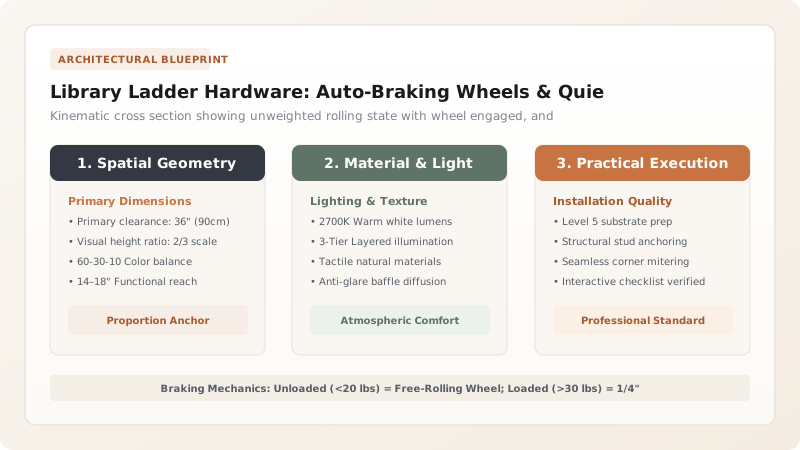
Safety in rolling library ladders is governed by weight-activated auto-braking bottom wheel trucks and precision top roller guides. Internal tempered steel coil springs inside the lower wheel housings allow effortless silent gliding when unloaded, but compress 1/4-inch under 30+ pounds of climber weight, locking high-friction neoprene rubber brake shoes against the floor to eliminate slip.
At a Glance: Key Takeaways
- Weight-Actuated Auto-Braking: Internal springs compress under foot pressure, dropping solid rubber brake pads to immobilize the ladder during climbing.
- Quiet-Glide Top Rollers: Precision Delrin or polyurethane wheels with sealed ABEC-5 ball bearings eliminate metal-on-metal screeching on brass tracks.
- Floor Protection Treads: Soft 75-durometer non-marking polyurethane or natural rubber wheel treads prevent scratching polished hardwood and stone.
- Dual-Position Stow Brackets: Upper roller slide mechanism pivots ladder into a vertical flush position against the bookcase when not in use.
- Anti-Derailment Safety Flanges: Top roller housings wrap securely around the track rail, preventing ladder lift-off during dynamic movement.
1. Failsafe Safety: Spring Kinetics & Auto-Locking Friction Pads
In classical libraries, a rolling ladder that lacks automatic braking is an extreme liability. A person reaching for an encyclopedia on the tenth rung can inadvertently kick the ladder sideways or cause it to roll away if weight shifts, resulting in severe falls.
Modern architectural hardware incorporates Weight-Actuated Auto-Braking Bottom Roller Trucks. Each bottom wheel fork houses an engineered Tempered Chrome-Vanadium Die Spring:
- Unoccupied State (Weight < 20 lbs): The spring force holds the ladder legs elevated 1/4 inch above the floor. The ladder rolls across the room with a light push force of under 3 pounds.
- Climbing State (Weight > 30 lbs): The moment a climber's foot touches the bottom rung, downward force overcomes spring resistance. The wheel carriage telescopes upward into the brass housing, lowering the ladder foot until a High-Friction Neoprene Rubber Brake Shoe presses firmly against the floor.
The normal force of the climber's weight (\(F_N = m \cdot g\)) drives the rubber pad into the floor surface, generating immense static friction (\(F_f = \mu_s \cdot F_N\)) that completely locks the ladder in place. Learn about track mounting in our guide to ladder track brackets and standoffs.
2. Quiet-Glide Top Rollers: Delrin Bearings vs Metal Wheels
Historic library ladders utilized solid cast iron or brass wheels rolling directly on bare steel rails. The resulting metal-on-metal contact produced an unpleasant grating shriek that shattered the serene, quiet ambiance of a luxury library.
Contemporary luxury systems utilize Quiet-Glide Composite Rollers. The roller wheel is machined from solid Delrin (Polyoxymethylene / POM) or cast polyurethane with a 90-durometer hardness, running on dual ABEC-5 Stainless Steel Precision Ball Bearings lubricated with synthetic low-viscosity grease.
Delrin provides low surface friction (\(\mu \approx 0.15\)) and high dimensional stability without flat-spotting under stationary loads. The roller glides across the solid brass round track with an imperceptible whisper (operating sound levels under \(28 \text{ dBA}\)), preserving library tranquility. Review bookcase design in our library wall bookcases hub.
3. Floor Preservation: Non-Marking Polyurethane vs Hard Casters
Hard nylon or metal wheels can wreak havoc on finished hardwood, limestone, or marble flooring, grinding abrasive grit into wood fibers and carving permanent circular ruts in front of bookcases.
Ladder trucks feature Non-Marking Thermoplastic Polyurethane (TPU) or Natural Gum Rubber Treads with a Shore A hardness of 70 to 80. The compliant rubber tread deflects micro-fractions under rolling contact, absorbing floor irregularities and distributing pressure over a larger contact patch (\(A_{\text{contact}} \propto F_N^{2/3}\)).
The tread formulation is guaranteed non-marking, leaving zero black scuffs on white oak, parquet, or polished travertine floors. Explore shelf joinery in our guide on shelf span deflection limits.
4. Space Optimization: The Stow-Away Dual-Position Top Bracket
In standard climbing mode, a 10-foot ladder angled at \(15^\circ\) projects outward into the room by approximately 28 to 32 inches from the bookcase face. In private reading rooms or narrow corridors, leaving the ladder permanently projected creates an annoying obstruction.
Architects specify Dual-Position Swivel Slide Brackets. When climbing is finished, the user lifts the ladder slightly and pushes it gently toward the bookcase. The upper bracket slides along a secondary internal pivot slot, rotating the ladder into a completely vertical Stow-Away Position resting just 4 inches off the bookcase face. Magnetic catches or friction detents hold the ladder safely upright until needed. Contrast with vitrine mechanisms in our guide to museum-grade art vitrines.
Library Ladder Hardware: Auto-Braking Wheels & Quiet Roller Guides Architectural Decision Matrix
Use this reference table to calculate exact physical dimensions, ratios, and specifications before purchasing:
| Architectural Factor | Professional Recommendation | Significance |
|---|---|---|
| Braking Mechanism | Internal weight-activated spring-loaded brake shoe | Locks ladder at >30 lbs vertical load; static friction μs ≥ 0.70 |
| Top Roller Material | Machined Delrin (POM) with dual ABEC-5 stainless bearings | Operating noise < 28 dBA; zero metal-on-metal screeching |
| Bottom Wheel Tread | 75-Durometer non-marking polyurethane or gum rubber | Zero floor gouging or black scuffing on high-gloss hardwood |
| Stowage Capability | Dual-position pivoting bracket (15° climb / 90° stow) | Reduces floor projection from 30" to 4" when stored |
Execution Blueprint & Craftsmanship Sequence
Execute this professional sequence to achieve flawless results without backtracking:
Phase 1: Hardwood Ladder Stringer Preparation
Mortise lower ends of solid walnut/oak stringers to receive cast brass wheel truck chassis (Benchmark: Mortise depth within ±0.010"; holes bored for 1/4" through-bolts)
Phase 2: Spring-Loaded Wheel Assembly Mounting
Install internal compression springs, wheel axles, and neoprene brake pads into brass chassis (Benchmark: Wheel spins freely on bearings; spring compresses smoothly under hand force)
Phase 3: Top Roller Truck Installation
Bolt dual-position Delrin roller guide brackets to top of ladder stringers with stainless bolts (Benchmark: Brackets torqued with nylon-insert lock nuts; pivot mechanism operates without play)
Phase 4: Track Engagement & Alignment
Hook top roller guides over 1" brass track rail and set bottom wheels on finished floor (Benchmark: Ladder rests at exactly 14-degree climbing angle; wheels track parallel to track rail)
Phase 5: Auto-Brake Functional Proof Testing
Push ladder laterally across floor, then step on first rung and re-test lateral resistance (Benchmark: Ladder glides with 2 lbs push empty; becomes 100% immobile under 50 lbs foot load)
Common Mistakes & Countermeasures
Avoid these costly errors that compromise aesthetics, ergonomics, and budget:
Using Solid Metal Wheels Directly on Wood Floors
Omitting Auto-Braking Wheels on Tall Ladders (> 9 Feet)
Over-Tightening Pivot Bolts on Stow Brackets
Using Metal-on-Metal Top Roller Hooks Without Bearings
Project Execution Checklist
Track your physical progress. Checkboxes persist automatically on this device:
Frequently Asked Questions
Can rolling library ladders be used on thick wool carpeting or area rugs?
Rolling ladders operate best on smooth hardwood, stone, or tile floors. If an area rug is present, specify larger 4-inch diameter wheels with wider rubber treads, or ensure the rug perimeter is held at least 36 inches clear of the bookcase face so the ladder wheels roll on bare wood.
How do you adjust the sensitivity of the auto-braking spring mechanism?
High-end ladder wheel trucks feature an adjustable threaded internal spring collar. By tightening or loosening the internal set screw with an Allen key, you can increase or decrease spring preload, dialing in the exact weight (typically 25 to 35 lbs) required to engage the brake pads.
Are rolling library ladders compatible with baseboard radiators?
Yes. If baseboard heaters or deep architectural plinths project from the bottom of the bookcase, specify a custom extended top roller bracket offset (e.g., 2.5" to 3.0" fascia standoff) to hold the ladder rungs clear of the baseboard projection.


