
Incorporate live-edge timber into Wabi-Sabi interiors by stabilizing natural checking cracks with hand-carved solid hardwood butterfly keys (Dutchmen) oriented with the grain perpendicular to the split. Strip loose outer bark with a drawknife while preserving the natural cambium layer, and finish with matte hardwax oil.
At a Glance: Key Takeaways
- Butterfly Keys (Dutchmen): 5-degree tapered dovetail wedges lock radial wood cracks mechanically.
- Perpendicular Grain Orientation: Key grain MUST run perpendicular to the crack to provide maximum tensile holding power.
- Cambium Layer Preservation: Removing loose bark while sanding the underlying fibrous cambium creates a velvety tactile edge.
- Hardwax Oil Finish (Osmo / Rubio Monocoat): Penetrates wood pores without forming an artificial plastic film.
- George Nakashima Heritage: Pioneered the modern appreciation of natural wood splits, pith defects, and live contours.
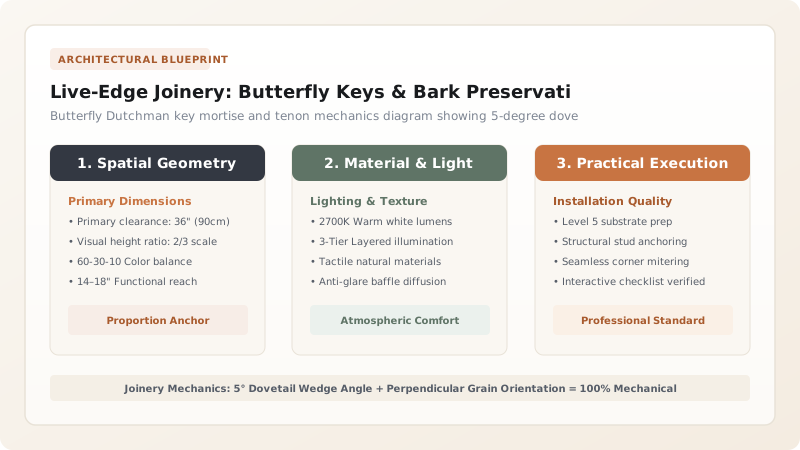
1. Wood Science: Tangential Shrinkage & Radial Checking Cracks
As massive solid wood tree slabs dry from fresh green lumber (\(80\%\text{ moisture}\)) down to interior equilibrium (\(8\%\text{ moisture}\)), wood shrinks twice as fast along its tangential growth rings as it does radially from the center heartwood.
This differential tension inevitably creates deep radial drying splits (checks). While commercial factories discard checked slabs as 'defective', Wabi-Sabi woodworkers embrace these fissures. Inserting solid walnut or brass butterfly keys arrests the crack, transforming a natural structural tension point into a breathtaking focal point of human craftsmanship.

Butterfly Key Dimensions vs Crack Width
Use this reference table to calculate exact physical dimensions, ratios, and specifications before purchasing:
| Slab Crack Width | Butterfly Key Length & Width | Key Depth (% of Slab) | Optimal Wood Species Pairing |
|---|---|---|---|
| Hairline Check (< 1/8" Wide) | 2.5" Length × 1.0" Width | 1/2 Slab Thickness (1.0") | Walnut key into White Oak slab |
| Medium Split (1/4" - 1/2" Wide) | 4.0" Length × 1.75" Width | 2/3 Slab Thickness (1.5") | Wenge / Ebony key into Maple slab |
| Major Structural Gap (> 1" Wide) | 6.0" Length × 2.5" Width | Full-Thickness Through-Key | Solid Cast Brass key into Walnut |
| Epoxy Pour Only (No Keys) | N/A | Surface fill only | FAILS: Cracks continue to expand |
Bark Falling Off Over Time Constraints
Every successful decoration project must account for physical and environmental constraints:
Leaving Dead Tree Bark Intact on Table Edges Eventually Crumbling Off
Tree bark dries and separates from the wood after 2 years, leaving ugly voids; always strip the outer bark with a drawknife down to the solid, living inner cambium wood layer, and sand silky smooth to 240-grit.
How to Layout and Inset a Butterfly Key
Execute this professional sequence to achieve flawless results without backtracking:
Cut Butterfly Key on Band Saw
Cut key from dense hardwood with grain running lengthwise; taper waist inward at 5°.
Trace Key Across Split with Marking Knife
Hold key firmly across the split (grain perpendicular) and score outline with a razor marking knife.
Rout Mortise Cavity to 3/4" Depth
Use a plunge router with 1/8" straight bit to clear the waste wood within 1/16" of the scored line.
Chisel Corners Razor Sharp
Pare exactly to the knife lines using sharp bench chisels, checking mortise depth with a depth gauge.
Drive Key with Glue and Hand-Plane Flush
Apply wood glue, tap key home with a mallet, let dry 24 hours, and hand-plane flush to slab surface.
Common Mistakes & Countermeasures
Avoid these costly errors that compromise aesthetics, ergonomics, and budget:
Cutting Butterfly Keys with Grain Running Parallel to the Crack
Project Execution Checklist
Track your physical progress. Checkboxes persist automatically on this device:
Frequently Asked Questions
What finish best preserves the natural look of raw live-edge wood?
Matte natural hardwax oils (such as Osmo Polyx-Oil 3041 Natural or Rubio Monocoat 2C Pure) are the finest finishes. They chemically bond with raw wood fibers, repelling water and stains while preserving 100% of the raw, tactile wood feel.


