
Build a climate-controlled glass wine cellar under a staircase by creating an airtight thermal envelope: insulate all wall and ceiling cavities with 3.5 inches of closed-cell spray foam (R-19) wrapped in a 6-mil poly vapor barrier on the warm exterior side. Install a dedicated 1/4 HP split refrigeration system set to 55°F and 60% RH.
At a Glance: Key Takeaways
- 55°F (13°C) & 60% RH Golden Standard: Preserves fine wine corks, prevents oxidation, and stops label mold growth.
- Continuous 6-Mil Poly Vapor Barrier: Must be installed on the warm exterior side of studs to prevent interior condensation rot.
- R-19 Closed-Cell Spray Foam Insulation: Acts as both high-performance thermal insulation and an impermeable moisture barrier.
- Double-Glazed Low-E Argon-Filled Glass: Thermally broken glass enclosure prevents exterior sweating in air-conditioned homes.
- Whisper-Quiet Ducted Split Cooling: Remote condensing unit placed in garage or mechanical room eliminates interior compressor hum.
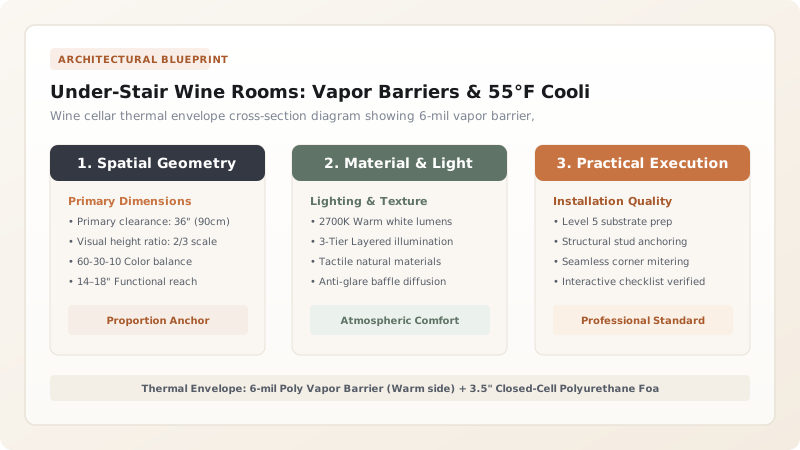
1. Building Thermodynamics: Dew Point & Vapor Barrier Physics
Maintaining a wine room at \(55^{\circ}\text{F} (13^{\circ}\text{C})\) with 60% Relative Humidity inside a home kept at \(72^{\circ}\text{F}\) creates a permanent vapor pressure drive: moisture in the warm house air constantly migrates toward the cold wine room.
If the wall envelope lacks an airtight vapor barrier, warm humidity condenses inside the wall studs at the Dew Point (\(58^{\circ}\text{F}\)), fostering toxic black mold and rotting wood framing within months. The entire under-stair cavity must be sealed with 3.5 inches of Closed-Cell Spray Foam (R-19). Combine with angled storage drawers.

2. Frameless Glass Thermal Break Engineering
Using single-pane 10mm glass for a refrigerated wine room is a severe mistake: the cold glass will constantly weep condensation water onto the surrounding living room floor.
Enclosures must be glazed with Double-Glazed Insulated Glass Units (1/2" IGU: 5mm Low-E + 12mm Argon + 5mm Clear) mounted in thermally broken aluminum or steel frames with magnetic compression gaskets. For ambient accent lighting, explore cove lighting details.
Wine Cellar Insulation & Cooling Specifications
Use this reference table to calculate exact physical dimensions, ratios, and specifications before purchasing:
| Component | Minimum Standard Spec | Thermal / Performance Role | Failure Consequence if Omitted |
|---|---|---|---|
| Cavity Insulation | 3.5" Closed-Cell Spray Foam (R-19) | Zero thermal leakage & vapor seal | Cooling unit runs continuously & burns out |
| Vapor Barrier | 6-Mil Polyethylene (Taped seams) | Blocks moisture migration from warm house | Mold growth inside wall cavity |
| Glass Enclosure | 1/2" Double-Glazed Argon Low-E IGU | Prevents exterior surface condensation | Water puddles on hardwood floor daily |
| Cooling System | Ducted Split System (Wine Guardian / CellarPro) | Maintains 55°F / 60% RH silently | Through-wall ACs rattle and heat house |
Condensate Drain Overflow Constraints
Every successful decoration project must account for physical and environmental constraints:
Refrigeration Condensate Drain Clogging and Leaking Under Stairs
Wine cooling units extract gallons of atmospheric humidity weekly; running drain lines without gravity slope causes overflow into walls; plumb a 3/4" dedicated PVC condensate drain line tied directly into household plumbing or install an automatic condensate removal pump with high-water alarm.
How to Build a Climate-Controlled Under-Stair Wine Room
Execute this professional sequence to achieve flawless results without backtracking:
Frame Enclosure with 2x4 Wood Studs
Frame walls under stair stringer; line exterior with 6-mil poly vapor barrier, taping all seams.
Spray 3.5" Closed-Cell Polyurethane Foam
Fill all stud cavities, underside of stair treads, and floor with closed-cell foam to achieve R-19.
Hang Mold-Resistant Greenboard Drywall
Install moisture-resistant gypsum board (Greenboard) and finish with zero-VOC mildew-proof paint.
Rough-In Refrigeration Lines & 3/4" Drain
Run insulated copper refrigerant lines and 3/4" PVC condensate drain to remote condenser.
Install Double-Glazed Thermal Glass Doors
Set double-glazed Low-E glass panels with full perimeter silicone bulb gaskets and magnetic latches.
Commission 55°F / 60% RH Cooling System
Charge system, calibrate digital thermostat to 55°F, and verify zero condensation on exterior glass.
Common Mistakes & Countermeasures
Avoid these costly errors that compromise aesthetics, ergonomics, and budget:
Placing the Vapor Barrier on the Inside (Cold Side) of the Wine Room
Project Execution Checklist
Track your physical progress. Checkboxes persist automatically on this device:
Frequently Asked Questions
What lighting is safe for wine cellars?
Always use 2700K Low-Voltage LED Lighting. Never use incandescent or halogen bulbs, which emit high heat and harmful ultraviolet (UV) radiation that degrades wine tannins and damages vintages.


