
River-Boulder Rubblestone and Fat Lime Grouting are the foundational technologies of Transylvanian defensive masonry. Constructing multi-meter-thick curtain walls using smooth, unworked river cobbles required an exceptionally tenaciously bonded binder. Master builders utilized hot-mixed quicklime slaked directly with damp river aggregates, producing an energetic, highly alkaline lime mortar that expanded into microscopic fissures. Conservation involves low-pressure consolidation using hydraulic lime-pozzolan grouts to re-solidify internal cavities.
At a Glance: Key Takeaways
- Unworked Alluvial Cobbles: Smooth, river-tumbled quartzite, gneiss, and limestone boulders (150mm–400mm diameter).
- Hot-Mixed Lime Technology: Slaking quicklime (CaO) in situ with moist aggregate, generating 100°C steam and superior adhesion.
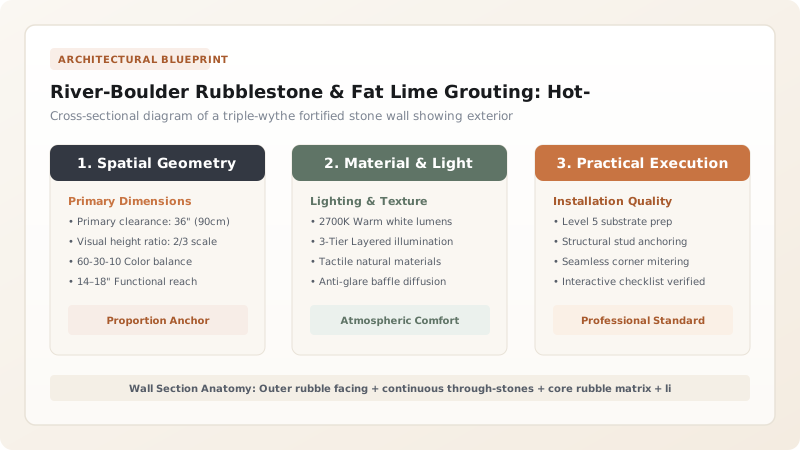
- Triple-Wythe Wall Anatomy: Two outer dressed stone wythes enclosing a massive rubble-and-lime core.
- Internal Void Consolidation: Gravity-fed and low-pressure injection of breathable lime-pozzolan grouts.
- Zero-Cement Compatibility: Avoiding rigid Portland cement that shatters brittle river-boulder contact interfaces.
1. Lithological Dynamics of River-Boulder Masonry
Unlike quarry stone that has sharp, fractured faces with high mechanical friction, river boulders (alluvial cobbles) have smooth, water-rounded surfaces. Building a load-bearing wall from rounded boulders presents severe structural instability: under compressive stress, round stones act like ball bearings, exerting outward lateral bursting thrust.
Saxon masons solved this through two techniques:
- Through-Stone Lacing (Boutisses): Every 1.0m to 1.5m of elevation, long flat quarry stones or split timber lacing beams were laid completely across the wall thickness to tie the outer wythes together.
- Deep Matrix Encapsulation: Boulders were not laid dry; each stone was completely submerged in a thick bed of energetic hot lime mortar that formed a cast-in-place conglomerate matrix.
2. The Chemistry of Hot-Mixed Lime Mortars
Historic Transylvanian mortar was prepared using the traditional hot-mix method. Freshly burned quicklime lumps (\(\text{CaO}\)) were buried in a pile of damp, well-graded river sand containing coarse pebbles (0mm to 8mm). As water was added, the slaking reaction occurred within the sand pile:
The mix boiled violently, reaching temperatures between 100°C and 120°C. The steam pressure pulverized the lime into sub-micron colloidal particles, coating every aggregate grain in a sticky, high-suction lime paste. Placed while still warm, the mortar expanded slightly into the irregularities of the river boulders, creating an unbreakable mechanical and chemical bond.
3. Pathology of Internal Voids & Low-Pressure Grouting
Over centuries, seismic tremors and roof leaks leach out soluble lime, creating massive hollow caverns inside the 2-meter-thick rubble wall core. The wall can buckle outward suddenly under its own dead weight.
Conservation requires gravity-fed or low-pressure lime grouting:
- Grout Formulation: Natural hydraulic lime (NHL 2 or NHL 3.5) blended with micronized pozzolan (pulverized brick dust / metakaolin) and limestone filler, creating a zero-shrink, non-staining slurry.
- Water Pre-Wetting: The internal core is flushed with deionized water to prevent dry rubble from sucking water out of the grout prematurely.
- Controlled Injection: The grout is pumped through transparent plastic tubes at pressures below 1.0 bar (15 psi), filling voids from the bottom upward until clean grout overflows from inspection ports above.
Transylvanian Rubble Mortar & Grout Formulations
Use this reference table to calculate exact physical dimensions, ratios, and specifications before purchasing:
| Mortar Application | Binder Type | Aggregate Ratio & Grading | Compressive Strength (28d) | Flowability (Cone Flow) |
|---|---|---|---|---|
| Hot-Mix Bedding Mortar | Quicklime lumps (CaO) CL90 | 1:3 Coarse river aggregate (0–8mm) | 2.5 - 3.5 MPa | Thiff plastic workability |
| Core Consolidation Grout | NHL 2 + 15% Metakaolin | Fine limestone powder (0–0.2mm) | 3.0 - 4.5 MPa | High Flow (> 300mm spread) |
| Exterior Joint Pointing | NHL 3.5 Natural Lime | 1:2.5 Sharp washed sand (0–3mm) | 3.5 - 5.0 MPa | Stiff struck joint tooling |
| Structural Through-Stitch | NHL 5 + Basalt Rebar | Micro-silica fine grout | 8.0 - 12.0 MPa | Poured core anchor |
Structural & Material Constraints
Every successful decoration project must account for physical and environmental constraints:
Enormous Core Void Volume
A 50-meter section of 2m-thick wall can consume over 15 tonnes of dry lime grout to fill internal cavities.
Winter Frost Freeze
Grouting must cease 30 days before winter frosts to allow lime and pozzolan to achieve carbonation and hydraulic set.
Protocol for Deep Void Grouting in a Fortified Curtain Wall
Execute this professional sequence to achieve flawless results without backtracking:
Endoscopic Void Inspection
Drill 20mm probe holes; insert optical borescopes to inspect internal cavity dimensions and core delamination.
Joint Sealing & Port Installation
Point exterior wall joints with temporary clay or lime putty; set 25mm PVC injection ports at 800mm vertical and horizontal centers.
System Flushing & Saturation
Pump clean potable water into top ports until water flows clear from bottom ports, washing out pulverized dust and pre-wetting stones.
Colloidal Lime Grout Batching
Mix NHL 2 lime, pozzolan, and water in a high-shear colloidal mixer for 5 minutes to fully disperse fine particles.
Low-Pressure Bottom-Up Injection
Connect grout pump to lowest port; inject at < 0.8 bar until grout appears at neighboring port; cap and advance upward.
Port Striking & Breathable Repointing
After 48 hours of initial set, remove injection ports; point holes with matching NHL 3.5 lime mortar and sponge finish.
Common Mistakes & Countermeasures
Avoid these costly errors that compromise aesthetics, ergonomics, and budget:
Pumping grout at high pressures (> 2.5 bar) into ancient rubble walls
Using Portland cement-based grouts inside river-boulder walls
Project Execution Checklist
Track your physical progress. Checkboxes persist automatically on this device:
Frequently Asked Questions
How did medieval builders get smooth river boulders to stay in place before the mortar dried?
Masons used split slate and small sandstone 'pinning stones' (chinking stones) wedged tightly between large round boulders, mechanically locking the stones in place before hot mortar was poured into the joints.
Why is hot-mixed lime superior to modern pre-hydrated bagged lime?
Hot-mixed lime retains energetic warmth and micro-steam during placement, creating a finer microscopic crystal structure with higher initial stickiness (suction) and superior vapor permeability compared to factory-slaked powdered lime.


