
Natural slate can be fixed via center-holing or head-holing. Center-holing—where two nail holes are punched 25mm to 30mm from the sides just above the center line (Gauge + Lap + 10mm from tail)—is mechanically superior for wind resistance, reducing the wind suction lever arm by 50% compared to head-holing. All slates must be secured with high-purity solid copper clout nails with a minimum 3.35mm shank diameter driven flush into punch spalls.
At a Glance: Key Takeaways
- Center-Holing Advantage: Halves the aerodynamic lever arm (\(M = F \cdot L/2\)), preventing wind suction from levering nails out of timber battens.
- Head-Holing Economy: Holes punched 25mm below the head are covered by two layers of slate, used primarily on sheltered steep roofs (>45° pitch).
- Punch Spall Dynamics: Punching from underside creates a conical spall on the top face that cradles the flat clout nail head flush.
- Solid Copper Metallurgy: Minimum 99.9% pure deoxidized copper (Cu-DHP) clout nails resistant to salt air, sulfur dioxide, and timber tannic acids.
- Withdrawal Load Capacity: 3.35mm jagged or barbed copper nails provide pull-out resistance >0.85 kN per fastener in softwood battens.
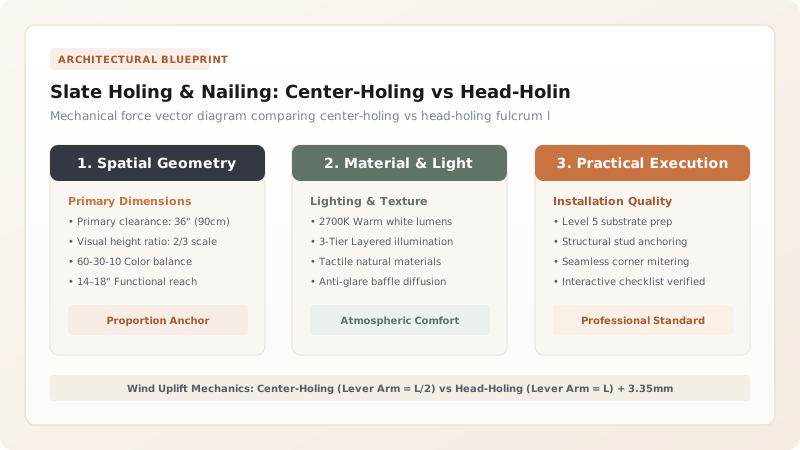
1. Aerodynamic Physics: Overturning Moments & Lever Arm Analysis
When high-velocity wind blows across a pitched roof, negative pressure (suction) develops over the leeward slope and along ridges, reaching peak forces exceeding \(-2.8\,\text{kPa}\). This suction attempts to lift the exposed tail of each slate, pivoting the stone around its batten fulcrum.
The mechanical difference between center-holing and head-holing is governed by simple statics:
- Head-Holing Overturning Moment: With nail holes placed 25mm from the top of the slate, the distance from the pivot fulcrum to the exposed tail is the full slate length \(L\). The resulting overturning moment is:
- Center-Holing Overturning Moment: Holes are punched just above the middle of the slate (at a distance equal to \(\text{Gauge} + \text{Lap} + 10\text{ mm}\) from the tail). The nail sits directly above the lower batten, reducing the effective lever arm by roughly \(50\%\):
Consequently, building codes (BS 5534) mandate center-holing for all exposed coastal locations, buildings over two stories, and roof pitches below 45 degrees.
2. Hole Punching Mechanics: Rotary Punches vs Slater's Pick Spalls
Slate has a natural geological cleavage plane along which it splits cleanly. Drilling slate with high-speed masonry drills generates heat and creates a cylindrical straight hole that cannot seat a nail head flush. Slaters always Punch slate holes:
- Bed-to-Back Punching Direction: The slate is laid flat on a steel dressing anvil (zax). The slater strikes the underside (bed) with the pointed beak of a slater's axe or operates a mechanical foot-treadle rotary punch.
- Conical Spall Formation: As the steel punch exits the top face (back), it pops out a small cone of stone, creating a countersunk crater (spall) measuring \(10\text{ mm} \text{ to } 12\text{ mm}\) in diameter.
- Flush Nail Seating: The flat head of the copper nail seats completely flush inside this spall. If the nail head protruded above the slate face, the heavy stone laid in the next course would ride up on the metal head, concentrating point loads that snap the overlapping slate under snow load.
3. Fastener Metallurgy: Solid Copper Clouts vs Corrodible Substitutes
Because Welsh slate lasts over 100 years, the entire roof assembly is limited by the service life of its fasteners. Using zinc-plated steel or aluminum nails is catastrophic malpractice:
- Galvanized Steel Failure: Acid rain and damp condensation inside the roof batten space corrode zinc coatings in 10 to 15 years. The steel core rusts, expands (nail rot), cracks the slate hole, and shears off, allowing whole sheets of slate to slide off the roof.
- Solid Copper Clout Nails: Slaters specify Grade Cu-DHP Cold-Drawn Solid Copper Clouts. Copper forms a passive cuprite coating that is chemically inert in the presence of oak and pine wood acids.
- Shank Geometry: Fasteners must have a minimum shank diameter of \(3.35\text{ mm}\) (10 gauge) with jagged or ring-shank barbs, ensuring a timber batten withdrawal resistance exceeding \(0.85\text{ kN}\). Nail length must equal slate thickness \(\times 2 + 25\text{ mm}\) of batten embedment (typically \(38\text{ mm} \text{ to } 50\text{ mm}\)). Explore hip detailing in our guide to mitered hips and lead soakers.
Slate Fastener & Holing Specification Matrix
Use this reference table to calculate exact physical dimensions, ratios, and specifications before purchasing:
| Fastener / Holing Type | Pull-Out / Shear Strength | Corrosion Resistance | Recommended Application |
|---|---|---|---|
| Center-Holed Copper Clouts (3.35mm) | Maximum (1.8 kN/pair) | 120+ Years (Impervious) | Standard for all pitches & exposures |
| Head-Holed Copper Clouts (3.35mm) | Moderate (0.9 kN/pair) | 120+ Years (Impervious) | Sheltered roofs >45° pitch only |
| Austenitic Stainless Steel (316) | Exceptional (2.2 kN/pair) | 150+ Years (Impervious) | Severe coastal marine (<1km to sea) |
| Galvanized Carbon Steel Nails | High initial / Rapid decay | 10 - 20 Years (Severe failure) | Strictly prohibited by building codes |
| Silicon Bronze Ring-Shank Nails | Maximum (2.0 kN/pair) | 120+ Years (Impervious) | Monumental heavy slate installations |
Fastening & Tooling Constraints
Every successful decoration project must account for physical and environmental constraints:
Punching Distance from Edge
Punching nail holes closer than 25mm (1.0 inch) to the side edge of a slate causes the corner to shear off along natural cleavage lines. Maintain 25mm to 35mm side margin.
Batten Splitting from Heavy Shanks
Driving 3.35mm copper nails into dry softwood battens without staggered nailing can split the timber batten along its grain. Always stagger nail locations 10mm off center.
Copper Nail Bending on Hardwood Rafters
Copper is malleable; driving nails into dense oak sarking without pre-drilling pilot holes bends nail shanks. Use silicon bronze ring-shank nails when fixing into seasoned oak.
Precision Slate Holing & Fixing Sequence
Execute this professional sequence to achieve flawless results without backtracking:
Holing Position Calculation
Calculate center-holing distance from slate tail: Distance = Batten Gauge + Required Head-Lap + 10mm clearance. Mark a template slate with sharp awl.
Mechanical Punch Calibration
Adjust rotary or lever punch depth stop so holes land exactly 30mm from side edges and at calculated center-holing line.
Bed-to-Back Punching
Feed slates bed-side up. Punch dual holes cleanly, inspecting the back face to verify a uniform 10mm countersunk spall has popped out.
Batten Placement & Nail Alignment
Position slate over timber batten. Verify holes align over the top half of the 50mm batten width, leaving 15mm of solid wood above the nail.
First Copper Nail Driving
Drive 3.35mm copper clout nail into first hole until head rests flush inside the spall. Tap lightly with cross-peen slater's hammer.
Second Nail Driving & Level Check
Drive second nail, verifying slate does not pivot or pinch. Run hand over nail heads to ensure 100% flush seating before laying adjacent slate.
Common Mistakes & Countermeasures
Avoid these costly errors that compromise aesthetics, ergonomics, and budget:
Punching from Back to Bed
Single-Nailing Slates
Pinching Slates Tight Against Battens
Project Execution Checklist
Track your physical progress. Checkboxes persist automatically on this device:
Frequently Asked Questions
Can slate hooks be used instead of copper nails?
Yes. In France and parts of continental Europe, stainless steel or copper slate hooks (crochets) are widely used. Hooks provide rapid installation and allow broken slates to be replaced easily. However, traditional British and American practice favors copper nails because nailed slates sit flatter against the roof and create tighter capillary breaks.
How do you replace a broken center-holed slate in the middle of a roof?
A slater inserts a specialized tool called a 'ripper' (a long thin steel blade with hooked notches) up under the courses to hook and cut the two copper nails. A replacement slate is prepared, and a malleable copper 'tingle' (a narrow copper strap nailed to the batten below) is slid up to cradle the tail of the new slate.
What nail size is required for heavy 8mm Welsh slates?
Standard 5.5mm slates require 38mm x 3.35mm copper clout nails. Heavy 8mm to 10mm slates used on eaves courses require 45mm to 50mm x 3.75mm heavy copper nails to achieve adequate timber batten penetration.


