
Revzen-i Menkuş (literally 'embroidered lattice windows') is the traditional Ottoman method of constructing stained glass windows without lead cames. Master glassmakers arrange hand-blown colored crown glass pieces (göztepe) onto a flat casting cartoon bed. High-strength alabaster gypsum plaster reinforced with animal hair or hemp fibers is poured around the glass edges. As the plaster sets, it creates a rigid, lightweight, and thermally insulating stone lattice that filters jewel-toned light into mosque clerestories.
At a Glance: Key Takeaways
- Fiber Reinforcement: Combed goat hair or unspun hemp fiber strands
- Glass Typology: Hand-blown colored crown glass (Revzen camı / Göztepe roundels)
- Lattice Material: Structural high-density alabaster gypsum (Alçı)
- Lattice Profile: Triangular beveled ribs for maximum light refraction
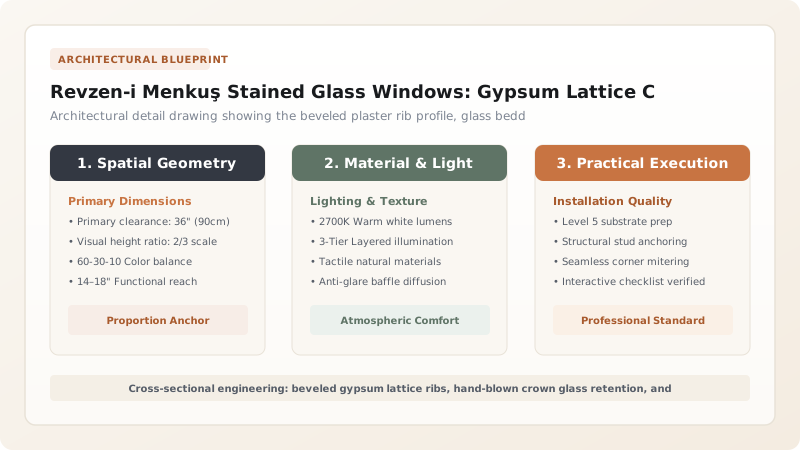
Architectural Optics and the Geometry of Revzen-i Menkuş
In Ottoman mosque design, windows were engineered as architectural illuminators rather than mere wall apertures. Revzen-i Menkuş windows were placed high in the upper clerestory tiers and dome drums, where the glare of direct Mediterranean sunlight had to be diffused into serene, atmospheric interior illumination.
Unlike flat European stained glass which can cast harsh chromatic hotspots, the thick, white gypsum lattice of a Revzen window has chamfered triangular ribs. The white plaster acts as an internal optical reflector, scattering light softly into the sanctuary while the jewel-toned glass creates radiant spiritual rosettes, cypress trees, and celestial urn motifs.
Hand-Blown Crown Glass (Revzen Camı) and Göztepe Roundels
Authentic Ottoman window glass is fundamentally different from modern machine-drawn float glass. Known historically as Revzen camı or göztepe, it was manufactured using the crown glass method. A master glassblower blew a glass sphere, opened the end, and spun the molten bubble on a pontil rod until centrifugal force flattened it into a thin circular disk (up to 1 meter in diameter).
Crown glass features subtle concentric ripples, variable thickness (thinner at edges, thick at the center bullseye), and microscopic air seed bubbles. When sunlight strikes this undulating glass, it refracts the light with an organic, shimmering brilliance that modern perfectly flat glass cannot duplicate.
The Casting Bed: Laying Glass and Pouring Reinforced Gypsum
Constructing a Revzen window is a precision casting operation. The master artist drafts a 1:1 scale cartoon on a flat marble or zinc-topped casting table. Individual pieces of colored crown glass are hand-cut to match the cartoon, with beveled edges to help the plaster grip the glass mechanically.
The glass pieces are positioned face-down on the cartoon with 8mm to 12mm gaps separating them. The master pours freshly mixed high-strength alabaster gypsum reinforced with combed goat hair or hemp fibers into the channels. Before the plaster fully sets, the artisan tools the top of each rib into an inverted V-bevel with curved scraping irons, ensuring maximum light ingress and preventing dust accumulation.
The Dual-Window System: Interior Revzen and Exterior Storm Grille
Ottoman mosques in Istanbul face intense coastal storms with gale-force winds blowing off the Black Sea and Sea of Marmara. Because decorative Revzen plaster windows are delicate, builders developed a dual-window system (çift cam sistemi).
On the interior wall face sits the delicate İç Revzen with intricate floral stained glass. On the exterior face, set 150mm away in the masonry reveal, sits the Dış Revzen (or protective storm window)—a heavy, coarse gypsum grille fitted with thick, round clear bullseye glass (revzen-i harici). The dead-air cavity between the two windows provides outstanding acoustic isolation, thermal insulation, and total protection against wind-driven driving rain.
Ottoman Revzen Window Component & Dimension Specifications
Use this reference table to calculate exact physical dimensions, ratios, and specifications before purchasing:
| Window Component | Material Specification | Thickness | Optical / Structural Function | Maintenance Protocol |
|---|---|---|---|---|
| Decorative Inner Window (İç Revzen) | High-density alabaster gypsum | 25mm – 35mm rib thickness | Colored light filtering & floral imagery | Dry sponge dust cleaning every 5 yrs |
| Protective Outer Window (Dış Revzen) | Coarse hydraulic lime-gypsum | 45mm – 60mm heavy lattice | Wind & rain storm protection barrier | Exterior limewash recoat every 7 yrs |
| Colored Crown Glass Roundels | Pot-metal hand-blown glass | 2.0mm to 4.5mm variable | Chromatic refraction & UV filtration | Deionized water swab cleaning |
| Air Cavity Insulation Gap | Sealed masonry reveal space | 120mm – 180mm depth | Thermal barrier & condensation buffer | Inspect lower weep ports annually |
Practical Constraints
Every successful decoration project must account for physical and environmental constraints:
Vulnerability of Gypsum Lattices to Internal Condensation
If the exterior storm window leaks, trapped water can dissolve the interior gypsum frame; requires open weep holes in the window sill.
Complex Scaffolding in Soaring Mosque Clerestories
Installing large 2-meter Revzen panels at 25-meter heights requires specialized hoisting pulleys and cushioned lifting cradles.
Execution Blueprint & Craftsmanship Sequence
Execute this professional sequence to achieve flawless results without backtracking:
Full-Scale Window Cartoon Drafting
Draft the full-scale Revzen cartoon (kalıp) on heavy card, outlining Cypress trees, floral urns, and calligraphy with 10mm lattice channel spacing.
Colored Crown Glass Hand-Cutting
Cut hand-blown colored crown glass wafers to match pattern segments, grinding outer edges on a diamond lap to form mechanical gripping bevels.
Glass Alignment on Flat Casting Table
Lay the beveled glass pieces face down on the zinc casting table over the cartoon, securing temporary positions with tiny dabs of clay.
Fiber-Reinforced Gypsum Pouring
Mix high-purity alabaster gypsum with combed goat hair; pour into interstitial channels, vibrating the table lightly to release air bubbles.
Lattice Rib Chamfering and Tooling
While the plaster is in its cheese-hard setting state, tool every lattice rib into a sharp triangular chamfer using curved steel scraping knives.
Curing, Demolding, and Masonry Installation
Allow 48 hours for complete chemical crystallization; lift the rigid monolithic panel, bed into stone window jambs with breathable lime mortar.
Common Mistakes & Countermeasures
Avoid these costly errors that compromise aesthetics, ergonomics, and budget:
Using Machine-Made Flat Float Glass Instead of Crown Glass
Casting Gypsum Lattices Without Internal Fiber Reinforcement
Project Execution Checklist
Track your physical progress. Checkboxes persist automatically on this device:
Frequently Asked Questions
What is the meaning of 'Göztepe' in Turkish window glass?
Göztepe refers to the thick central roundel (the bullseye) formed where the glassblower's pontil rod was attached to the spinning crown glass disk. These bullseyes were prized by Ottoman masters for their concentrated color and dramatic light dispersion.
How long do authentic Ottoman plaster stained glass windows last?
When protected behind an exterior storm window and shielded from active water infiltration, authentic gypsum Revzen windows in Istanbul mosques have survived in pristine condition for over 450 years.


