
The chromatic finale of Ottoman Malakari plasterwork is the application of pure 24-karat gold leaf (altın varak) and mineral gouache distemper. Applied over a red bole (kil-i ermeni) size or natural garlic juice mordant, the gold leaf is burnished with smooth agate stones (akik) to a mirror finish. Interstitial fields are infilled with lapis lazuli blues, copper malachite greens, and cinnabar reds ground in gum arabic, creating glowing imperial inscriptions and celestial motifs across soaring dome pendentives.
At a Glance: Key Takeaways
- Burnishing Stone: Polished red Carnelian / Agate stone (Akik burnisher)
- Gilding Gold Purity: 24-Karat Pure Gold Leaf (Altın Varak, 0.1 to 0.2 microns thick)
- Gilding Mordant: Traditional red Armenian bole (Kil-i Ermeni) + Garlic juice / Oil size
- Mineral Pigments: Lapis lazuli, malachite, cinnabar, lampblack carbon
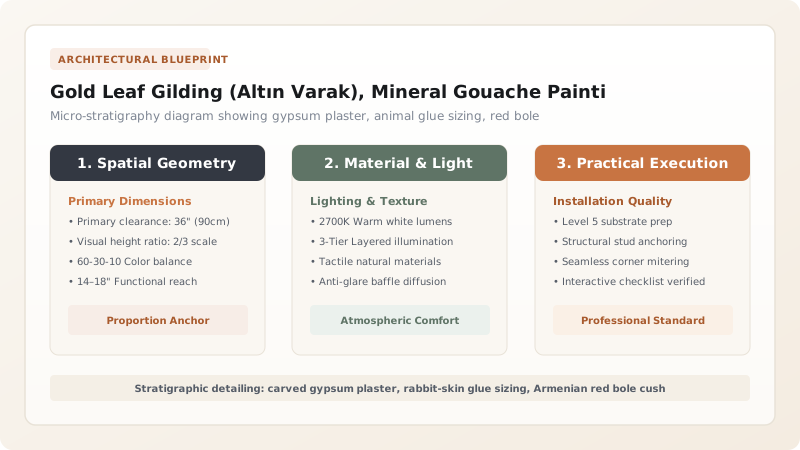
24-Karat Gold Leaf (Altın Varak) and Armenian Bole Sizing
In Ottoman imperial mosques, gold was not a decorative excess; it was an optical device used to capture and reflect light from clerestory windows. Master gilders (varakçılar) used pure 24-karat gold beaten by hand between animal vellum sheets down to a thickness under 0.2 microns.
To achieve the radiant deep warmth characteristic of classical Ottoman gilding, the carved plaster crests are coated with Kil-i Ermeni (Armenian bole)—a fine, colloidal red iron-rich clay. Blended with diluted rabbit-skin glue, the red bole provides a smooth, flexible cushion beneath the micro-thin gold leaf. When burnished with an agate stone, the underlying red imparts a glowing, sunset-warm tonality to the gold.
The Ottoman Chromatic Spectrum: Lapis, Malachite, and Cinnabar
Contrasting against the radiant gold leaf, background fields of the Malakari relief are infilled with intense mineral distemper paints (kalem işi). Master artists prepared their paints fresh on stone slabs, grinding precious mineral ores in purified well water and binding them with high-grade gum arabic (zamk-ı arabi) from Acacia trees.
The royal palette is strictly codified: Lacivert (deep ultramarine blue derived from Afghan lapis lazuli or azurite), Zümrüt Yeşili (emerald green from crushed copper malachite), Kırmızı (rich vermilion from cinnabar), and İs Mürekkebi (velvety black calligraphy ink produced by collecting soot from burning beeswax lamps inside the mosque).
Water Gilding Execution and Agate Stone (Akik) Burnishing
Applying gold leaf to delicate plaster relief requires exceptional dexterity. The gilder charges a flat badger-hair brush (gilding tip) with static electricity by brushing it lightly against facial skin or hair, lifting the gossamer-thin leaf from the gilding cushion.
The red bole surface is wetted with a mixture of water and alcohol (or traditional diluted garlic juice). As the leaf touches the wet bole, surface tension pulls it flat onto the plaster. Once the moisture reaches the exact leather-hard stage, the gilder burnishes the gold with an oval agate stone (akik). The pressure flattens the gold into the bole cushion, turning the matte leaf into a mirror-like sheet of liquid metal.
Conservation of Historic Dome Friezes: Soot Removal and Consolidation
Centuries of burning oil lamps and candles inside Ottoman mosques have covered dome friezes with thick deposits of fatty soot, carbon, and dust. Furthermore, historic roof leaks frequently cause moisture staining and salt crystallization that lifts the gold leaf.
Scientific conservators clean these delicate surfaces using dry chemical sponges (Wishab sponges) and non-ionic surfactant compresses (triammonium citrate buffered at pH 7.0). Detached gold flakes and flaking paint layers are consolidated via micro-injection of 2% Klucel G or Funori seaweed polysaccharide, preserving every fleck of original 16th-century imperial gilding.
Gilding & Pigment Specification for Malakari Conservation
Use this reference table to calculate exact physical dimensions, ratios, and specifications before purchasing:
| Application Element | Raw Material | Binder / Mordant | Application Method | Optical / Aesthetic Quality |
|---|---|---|---|---|
| Burnished Relief Crests | 24-Karat Pure Gold Leaf | Armenian red bole + rabbit glue | Water gilding + Agate burnishing | Mirror-reflective warm golden glow |
| Matte Architectural Inscriptions | 23.75k Transfer Gold Leaf | Oil-based gold size (Mixtion) | Dry surface gilding | Satin-matte legible calligraphic finish |
| Dome Recessed Grounds | Afghan Lapis Lazuli / Azurite | Pure Acacia gum arabic (6%) | Fine pointed sable brush washes | Deep, luminous velvety midnight blue |
| Floral Border Arabesques | Crushed Malachite & Cinnabar | Gum arabic + clove oil | Layered opaque gouache strokes | Brilliant botanical emerald & crimson |
Practical Constraints
Every successful decoration project must account for physical and environmental constraints:
Vibration from Urban Traffic and Earthquakes in Istanbul
Requires continuous micro-consolidation of brittle plaster friezes to prevent shockwaves from dislodging gilded relief fragments.
Drafts and Air Currents During Scaffolding Gilding
Ultra-thin 0.2-micron gold leaf blows away in the slightest breeze; requires fully enclosed temporary poly-sheeting tents on high scaffolding.
Execution Blueprint & Craftsmanship Sequence
Execute this professional sequence to achieve flawless results without backtracking:
Surface Cleaning and Soot Extraction
Clean historic dome plaster friezes using dry vulcanized latex sponges; remove fatty candle soot using triammonium citrate swabs buffered at pH 7.0.
Rabbit-Skin Glue Sizing
Apply a penetrating sizing coat of 5% warm rabbit-skin glue over the carved gypsum relief to seal plaster porosity and ensure uniform suction.
Armenian Red Bole Preparation and Laying
Apply 3 thin coats of red Armenian bole slurry over the raised relief areas, sanding lightly between coats with 600-grit paper to achieve an ultra-smooth bed.
24k Gold Leaf Water Gilding
Wet the bole with diluted alcohol; lift sheets of 24k gold leaf using a badger-hair gilders tip, placing leaf over the wet cushion.
Agate Stone Burnishing (Akik)
Allow bole to firm to leather-hard stiffness; burnish gold vigorously with an oval carnelian or agate stone to develop a mirror-like liquid gold luster.
Mineral Gouache Infill and Calligraphy
Paint background fields with mineral lapis and malachite gouache bound in gum arabic, detailing calligraphic borders with fine carbon-soot black.
Common Mistakes & Countermeasures
Avoid these costly errors that compromise aesthetics, ergonomics, and budget:
Applying Modern Acrylic Gold Paint Over Historic Plaster
Burnishing Gold Leaf While the Bole is Still Wet
Project Execution Checklist
Track your physical progress. Checkboxes persist automatically on this device:
Frequently Asked Questions
Why is Armenian red bole used beneath gold leaf instead of white gesso?
Red bole contains iron oxides that provide a soft, elastic cushion that compresses under the agate stone without cracking. The warm red undertone reflects through the microscopic pores of the ultra-thin gold leaf, giving it a rich, warm, luminous glow.
How do conservators know if gold on a historic mosque dome is original 16th-century gold?
Conservators use non-destructive X-ray Fluorescence (XRF) spectroscopy and optical microscopy. Historic Ottoman gold leaf contains trace natural silver and copper impurities characteristic of 16th-century alluvial refining, distinct from modern electro-refined gold.


