
Turkish Malakari and Revzen-i Menkuş represent the twin summits of classical Ottoman architectural plaster and light arts. Developed during the golden age of Mimar Sinan in Istanbul, Edirne, and Bursa, 'Malakari' is the technique of carving multi-layered bas-relief gypsum plaster (alçı) with specialized trowels (mala) into exquisite rumi arabesques, floral hatayi swags, and calligraphic friezes adorned with pure 24-karat gold leaf (altın varak). In the clerestory windows above, 'Revzen-i Menkuş' integrates hand-blown colored crown glass roundels into cast gypsum lattices, filtering celestial jewel-toned light into grand imperial mosque sanctuaries.
At a Glance: Key Takeaways
- Gilding & Pigments: 24k Gold Leaf (Altın Varak) & mineral distemper (lapis, malachite)
- Relief Plaster: Aged calcined alabaster gypsum (Alçı) over Horasan hydraulic mortar
- Tooling System: Hand-forged steel Malakari trowels (Mala) & curved scrapers
- Window Technology: Revzen-i Menkuş (Plaster lattice cast with colored crown glass)
In-Depth Guides in this Directory
Explore specialized subtopic blueprints, technical dimensions, and execution checklists:
Ottoman Horasan Mortar Substrates and Multi-Layered Malakari Gypsum Relief Carving
Technical manual on Ottoman Horasan pozzolanic hydraulic mortar, alabaster gypsum retarder formulations, steel mala carving tools, and multi-layered bas-relief.
Revzen-i Menkuş Stained Glass Windows: Gypsum Lattice Casting and Crown Glass Insertion
Master artisan guide to Ottoman Revzen-i Menkuş stained glass windows, gypsum plaster lattice casting, hand-blown crown glass, and window setting.
Gold Leaf Gilding (Altın Varak), Mineral Gouache Painting, and Dome Frieze Conservation
Technical manual on 24k gold leaf gilding (altın varak), mineral distemper pigments, agate burnishing, and scientific conservation of Ottoman dome friezes.
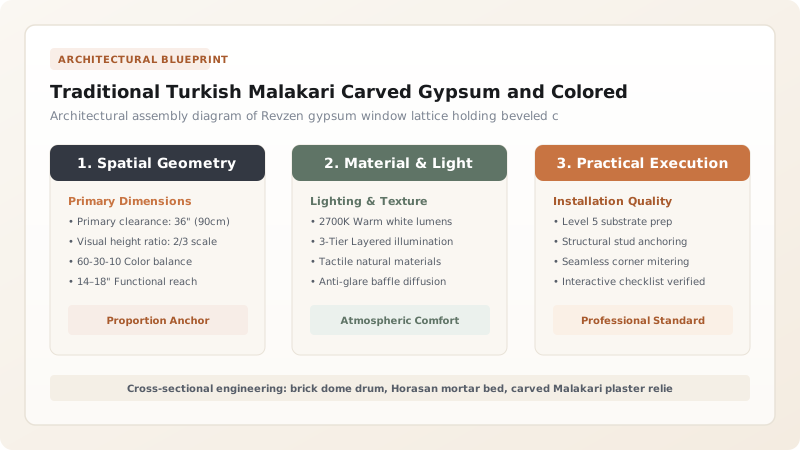
The Synthesis of Light and Relief in Classical Ottoman Architecture
During the 16th-century reign of Sultan Süleyman the Magnificent, Chief Imperial Architect Mimar Sinan revolutionized religious architecture by maximizing natural interior illumination. Heavy Byzantine-style masonry walls were pierced with soaring cascades of clerestory windows, dematerializing the structural dome into a weightless celestial sphere.
To articulate these luminous interiors, imperial decorators developed two complementary arts: Malakari (low- and high-relief carved gypsum ornamentation executed across dome transition rings, pendentives, and arch intrados) and Revzen-i Menkuş (ornamental stained glass set within cast gypsum traceries). Working in tandem, the carved reliefs cast dynamic raking shadows while the plaster windows flooded the marble carpets with chromatic patterns of sapphire, ruby, and amber.
Material Science: Horasan Mortar and Retarded Alabaster Gypsum
The foundation of all Ottoman interior relief is Horasan Harcı—a hydraulic mortar formulated from slaked calcium lime putty, crushed pozzolanic red brick dust (tuğla kırığı), and washed river sand. Horasan mortar possesses high elasticity and moisture-buffering capacity, forming an unbreakable bond with structural brick dome vaults.
Over the Horasan base, artisans apply multiple coats of high-purity alabaster gypsum (Alçı). To prevent fast-setting gypsum from hardening before intricate rumi arabesques can be carved, master plasterers mix the gypsum with dilute animal hide glue (tutkal) or fermented marshmallow-root mucilage (hatmi suyu). This extends the plastic open-carving window from 5 minutes to over 3 hours.
The Malakari Carving Process: Relief, Pouncing, and Undercuts
The word Malakari derives from the Turkish mala (the plasterer’s trowel). Unlike cast mold ornaments which appear repetitive and rigid, authentic Malakari is carved entirely freehand in situ. The design is transferred onto the firm gypsum using charcoal pounce stencils (silkeleme).
The artisan cuts away the background at a 45-degree angle using specialized leaf-shaped steel trowels and miniature rifflers, creating raised floral motifs (hatayi), stylized lotus blossoms, and interlocking palmettes (rumi). The edges are beveled and chamfered so that ambient sunlight sweeping across the dome drum illuminates the gilded crests while casting deep, velvety shadows into the carved recesses.
Revzen-i Menkuş: Casting Gypsum Window Lattices with Crown Glass
Unlike Western Gothic stained glass which joins glass pieces with lead cames (H-shaped lead strips), Ottoman stained glass windows are cast directly within monolithic gypsum plaster frames (Alçı Pencere or Revzen).
Artisans lay hand-blown colored crown glass roundels (göztepe) face down on a flat marble casting bed according to a geometric cartoon. Freshly mixed structural gypsum reinforced with flax fiber is poured around the glass edges. As the plaster crystallizes, it forms a lightweight, rigid, non-corrosive stone lattice that holds the glass permanently without rattling in high winds, acting as a natural thermal insulator.
Ottoman Plaster & Revzen Window Engineering Matrix
Use this reference table to calculate exact physical dimensions, ratios, and specifications before purchasing:
| Architectural Zone | Substrate Layer | Relief / Glass Medium | Retarding / Binding Agent | Surface Embellishment |
|---|---|---|---|---|
| Dome Cornice Frieze | Horasan hydraulic mortar (15mm) | Malakari gypsum relief (10–25mm) | Bone hide glue (tutkal, 4%) | 24k Gold Leaf + Lapis lazuli gouache |
| Pendentive Muqarnas | Curved fired brick corbeling | Multi-tier carved alçı stalactites | Marshmallow root water (hatmi) | Vermilion red & mineral green linework |
| Upper Clerestory Windows | Stone window jambs & sill | Revzen-i Menkuş (cast alçı lattice) | Animal hair / hemp fiber reinforce | Hand-blown colored crown glass rondels |
| Lower Exterior Storm Grille | Structural iron window grille | Revzen-i Harici (outer protective alçı) | Pure coarse structural gypsum | Clear thick crown glass roundels |
Practical Constraints
Every successful decoration project must account for physical and environmental constraints:
Scaffolding at Extreme Heights in Monumental Ottoman Domes
Restoring Malakari dome friezes at 35-meter heights requires complex modular internal birdcage scaffolding anchored without drilling into historic walls.
Availability of Authentic Hand-Blown Crown Glass
Requires specialized glassblowers using traditional pontil spin methods to replicate the uneven bubble inclusions and concentric rings of 16th-century glass.
Execution Blueprint & Craftsmanship Sequence
Execute this professional sequence to achieve flawless results without backtracking:
Substrate Horasan Mortar Rendering
Trowel an 8mm base coat of hydraulic Horasan mortar over dampened brick dome vaults; score diagonal keys to provide mechanical anchorage.
Retarded Gypsum Plaster Floating
Mix fine alabaster gypsum with bone glue water; apply two 6mm coats, floating to a dead-flat, silky white surface with a 3-hour working window.
Pounce Stencil Transfer (Silkeleme)
Align perforated parchment cartoons of rumi and hatayi motifs; tamp with powdered charcoal to transfer coordinate guidelines onto the plaster.
Malakari Freehand Trowel Carving
Carve away negative background spaces using hand-forged steel malas, undercutting leaf borders at 45 degrees to create dramatic shadow relief.
Revzen Glass Assembly and Gypsum Casting
Arrange cut colored crown glass on the casting table; pour fiber-reinforced gypsum plaster between glass segments, tool bevels, and cure for 48 hours.
Gold Leaf Gilding and Gouache Infill
Apply garlic-juice or oil gold size to raised floral crests; lay 24k gold leaf, burnishing with agate, and in-paint background grounds with lapis gouache.
Common Mistakes & Countermeasures
Avoid these costly errors that compromise aesthetics, ergonomics, and budget:
Using Un-Retarded Fast-Setting Gypsum for Malakari Carving
Mounting Revzen Windows with Modern Rigid Cement Mortar
Overpainting Historic Gilded Friezes with Synthetic Metallic Paints
Project Execution Checklist
Track your physical progress. Checkboxes persist automatically on this device:
Frequently Asked Questions
What is the difference between Malakari and European Stucco?
European stucco is typically formulated with slaked lime and marble dust, requiring days to set through atmospheric carbonation. Ottoman Malakari uses retarded alabaster gypsum (alçı), which sets through chemical crystallization, allowing sharper undercut relief carving and seamless gilding.
Why did Ottoman architects use gypsum instead of lead cames for stained glass?
Gypsum plaster is rigid, lightweight, and completely immune to the thermal creep and sagging that plagues heavy lead-came windows in hot Mediterranean climates. Additionally, the white gypsum lattice acts as an optical reflector, increasing the luminosity of the colored glass.
How are historic Revzen stained glass windows cleaned without damaging the plaster?
Conservators use dry vulcanized rubber sponges to lift soot from plaster lattices, and cotton swabs lightly dampened with 50/50 deionized water and ethanol to clean the colored glass faces without softening the gypsum frame.


