Microclimate humidity breathing without glue or nails is the core thermodynamic and structural principle of authentic Turkish kündekari. Wood is an anisotropic, hygroscopic material that continuously expands across its grain during humid periods and shrinks during arid droughts. By subdividing expansive surfaces into hundreds of miniature floating panels held loosely within grooved rails, kündekari absorbs dimensional expansion internally within thousands of micro-clearance gaps, preventing warping, splitting, or structural failure across centuries of severe climatic cycling.
At a Glance: Key Takeaways
- Material Behavior: Anisotropic hygroscopic expansion (tangential, radial, longitudinal)
- Climatic Challenge: Anatolian plateau: winter humidity spikes and bone-dry summer droughts (15% to 85% RH)
- Engineering Strategy: Decentralized micro-expansion absorption across hundreds of floating seams
- Expansion Clearance: Calculated 1.0–1.5 mm gap per panel edge relative to species swelling coefficient
- Expected Service Life: 600 to 1,000+ years without adhesive degradation or joint shearing
Anisotropic Wood Physics and the Continental Anatolian Climate
To comprehend the sheer engineering brilliance of kündekari, one must first examine the thermodynamic and physical challenges of the Anatolian plateau. Cities such as Konya, Sivas, and Erzurum experience an extreme continental climate: freezing, snow-laden winters with relative humidity exceeding 80%, followed by scorching, arid summers where humidity drops below 20%. Solid wood is an anisotropic material that contains bound water within its cellular fibrils; as ambient humidity fluctuates, wood constantly absorbs or desorbs moisture, striving toward an equilibrium moisture content (EMC).
Crucially, timber changes dimensions unevenly across its three anatomical axes: negligible movement longitudinally along the grain (0.1%), moderate expansion radially across growth rings (3–5%), and severe dimensional shift tangentially along ring arcs (6–10%). In conventional furniture where large wooden planks are edge-glued or restrained with metal fasteners, these violent dimensional shifts generate thousands of pounds of internal shear stress, inexorably resulting in bowed panels, blown joints, and catastrophic splits.
The Floating Joint Solution: Decentralized Stress Absorption
The genius of the Seljuk master joiners was to replace monolithic panels with a decentralized cellular matrix. Rather than building a mosque door from two or three wide boards, the kündekari master subdivides the door face into five hundred to one thousand miniature polygonal panels (tabla), each rarely exceeding 10 to 15 centimeters in width. By keeping each individual component small, the absolute dimensional shift of each piece is reduced to a fraction of a millimeter.
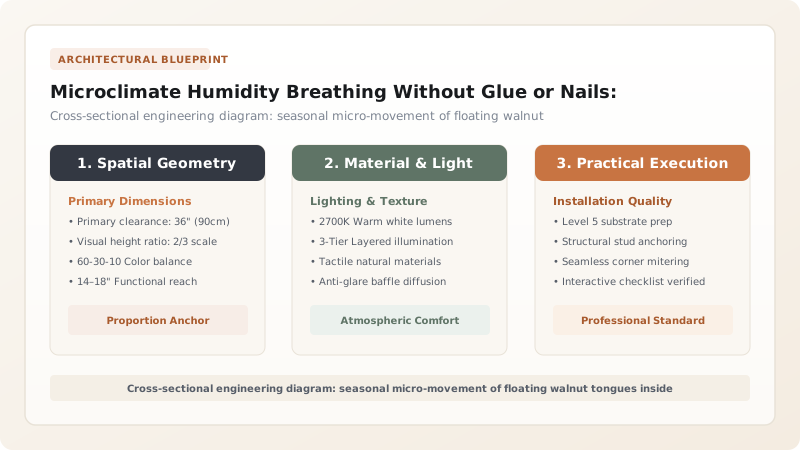
These micro-panels are fitted with precision-cut tongues that sit loosely within matching grooves in the surrounding framing battens (kiriş). The joints contain no adhesive, nails, or dowels. When high summer temperatures drive moisture from the wood, each individual star and kite panel shrinks slightly into its own void; the tongue remains safely engaged within the groove, preventing drafts or light from penetrating. When winter dampness causes the wood to swell, each panel expands outward into its dedicated expansion gap without encountering rigid resistance or pushing against adjacent members.
Friction Coefficients and Internal Lubrication Mechanics
The long-term success of this glueless breathing system relies on maintaining low sliding friction between the moving wooden surfaces. If rough, unsmoothed wood fibers rub against one another inside a tight groove, they can gall, bind, and lock under compressive expansion, defeating the floating mechanism and inducing stress fractures.
Historical records and modern micro-CT analyses reveal that Seljuk masters burnished all interlocking tongues and grooves to a mirror polish using smooth bone burnishers or sharkskin abrasives. Furthermore, joints were traditionally dusted with pulverized dry soapstone (talc) or lubricated with natural vegetable waxes during assembly. This dry lubrication allows the thousands of interlocking parts to slide micro-millimetrically past one another with zero friction, creating an assembly that literally whispers and settles as atmospheric pressure and humidity shift.
Breathable Surface Finishes vs. Modern Barrier Coatings
A critical corollary of kündekari breathing is the philosophy of surface finishing. Modern industrial furniture relies on impermeable synthetic coatings—such as polyurethane varnishes, acid-cured lacquers, or epoxy resins—that form a plastic shell over the wood. If such coatings are applied to historic kündekari, moisture inevitably penetrates through microscopic micro-cracks on the unsealed reverse, creating severe moisture imbalances that warp the wood beneath the plastic shell.
Seljuk and Ottoman artisans relied exclusively on vapor-permeable, penetrating natural oils. Boiled virgin linseed oil (keten yağı), blended with natural pine turpentine and clarified beeswax (balmumu), was applied hot and hand-rubbed deep into the wood cellular structure. These natural oils polymerize within the cell lumens, repelling liquid water droplets while permitting water vapor molecules to pass freely in and out of the cellular matrix, preserving the dynamic equilibrium that has kept these wooden monuments alive for eight centuries.
Hygroscopic Movement Profiles of Anatolian Woodworking Timber
Use this reference table to calculate exact physical dimensions, ratios, and specifications before purchasing:
| Wood Species | Radial Shrinkage Coefficient | Tangential Shrinkage Coefficient | Dimensional Stability Index | Structural Role in Kündekari |
|---|---|---|---|---|
| Anatolian Walnut (Juglans regia) | 5.4% | 7.5% | High (very stable once cured) | Carved central star and polygonal panels (tabla) |
| Taurus Cedar (Cedrus libani) | 3.8% | 6.2% | Exceptional (minimal movement) | Primary structural framing rails (kiriş) and door stiles |
| Anatolian Black Pine (Pinus nigra) | 4.0% | 7.8% | Moderate-High (elastic grain) | Secondary framing lattices and internal interlocking keys |
| Wild Pear (Pyrus pyraster) | 5.3% | 8.9% | Moderate (dense, uniform texture) | Fine calligraphic medallions and delicate micro-frames |
| Ceylon Ebony (Diospyros ebenum) | 6.5% | 9.0% | Low-Moderate (very dense, prone to check) | Decorative corner inlays and accent diamond plugs |
Practical Constraints
Every successful decoration project must account for physical and environmental constraints:
Extreme Atmospheric Desiccation from Modern Winter Radiator Heating
Modern climate-controlled mosque interiors drop to 15% RH, shrinking wood beyond historic baseline dimensions. Mitigation: Install museum-grade ultrasonic humidification systems to maintain ambient indoor relative humidity between 40% and 55%.
Accumulation of Airborne Dust and Grit Inside Expansion Grooves
Centuries of fine dust pack into dry grooves, eventually obstructing tongue sliding and inducing mechanical stress. Mitigation: Perform periodic non-invasive vacuum conservation using fine micro-attachments and soft natural bristle brushes.
Execution Blueprint & Craftsmanship Sequence
Execute this professional sequence to achieve flawless results without backtracking:
Atmospheric Profiling and Moisture Equilibrium Analysis
Assess historical humidity cycles of the installation site, determining annual swings between peak summer dryness and winter dampness.
Species Matching and Radial Orientation
Select quarter-sawn boards where annual growth rings run perpendicular to the face (60° to 90°), minimizing tangential cupping during humidity cycles.
Calculating Micro-Expansion Tolerances
Multiply the width of each star panel by the species radial swelling coefficient to establish the exact required gap (typically 1.2 mm on all sides).
Precision Milling of Floating Tongues
Cut panel edge tongues with uniform shoulders, smoothing the contact arrises to ensure effortless gliding inside the framing channels.
Friction-Free Channel Preparation
Burnish internal groove walls of the pine rails and apply micro-fine dry mica or talc to prevent raw wood fibers from galling or sticking under pressure.
Dry Floating Assembly
Interlock all components without a trace of glue, confirming by hand that each panel can shift micro-millimetrically when pushed laterally.
Vapor-Permeable Oil Penetration
Saturate the assembled woodwork with warm, pure cold-pressed linseed oil thinned with natural pine turpentine, allowing it to soak deep into wood pores without forming a surface film.
Seasonal Calibration and Observation
Inspect the installation across the four seasons, verifying that all floating panels expand into their groove cavities during humid spells without bowing or buckling.
Common Mistakes & Countermeasures
Avoid these costly errors that compromise aesthetics, ergonomics, and budget:
Applying polyurethane, modern varnish, or epoxy surface coatings
Installing kündekari assemblies in direct contact with wet stone masonry or capillary rising damp
Using green or improperly seasoned timber with high bound water content
Project Execution Checklist
Track your physical progress. Checkboxes persist automatically on this device:
Frequently Asked Questions
Why does solid wood warp, and how does kündekari prevent it?
Wood is hygroscopic and anisotropic; it absorbs and loses atmospheric moisture, expanding and contracting twice as much along its tangential growth rings as it does radially. If a large wooden board is glued rigidly or screwed down, this differential movement creates massive internal tension that tears the wood apart or twists it into a bow. Kündekari avoids this by breaking the surface into hundreds of small pieces that move independently within floating expansion gaps.
What happens if someone puts glue on a kündekari joint?
Putting glue on kündekari joints is catastrophic. When ambient humidity changes, the wood tries to shrink or expand. Because the glued joint cannot move, tensile stress builds until the wood fibers fail, cracking the historic carved walnut panels right down the center. Traditional restorers spend hundreds of hours carefully dissolving and removing modern glue added by unqualified past repairs.
How do kündekari panels remain airtight and weathertight without glue or caulking?
Weathertightness is achieved through overlapping stepped tongues and deep labyrinthine grooves. Even when the panels shrink during dry weather and the joints open by a fraction of a millimeter, the tongue remains engaged deep inside the groove channel, blocking wind, rain, and daylight from passing through the assembly.
Why did Seljuk woodworkers not use metal nails or screws?
Wrought iron nails and screws corrode over time due to tannins and moisture in hardwoods like oak and walnut, causing wood rot ('iron sickness'). More importantly, metal fasteners hold wood rigidly in one localized spot; as the surrounding wood expands, the nail acts as an immovable wedge, splitting the board along the grain line.