Turkish kündekari is a monumental wood joinery technique perfected by Anatolian Seljuk and Ottoman master woodworkers (neccarlar) between the twelfth and sixteenth centuries. Characterized by assembling thousands of intricately carved polygonal hardwood panels (tabla) and interlocking grooved framing members (kiriş) entirely without the use of glue, nails, or metal fasteners, true kündekari (hakiki kündekari) allows wooden assemblies to expand and contract freely across extreme continental temperature and humidity shifts without warping, cracking, or splitting.
At a Glance: Key Takeaways
- Origin & Golden Era: Anatolian Seljuk (12th–13th c.) and Classical Ottoman (15th–16th c.)
- Primary Joinery System: Glueless floating tongue-and-groove and mortise-and-tenon interlocking joints
- Preferred Hardwoods: Walnut (ceviz), pear (armut), cedar (sedir), ebony (abanoz), and pine (çam)
- Primary Applications: Mosque doors, mimbar pulpits, window shutters (kepenk), and Quran chests
- Hygroscopic Advantage: Complete self-compensating expansion tolerance in arid continental microclimates
In-Depth Guides in this Directory
Explore specialized subtopic blueprints, technical dimensions, and execution checklists:
Tongue-and-Groove Octagonal and Star Pine Assemblies: Geometric Lattices & Polyhedral Tenons in Kündekari
Master tongue-and-groove octagonal and star pine assemblies in Turkish kündekari. Learn polyhedral tenon cutting, girih geometric drafting, and floating joint tolerances.
Microclimate Humidity Breathing Without Glue or Nails: Floating Joint Mechanics in Arid Anatolian Climates
Explore microclimate humidity breathing in Turkish kündekari woodwork. Understand floating joint mechanics, hygroscopic wood expansion, and glueless engineering.
Carved Walnut and Ebony Relief Doors and Mimbar Screens: Royal Craftsmanship & Sacred Calligraphic Panels
Discover carved walnut and ebony relief doors and mimbar screens in Turkish kündekari. Learn Seljuk rumi arabesques, Thuluth calligraphy, and imperial mosque woodwork.
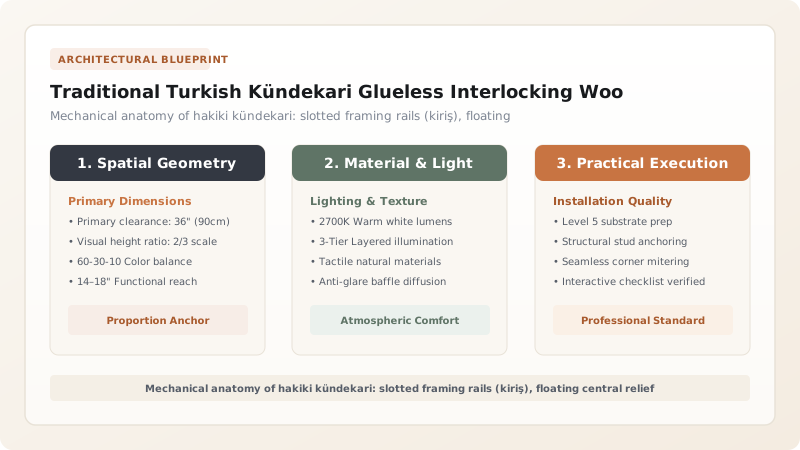
The Seljuk Genesis and Ottoman Perfection of Kündekari
Emerging from the harsh climatic realities and sublime artistic vision of medieval Anatolia, kündekari represents one of humanity's highest achievements in precision joinery. Developed during the twelfth-century Seljuk Sultanate of Rum and brought to imperial maturity under the Ottoman Empire, this woodworking tradition solved a profound engineering challenge: how to build massive architectural portals, monumental mosque pulpits (mimbars), and royal furnishings from solid timber in an arid continental climate where extreme seasonal swings in temperature and humidity tore ordinary glued furniture apart.
The guild of master woodworkers—the neccarlar—developed hakiki kündekari (true kündekari), a system where thousands of individually carved hardwood panels and slotted framing members interlock with clockwork precision. By abandoning all glues, iron nails, and rigid fasteners, Seljuk masters created dynamic wooden membranes that could absorb internal stresses, breathing through seasonal microclimatic cycles across centuries without a single hairline fracture.
The Hakiki vs. Imitation Typology: Structural Authenticity
In woodworking history, kündekari is categorized into distinct technical classes based on joinery integrity. The absolute apex is hakiki kündekari, wherein every polygonal component is a freestanding, three-dimensional element featuring perimeter tongues that float freely within matching grooves hollowed out along structural framing rails. The assembly possesses no backing board; light shining from behind illuminates the micro-seams between framing members, confirming its fully interlocking, self-supporting nature.
As imperial resources waned in the eighteenth and nineteenth centuries, faster imitation methods arose. Çakma kündekari employed pre-carved geometric stars and battens that were blind-nailed onto solid wooden backing planks, while yapıştırma kündekari utilized animal glue or early synthetic resins to affix geometric veneers onto timber substrates. While visually similar from a distance, imitation works lacked the hygroscopic resilience of true kündekari; as seasonal humidity fluctuated, the backing planks warped and shrank at different rates than the applied stars, causing catastrophic buckling and popped nails that have plagued historic preservationists.
Material Alchemy: The Synergy of Anatolian Hardwoods
The enduring stability of authentic kündekari hinges upon the calculated pairing of specific tree species, each chosen for distinct mechanical and aesthetic properties. The structural framing skeleton (kiriş) is frequently fashioned from dense, stable conifers such as Taurus cedar (sedir) or slow-growth Anatolian black pine (çam), renowned for their straight grain, dimensional stability, and natural insecticidal resins that deter wood-boring pests.
In contrast, the central floating medallions (tabla) demand dense, close-grained hardwoods capable of holding razor-sharp, sculptural relief. Master artisans selected aged Anatolian walnut (ceviz), wild pear (armut), and boxwood (şimşir), accenting elite imperial commissions with imported Ceylon ebony (abanoz) and ivory inlay. By contrasting the deep chocolate hues of walnut against the golden warmth of pine and the velvet blackness of ebony, the kündekari master achieved profound optical depth without applying artificial chemical stains or synthetic paints.
Preservation, Laser Documentation, and Modern Conservation
Conserving eight-hundred-year-old Seljuk kündekari masterpieces—such as the celebrated 1155 mimbar of the Alaeddin Mosque in Konya—requires extraordinary specialized knowledge. The primary threat to historical works is well-intentioned but catastrophic modern restoration, specifically the injection of modern epoxies or polyurethane glues into loosened joints, which permanently destroys the floating mechanism and triggers catastrophic splitting when humidity fluctuates.
Modern conservation mandates non-invasive documentation using high-resolution 3D laser scanning and micro-computed tomography (micro-CT) to map internal tenons and expansion clearances. Restorers dismantle damaged assemblies dry, replacing degraded dowels with matching seasoned walnut, re-establishing precise 1.0-millimeter expansion tolerances, and conditioning the wood with pure cold-pressed linseed oil and purified beeswax. Today, specialized woodworking ateliers in Konya, Bursa, and Istanbul continue this royal craft, preserving an unbroken lineage of sacred architectural joinery.
Kündekari Fabrication Typology Comparison
Use this reference table to calculate exact physical dimensions, ratios, and specifications before purchasing:
| Technique Classification | Joinery Principle | Adhesive / Fastener Usage | Structural Longevity | Historical Authenticity |
|---|---|---|---|---|
| Hakiki Kündekari (True / Authentic) | Fully interlocking tongue-and-groove skeleton with floating carved panels | Zero glue, zero nails, zero screws | Centuries (survives 800+ years without warping) | Seljuk and early Ottoman royal imperial works |
| Çakma Kündekari (Nailed / Blind-Pinned) | Carved geometric battens blind-nailed onto a solid flat timber backing board | Wrought iron or brass nails, concealed pins | Decades to a century (backing boards split over time) | Late Ottoman provincial mosques and furnishings |
| Yapıştırma Kündekari (Glued Applied) | Geometric pieces sawn and glued flat onto a plywood or solid substrate | Modern synthetic adhesives or animal hide glue | Short (glue fails under temperature cycling; faces blister) | 19th–20th century commercial revivals and imitations |
| Oyma Kündekari (False / Relief-Carved) | Solid single board carved in relief to simulate interlaced star geometry | None (monolithic solid timber panel) | Moderate (susceptible to warping across broad widths) | Secondary architectural screens and decorative panels |
Practical Constraints
Every successful decoration project must account for physical and environmental constraints:
Severe Anatolian Continental Temperature Fluctuations
Winter sub-zero temperatures followed by bone-dry summer heat cause radical dimensional changes in timber. Mitigation: Divide expansive door surfaces into hundreds of micro-panels (under 15 cm width) so aggregate expansion is absorbed locally.
Immense Manual Milling Time and Extreme Geometric Precision
Fabricating thousands of unique polygonal joints with fractional-millimeter accuracy requires hundreds of artisan hours. Mitigation: Utilize precision hardened-steel scrapers, wooden routing templates, and standardized master angular gauges.
Execution Blueprint & Craftsmanship Sequence
Execute this professional sequence to achieve flawless results without backtracking:
Timber Harvesting, Curing, and Selection
Harvest slow-growth Anatolian walnut and Taurus cedar during winter dormancy, air-drying the quarter-sawn planks for five to seven years to achieve structural equilibrium.
Geometric Compass-and-Straightedge Layout
Develop the full-scale cartoon on hardwood parchment, drafting intersecting 8-pointed or 12-pointed girih stars and surrounding hexagonal kites.
Milling Profiled Frame Rails (Kiriş)
Rip and plane slender pine or pear framing slats, shaping their edges with matched tongue-and-groove profiles and mitered lap-joint intersections.
Roughing and Dimensioning Floating Panels (Tabla)
Cut polygonal hardwood blanks matching the star, lozenge, and polygon centers of the geometric lattice, chamfering outer edges to form floating tongues.
Intaglio and High-Relief Panel Carving
Carve intricate floral rumi arabesques, split-palmettes, and sacred calligraphic scripts into the upper faces of the hardwood panels using fine gouges.
Incremental Glueless Core Interlocking
Slot the floating carved star panels into the grooved framing members starting from the central star nexus, building outward radially like a self-locking puzzle.
Perimeter Mortise Encasement and Doweling
Enclose the entire interlocking lattice inside massive perimeter walnut stiles and rails, locking outer corners with drawbored dry walnut peg dowels without glue.
Natural Oil Penetration and Polishing
Apply successive coats of hot virgin linseed oil blended with natural gum mastic and beeswax, buffing the relief with horsehair brushes to enhance grain luster.
Common Mistakes & Countermeasures
Avoid these costly errors that compromise aesthetics, ergonomics, and budget:
Applying modern polyvinyl acetate (PVA) glue or epoxy inside kündekari interlocking grooves
Using flat-sawn lumber prone to cupping and dimensional instability
Milling groove tolerances with zero clearance (tight interference fit)
Project Execution Checklist
Track your physical progress. Checkboxes persist automatically on this device:
Frequently Asked Questions
What is the philosophical and spiritual meaning behind kündekari woodwork?
In Islamic and Seljuk metaphysics, the intricate geometric lattices of kündekari—unfolding from central stars into infinite polyhedral constellations—symbolize the divine order, cosmic unity (Tawhid), and the endless harmony of creation. The fact that the structure holds together entirely through balance and interlocking relationships without external binders like glue or iron reflects the principle of structural truth and inner balance.
Where are the most famous historic examples of kündekari preserved?
Monuments of Seljuk and Ottoman kündekari include the majestic 12th-century mimbar of the Alaeddin Mosque in Konya, the intricate cedar mimbar of the Divriği Great Mosque (1228), the monumental walnut mimbar of Bursa's Ulu Camii (1399), and the imperial doors of Topkapı Palace and the Süleymaniye Mosque in Istanbul.
How do conservators identify true (hakiki) kündekari from imitation styles?
True kündekari can be verified by examining the reverse of the assembly. Hakiki kündekari reveals an identical geometric interlocking frame on the reverse with visible expansion seams, or floating panels set within grooved rails without any continuous backing board or nail penetrations. Imitation kündekari reveals nail heads, modern plywood substrates, or glue squeeze-out under fiber-optic inspection.
Can kündekari techniques be applied to modern contemporary furniture?
Yes. Contemporary fine woodworkers adapt kündekari principles to bespoke dining tables, luxury wall cladding, room dividers, and headboards. The technique guarantees that large wooden surfaces remain completely flat and crack-free indefinitely, even in centrally heated or air-conditioned modern buildings that typically crack solid wood furnishings.