Carved walnut and ebony relief doors and mimbar screens represent the aesthetic and spiritual summit of Turkish kündekari craftsmanship. Set into glueless interlocking geometric frameworks, these precious hardwood panels are carved in deep intaglio and high relief with complex rumi-palmette arabesques, geometric rosettes, and flowing Thuluth calligraphic Quranic verses. Commissioned for royal palaces and grand Friday mosques, these masterpieces unite mathematical rigor with transcendent sacred artistry.
At a Glance: Key Takeaways
- Iconic Masterpieces: Konya Alaeddin Mosque Mimbar (1155), Divriği Ulu Camii (1228), Bursa Ulu Camii (1399)
- Sculptural Carving Styles: Rumi (stylized animal/wing arabesques), hatayi (floral palmettes), and girih strapwork
- Sacred Inscriptions: Quranic verses (Ayat al-Kursi) and artisan signatures in Thuluth and Kufic scripts
- Material Palette: Aged Anatolian walnut (ceviz), Ceylon ebony (abanoz), and mother-of-pearl (sedef)
- Relief Depth: Multi-layered relief carving varying from 3 mm to 8 mm depth
The Sacred Architecture of the Mimbar in Islamic Civilization
In the architectural typology of the Islamic world, few furnishings possess greater theological, political, and artistic gravity than the mimbar—the ceremonial pulpit from which the Friday sermon (khutbah) is proclaimed. Elevated upon a flight of steep triangular stairs beneath an arched canopy, the mimbar serves as the visual focus of congregational assembly. Under the Anatolian Seljuk sultans and early Ottoman padishahs, the triangular flanks and monumental entry gates of these pulpits became supreme showcases for royal prestige and artistic devotion.
Nowhere was this sacred ambition realized with greater magnificence than through the union of kündekari joinery and deep relief hardwood sculpture. The flanking side screens of the 1155 mimbar at Konya's Alaeddin Mosque and the 1228 mimbar of the Divriği Great Mosque are breathtaking architectural monuments in miniature. Thousands of individual walnut panels, each carved with microscopic floral arabesques and Quranic declarations, interlock into soaring geometric compositions that inspire contemplation of cosmic order and divine eternity.
The Visual Lexicon: Rumi Arabesques and Sacred Inscriptions
The decorative vocabulary carved into the floating walnut panels draws upon two foundational traditions: rumi arabesques and monumental calligraphy. The rumi motif, whose roots trace back to the animal-style art of Central Asian nomadic cultures, evolved in Anatolia into a sublime floral-geometric abstraction. Resembling bifurcated split-leaves, curving wings, and unfurling waves, rumi motifs are carved with sharp central ridges and steep, undercut bevels that catch dramatic raking light, creating a dynamic dance of luminescence and shadow.
Interspersed among these undulating foliage fields are majestic calligraphic inscriptions rendered in monumental Thuluth and geometric Kufic scripts. Master woodcarvers chiseled flowing Quranic verses—most frequently the Throne Verse (Ayat al-Kursi) and invocations of the Ninety-Nine Names of God—around door borders and panel medallions. In many masterworks, the artisan’s signature is modestly concealed within a miniature star at the base of the mimbar balustrade, recording the carver's name, city of origin, and a humble prayer for divine forgiveness.
Hardwood Sculptural Techniques: Tools, Gouges, and Undercutting
Executing deep relief carving across hundreds of small, irregularly shaped hardwood polygons requires extraordinary mastery of hand-eye coordination and edge tool mechanics. The carver worked exclusively with hand-forged carbon steel gouges (oluklu ıskarpela) and cranked ground-leveling chisels (boğaz ıskarpelası). Because walnut grain can reverse unexpectedly around burls and knots, the artisan had to constantly alter the angle and skew of the cutting stroke to avoid tearing the delicate wood fibers.
The carver first established vertical stop-cuts around the perimeter of the motif before excavating the surrounding waste wood down to a uniform recessed depth of 4 to 8 millimeters. Next, using delicate sweeps of skew chisels and curved gouges, the artisan sculpted the organic undulations of the leaves and calligraphic strokes. By creating subtle undercuts beneath the floral lobes, the carver cast deep, continuous shadows around the perimeter of every motif, making the dense hardwood appear as light and airy as embroidered lace.
Material Contrast and Imperial Inlay: Ebony, Bone, and Mother-of-Pearl
In the most prestigious imperial Ottoman commissions of the sixteenth and seventeenth centuries, the rich, warm chocolate grain of Anatolian walnut was elevated through the strategic incorporation of precious contrasting materials. Master artisans inlaid central star cores with polished facets of Ceylon ebony (abanoz), bleached bone, and iridescent mother-of-pearl (sedef) harvested from Red Sea mollusks.
This polychromatic inlay work (sedefkarlık) was integrated with consummate restraint. Rather than overwhelming the organic warmth of the timber, these luminous inlays acted as celestial focal points, reflecting the flickering glow of mosque oil lamps across the relief surface. Today, these carved panels remain among the most revered treasures of Islamic decorative art, standing as enduring monuments to an era when human craftsmanship, sacred geometry, and material engineering were united in absolute harmony.
Iconographic Motifs in Seljuk and Ottoman Kündekari Relief Carving
Use this reference table to calculate exact physical dimensions, ratios, and specifications before purchasing:
| Motif Category | Visual Structure | Historical Origin | Carving Technique | Spiritual / Symbolic Meaning |
|---|---|---|---|---|
| Rumi (Slanted Arabesque) | Curving split-leaves and bird-wing motifs | Central Asian nomadic animal style synthesized with Islamic art | Steeply undercut chamfers with central ridge lines | Divine breath of life, continuous cosmic movement, and vitality |
| Hatayi (Botanical Palmette) | Lotus blossoms, peonies, and rosettes | Chinese Tang/Song influence via Silk Road trade routes | Layered concave scoops with stippled centers | Paradise gardens, spiritual blossoming, and divine abundance |
| Thuluth / Kufic Epigraphy | Flowing cursive script with intertwining vertical ascenders | Classical Islamic scribal and monumental architecture | High-relief lettering against textured or floral grounds | The eternal word of God, sovereignty of the Creator, and prayers |
| Kündekari Geometric Straps | Interlacing bands creating polyhedral knots | Pythagorean-Islamic sacred mathematics (girih) | Flat-topped ribbon relief with channeled margins | Infinite divine order, cosmic interconnectedness, and unity |
Practical Constraints
Every successful decoration project must account for physical and environmental constraints:
Brittle Cleavage of Ancient Ebony Inlays under Dry Microclimates
Dense Ceylon ebony expands less than surrounding walnut, causing tension shear along inlay glue seams. Mitigation: Cut ebony inlays into miniature segmented tesserae rather than broad sheets to minimize aggregate tension.
Vandalism and Theft of Historic Loose Kündekari Panels
Because panels are not nailed or glued, unmonitored historic mimbars have suffered theft of individual star panels. Mitigation: Secure perimeter mosque grilles, install non-invasive vibration sensors, and document every panel via 3D photogrammetry.
Execution Blueprint & Craftsmanship Sequence
Execute this professional sequence to achieve flawless results without backtracking:
Heartwood Selection and Scribing
Harvest ancient walnut heartwood displaying deep chocolate tones, planing panels to 18-mm thickness and scribing the geometric star outline.
Calligraphic and Arabesque Drafting
Draw Quranic inscriptions (such as Surat Al-Ikhlas) or rumi palmettes onto tracing parchment, transferring ink lines onto the wood using carbon pounce.
Perimeter Incision and Relieving
Score vertical incisions around all calligraphic letters and floral contours using a razor-sharp straight chisel driven by light mallet taps.
Background Ground Excavation
Remove the negative background wood to a depth of 5 millimeters using a dog-leg router gouge, creating a flat, recessed shadow floor.
Sculptural Modeling of Arabesque Curves
Shape the rounded volumes of split leaves, lotus buds, and letter ascenders using curved gouges, keeping transitions crisp and fluid.
Ebony Inlay Excavation and Setting
Chisel mortise pockets into central star cores, fit hand-sawn ebony and mother-of-pearl diamond gems, and set them with warm hide glue.
Tenon Shoulder Profiling
Rabbet the underside and outer margins of the carved panel to create the exact 3.5-mm floating tongue that will engage the kiriş frame.
Final Burnishing and Natural Oil Sealing
Buff the relief surfaces with dry horsetail rush, apply three coats of warm linseed oil, and polish with a horsehair brush to achieve a soft eggshell luster.
Common Mistakes & Countermeasures
Avoid these costly errors that compromise aesthetics, ergonomics, and budget:
Over-sanding carved relief panels with modern abrasive sandpaper
Carving relief too close to panel edges, infringing on tongue margins
Inlaying mother-of-pearl or ebony using synthetic modern adhesives with different expansion rates
Project Execution Checklist
Track your physical progress. Checkboxes persist automatically on this device:
Frequently Asked Questions
What is a mimbar, and why was kündekari woodwork uniquely chosen for it?
A mimbar is the elevated pulpit in a Friday mosque from which the imam delivers the khutbah (sermon). As the most visually prominent and sacred piece of furniture in the mosque sanctuary, the mimbar symbolized religious and sovereign authority. Kündekari was chosen because its geometric complexity proclaimed divine order, its monumental durability ensured it would endure for centuries, and its glueless joinery resisted the arid heat of Anatolian interiors.
How did master carvers create the illusion of three-dimensional depth on small panels?
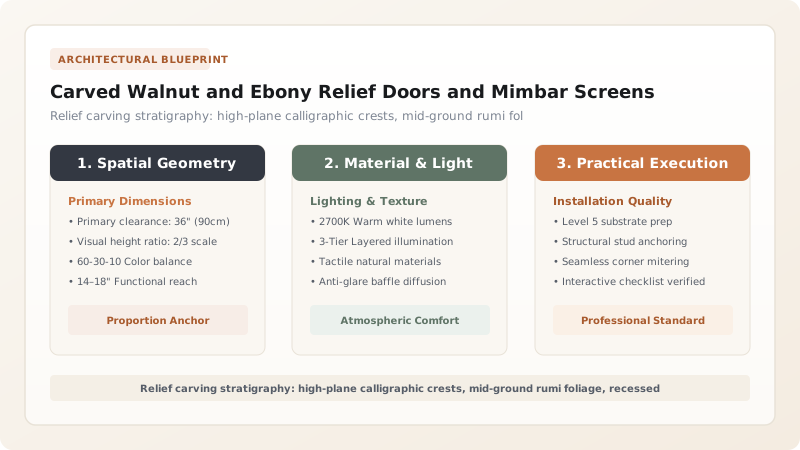
Carvers used multi-plane relief techniques. The calligraphic letterforms occupy the highest foreground plane; beneath them, intricate rumi arabesques weave in an intermediate mid-ground layer; finally, the recessed background floor is stippled or cross-hatched, creating dark optical shadows that make the polished foreground letters appear to float in space.
Who were the master woodworkers who created these imperial works?
Historic Seljuk and Ottoman masters—such as Hacı Mehmed bin Abdülaziz of Ahlat (creator of the Divriği mimbar) and Mehmed bin İlyas of Tabriz—were revered court artists known as 'neccarlar'. They signed their names proudly in hidden calligraphic cartouches woven seamlessly into the geometric lattice of the mimbar flanks.
How do modern woodworkers recreate these historic relief carvings today?
While CNC routing can rough out bulk background waste, master-level finishing still requires hand-carving with traditional gouges to achieve the organic, undulating bevels and crisp light-catching facets that give kündekari its sacred visual power.