
Himalayan rammed earth (known in Tibet as Shing-gyap or Hangtu) is an ancient monumental earth-walling technique utilizing wooden slip-form boxes and heavy manual pounding pestles. By compacting successive 15-centimeter lifts of damp, clay-sand subsoil between parallel timber boards held by tension pins, builders construct massive, monolithic walls up to 1 meter thick. As the wall rises, carpenters gradually tilt the forms inward to create an integral seismic batter that dampens tectonic shocks and resists high-plateau winds.
At a Glance: Key Takeaways
- Formwork System: Heavy pine or fir slip-boards (Shing-leb) secured with leather or cord ties
- Lift Compaction: Loose 15–20 cm layers compacted down to 8–10 cm dense lifts
- Pounding Pestle: Flat-bottomed heavy hardwood or iron pestle (Rta-rmig, 'horse-hoof')
- Soil Composition: 20–25% clay binder, 25–30% silt fines, 45–55% sharp sand/gravel
Himalayan Soil Agronomy: Grain Distribution and Drop-Ball Testing
Constructing a 10-meter-tall monolithic earth fortress begins with meticulous soil selection. Soil is excavated from deep alluvial deposits or hillside subsoil banks, bypassing organic topsoil completely. Ideal Himalayan walling soil contains a balanced geological distribution: 20% to 25% reactive clay (the glue), 25% silt, and 50% to 55% sharp, crushed rock sand and small pebble aggregate (the structural skeleton).
Moisture content is critical and assessed using the traditional drop-ball test. Master builders compress a fistful of damp subsoil into a firm ball and drop it from shoulder height (approximately 1.5 meters) onto hard ground. If the ball shatters into dozens of small crumbs, the moisture is optimal (typically 8% to 12% by weight). If it flattens like dough without breaking, it is too wet and will shrink excessively; if it turns to dust, it lacks sufficient water for compaction.
Formwork Engineering: Shing-Gyap Timber Slip-Planks and Tension Ties
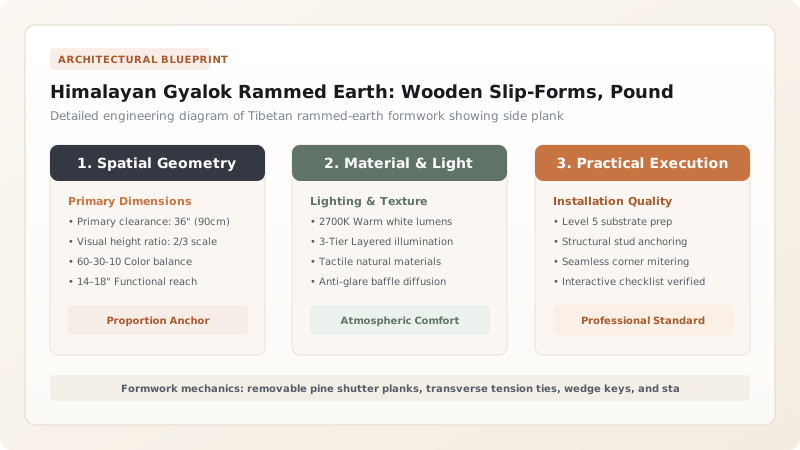
The formwork system—Shing-gyap—is modular, lightweight, and completely reusable. It consists of pairs of thick, seasoned pine boards (Shing-leb), typically 3 to 4 meters long, 40 cm tall, and 5 cm thick. These side boards are held apart at the desired wall thickness by transverse wooden separator battens.
To resist the immense outward lateral pressure generated during heavy pestle tamping, the boards are bound tightly using twisted rawhide thongs, yak-hair ropes, or removable iron pins locked with hardwood wedges. As the wall progresses upward, the formwork is shifted upward and horizontally (slip-forming), leaving distinctive horizontal joint lines and peg holes (Shing-khung) that are later plugged with stone or timber caps.
Tamping Dynamics: The Horse-Hoof Pestle (Rta-Rmig) and Work Songs
Compacting the earth is an intensely physical collective endeavor. Soil is shoveled into the form in loose 15 cm layers. Crews of four to eight workers stand directly inside the narrow formwork, wielding heavy tamping tools called Rta-rmig (literally 'horse-hoof pestle')—named for the semi-circular, beveled iron or fire-hardened birch head fitted to a 1.5-meter pole.
Workers tamp the soil in synchronized, overlapping blows, working from the outer form boards inward toward the center. To ensure uniform compaction cadence and prevent worker fatigue, tamping is always performed to the rhythm of traditional work songs (Hang-glu). Tamping continues until the pestle bounces off the surface and the compacted lift emits a sharp, ringing metallic pitch, indicating that air voids have been eliminated and dry density has exceeded 1,900 kg/m³.
Seismic Mechanics: Inward Batter, Timber Lacing, and Monolithic Strength
The Tibetan plateau is among the most seismically active tectonic zones in the world. Monolithic rammed earth, when unreinforced, can be brittle under pure shear tension. Gyalok builders solved this problem through three integrated engineering principles: the inward batter, horizontal timber lacing, and rounded building corners.
At each upward repositioning of the formwork, the carpenter steps the outer board inward by 10 to 15 millimeters, resulting in a continuous 3-degree inward slope. At window lintels and floor elevations, builders embed continuous horizontal juniper or willow poles (Shing-tag) into the wet earth. These timber cords act as natural rebar, distributing seismic tensile loads and preventing shear cracks from propagating through the wall during violent earthquake ground motion.
Rammed Earth Soil Grading & Compaction Parameters
Use this reference table to calculate exact physical dimensions, ratios, and specifications before purchasing:
| Soil Component | Target Percentage | Mechanical Function | Field Verification Test | Deficiency Remediation |
|---|---|---|---|---|
| Clay Fraction | 20% to 25% | Colloidal binder uniting sand grains | Smooth, soapy feel when rubbed between fingers | Incorporate pulverized river marl or local red clay |
| Silt Fraction | 25% to 30% | Micro-aggregate filling voids between sand | Silky feel; dissolves cleanly in water jar test | Blend pulverized dry slate or fine quarry dust |
| Sharp Sand / Gravel | 45% to 55% | Load-bearing skeleton preventing shrinkage | Gritty sound when rubbed next to the ear | Add washed river gravel and sharp angular sands |
| Moisture Content | 8% to 12% | Facilitates grain compaction without plasticity | Drop-ball test (shatters cleanly from 1.5 m) | Sun-dry over-wet mud; mist dry powder with watering cans |
Practical Constraints
Every successful decoration project must account for physical and environmental constraints:
Intense Physical Labor Demands
Tamping a single story of a family house requires lifting 8-kg pestles thousands of times, demanding large cooperative communal labor teams. Mitigation: Organize traditional village reciprocal labor exchange (Lang-gyap) or utilize modern pneumatic backfill tampers for contemporary earth builds.
Freezing Conditions During Overnight Curing
If newly tamped damp earth freezes before water has chemically combined or evaporated, frost crystals expand and destroy soil compaction. Mitigation: Cease all tamping when overnight temperatures approach 0°C; cover fresh wall heads with straw mats and heavy wool felt.
Erosion of Fresh Wall Heads by Unseasonal Rains
Uncapped rammed-earth walls are vulnerable to water gully erosion during unexpected summer cloudbursts. Mitigation: Always cap active wall heads with temporary overlapping wooden boards or heavy tarpaulins at the close of every workday.
Execution Blueprint & Craftsmanship Sequence
Execute this professional sequence to achieve flawless results without backtracking:
Excavating and Screening Subsoil Material
Excavate subsoil from depth (minimum 1 meter below surface), sifting out boulders larger than 30 mm while preserving fine gravel and sharp angular aggregates.
Calibrating Soil Moisture with Drop-Ball Tests
Blend dry soil with measured spring water until a compacted test ball dropped from shoulder height shatters into crumbs with zero plastic flattening.
Assembling and Shimming Wooden Shing-Gyap Forms
Erect pine shutter boards atop the stone plinth. Fasten cross-ties and tension wedges, plumbing the inner face and setting the outer face to a 3° inward batter.
Shoveling and Tamping 15 cm Soil Lifts
Shovel 15 cm of prepared soil into the forms. Tamp rhythmically with Rta-rmig pestles, working perimeter edges first and advancing toward the center.
Embedding Horizontal Juniper Seismic Ties
Every three vertical lifts (approx. 45 cm), lay continuous peeled juniper or willow poles horizontally across the earth core to act as seismic tension ties.
Stripping, Shifting, and Re-Setting the Formwork
Knock out wedge pins, slide shutter boards upward and forward along the wall, and repeat the process, staggering vertical form seams across courses.
Common Mistakes & Countermeasures
Avoid these costly errors that compromise aesthetics, ergonomics, and budget:
Adding Excess Water to Make Soil Easier to Trowel
Using Soil with High Organic Humus Content
Failing to Stagger Vertical Shutter Joints
Project Execution Checklist
Track your physical progress. Checkboxes persist automatically on this device:
Frequently Asked Questions
How long does a traditional rammed-earth wall take to cure?
Unlike concrete, which cures through chemical hydration, rammed earth gains strength through mechanical compaction and evaporation. A wall achieves 80% of its ultimate compressive strength within 4 to 6 weeks, continuing to harden over years as it carbonates.
Why is the tamping tool called a 'horse-hoof' (Rta-rmig)?
The tamping pestle head is cast or forged in the rounded semi-oval shape of a horse's hoof, which concentrates human downward force efficiently into the soil without cutting or tearing adjacent formwork wood.
Can rammed earth withstand earthquakes?
Yes. When engineered with thick walls, inward seismic batter (2°–5°), embedded horizontal timber cords, and an independent internal timber frame, traditional Tibetan rammed-earth buildings have survived massive magnitude 8.0 earthquakes for centuries.
Do Tibetan builders add lime or cement to the rammed earth?
Traditionally, no. The natural cohesion of high-calcium clay minerals, combined with precise gravel sizing and heavy mechanical pestle compaction, produces rock-like compressive strength without any chemical additives.


