Chofa (sky tassel) finials and sweeping Ppan Lom bargeboards crown the steeply pitched (55°–60°) gable roofs of traditional Thai architecture. Carved from single blocks of aged teak into stylized bird or dragon forms evoking the celestial Garuda, the Chofa terminates the ridge beam, anchoring curved bargeboards that shield exposed purlin ends from tropical rain. The extreme roof pitch accelerates rainwater shedding while generating a powerful thermal chimney draft that expels hot air through ventilated gable louvers.
At a Glance: Key Takeaways
- Finial Typology: Chofa (Sky Tassel / Garuda-head solar finial)
- Roof Pitch: 55° to 60° steep slope with gentle eave kick (up-turn)
- Bargeboard System: Ppan Lom (Sweeping curved wind-deflecting teak boards)
- Roof Cladding: Unglazed Terracotta Fish-Scale Tiles (Krabuang Hang Wao)
- Thermodynamic Engine: Passive convective chimney draft through ventilated gables
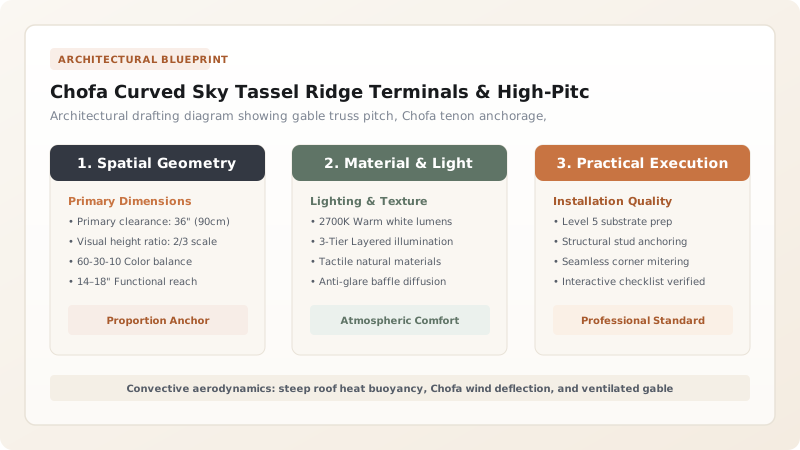
The Celestial Iconography of the Chofa
Soaring against the brilliant tropical sky above a Ruan Thai or royal wat, the sweeping silhouette of the Chofa (literally 'tassel of the sky' or 'sky tuft') is the quintessential crowning emblem of classical Thai architecture. Emerging from ancient Hindu-Buddhist cosmology, the Chofa represents the head and soaring beak of Garuda, the mythical golden-winged eagle and solar steed of the preserver deity Vishnu.
In sacred temples and royal palaces, the Chofa features an elaborate, slender curved neck and hooked beak. In noble residential dwellings (Ruan Khun Nang), the Chofa assumes a more abstract, streamlined serpentine form known as Chofa Hua Nork (bird head) or Hang Hong (swan tail). Beyond its mythological role in sanctifying the space and deflecting malevolent sky spirits, the Chofa serves a vital structural role as the protective terminal keystone of the timber ridge beam.
Ppan Lom Bargeboards: Wind Deflection and Purlin Shielding
Directly supporting the Chofa at the roof apex are the sweeping curved bargeboards known as Ppan Lom (literally 'wind-turners' or 'wind-catchers'). These long, sculpted teak boards follow the steep rafter rake, terminating in graceful upward-curving horns at the eaves corners.
Functionally, Ppan Lom boards serve two critical tasks: they shield the soft, vulnerable end grain of horizontal roof purlins from driving monsoon rainstorms, and they aerodynamically slice through violent typhoon crosswinds. By redirecting oncoming wind shear smoothly over the roof slopes rather than allowing it to catch beneath projecting tile lips, the Ppan Lom prevents roof tiles from being torn away during tropical cyclones.
High-Pitch Thermodynamics: The Convective Heat Pump
Central Plains Thailand experiences relentless daytime temperatures exceeding 35°C combined with 80% to 95% relative humidity. In such conditions, a low-pitch roof turns the interior of a home into an unbearable oven. Ruan Thai builders countered this by pitching roofs at extreme angles between 55° and 60°.
This steep geometry creates an enormous vertical air volume beneath the rafters. Heated indoor air rises naturally through buoyancy into the upper 2.5 meters of the roof peak. At the gable ends, carpenters install slatted, perforated decorative panels (Na Ban). The rising hot air continuously discharges through these high gable vents, creating a localized low-pressure zone that draws cool, shaded air upward from beneath the stilt undercroft through gaps in the teak floorboards, keeping the living zone 5°C to 7°C cooler than the ambient outdoor temperature without electricity.
Fish-Scale Terracotta Tile Cladding (Krabuang Hang Wao)
Covering the soaring roof slopes are thousands of small, hand-pressed unglazed terracotta tiles known as Krabuang Hang Wao (kite-tail or fish-scale tiles). Molded from local Chao Phraya river clay and fired in wood-fueled kilns, each tile features a rounded or pointed lower edge and a molded clay lug on its underside.
The tiles are hung loosely by their lugs over horizontal split-bamboo or teak battens, overlapping three courses deep. This loose, un-mortared hanging method is acoustically and thermally brilliant: unglazed terracotta breathes, allowing residual humidity to evaporate freely through the clay pores. Furthermore, during heavy rains, the triple overlap sheds torrential water instantly while allowing air to circulate continuously between the tiles and the ceiling space.
Roof Finial Styles Across Southeast Asian Vernacular Traditions
Use this reference table to calculate exact physical dimensions, ratios, and specifications before purchasing:
| Architectural Tradition | Finial Designation | Primary Iconography | Wind Deflection Role | Material Standard |
|---|---|---|---|---|
| Central Thai Ruan Thai | Chofa (Sky Tassel) | Garuda head / Celestial solar raptor | Splits ridge vortex; deflects typhoon shear | Single-piece Carved Golden Teak |
| Northern Thai Lanna | Kalae (Crossed Horns) | Crossed water buffalo horns | Braces gable apex rafters against wind | Carved Teak with floral openwork relief |
| Indonesian Toraja Tongkonan | Tulak Somba & Buffalo Horns | Water buffalo horns stacked vertically | Sacral lineage display; counterbalances prow | True Buffalo Horns on carved ironwood post |
| Burmese Pyatthat | Seinbu / Hti Umbrellas | Multi-tiered parasols and lotus buds | Sacred axis mundi; wind-resistant brass | Spun Brass and Gilded Copper Sheets |
Practical Constraints
Every successful decoration project must account for physical and environmental constraints:
Extreme Working Heights and Scaffolding Complexity
The Chofa apex sits 8 to 10 meters above ground level on an elevated stilt structure Mitigation: Erect multi-tier bamboo scaffolding towers tied with rattan cords, hoisting the finished finials using rope block-and-tackles
Violent Monsoonal Wind Uplift at Ridge Edges
High-velocity wind gusts can generate upward negative pressure that strips loose ridge capping Mitigation: Bed semi-circular terracotta ridge cap tiles in traditional lime-sand mortar reinforced with chopped coconut fiber
Execution Blueprint & Craftsmanship Sequence
Execute this professional sequence to achieve flawless results without backtracking:
Teak Finial Block Selection and Moisture Check
Select sound, straight-grained golden teak blocks free of pith cracks. Confirm wood is seasoned to <12% equilibrium moisture content.
Chofa Template Scribing and Rough Profiling
Scribe classical Garuda beak and neck curves onto the teak block using zinc stencils. Saw out the rough silhouette with a heavy bow saw.
Three-Dimensional Gouge Sculpting
Sculpt flowing feather scrolls (Kranok) and beak fluting using curved carving gouges, maintaining dynamic S-curve aerodynamics.
Ppan Lom Bargeboard Splicing and Carving
Hew sweeping 6-meter curved bargeboards from split teak slabs, carving matching upward-turning horns (Hang Hong) at eave corners.
Ridge Tenon Socketing and Anchorage
Cut a deep blind mortise into the bottom heel of the Chofa. Bed finial over a massive tenon carved on the ridge beam, driving cross-pegs.
Na Ban Ventilated Gable Lath Installation
Frame triangular gable openings beneath rafters with slatted wooden louvers (Plaeng Kret) to ensure unobstructed convective airflow.
Batten Grid Laying for Tile Cladding
Nail split bamboo or teak battens spaced at 80 mm intervals across 58° pitch rafters, checking level on every course.
Krabuang Hang Wao Tile Hanging and Wire Securing
Hang terracotta fish-scale tiles course by course, hooking lugs over battens and wiring every third course with copper wire against typhoons.
Common Mistakes & Countermeasures
Avoid these costly errors that compromise aesthetics, ergonomics, and budget:
Using metal nails or non-stainless screws to mount Chofa finials
Sealing the upper gable openings with glass or solid plywood
Bedding terracotta fish-scale roof tiles in rigid cement mortar
Project Execution Checklist
Track your physical progress. Checkboxes persist automatically on this device:
Frequently Asked Questions
What is the difference between a temple Chofa and a residential Chofa?
Temple and royal palace Chofas are monumental in scale (often 2 to 3 meters tall), richly gilded with pure gold leaf and inlaid with colored mirrored glass, featuring a pronounced hooked beak. Residential Chofas on Ruan Thai homes are smaller, left in natural un-gilded dark teak, and feature stylized abstract bird or serpentine tails.
How do fish-scale terracotta tiles keep the house cool?
Unglazed terracotta is highly porous. During rain, it absorbs a small amount of moisture; when the tropical sun emerges, this moisture evaporates rapidly, pulling latent heat away from the roof in a process called evaporative cooling. The overlapping air gaps between tiles also permit continuous heat dissipation.
Can modern metal roofing be installed on a traditional Ruan Thai?
While modern corrugated metal sheets are sometimes used on cheap rustic structures, they are acoustically deafening during monsoon downpours and turn the house into an oven. Traditional terracotta fish-scale tiles or cedar shingles remain the only materials that provide authentic acoustic damping and thermal comfort.
How long do hand-carved teak Chofa finials last outdoors?
When carved from old-growth golden teak heartwood and treated with natural oils, a Chofa finial easily withstands 80 to 120 years of intense tropical sunlight and rainstorms before requiring conservation touch-ups.