
Conserving historic Syrian Damascene Ajami woodwork requires multi-disciplinary architectural restoration. Soft Syrian white poplar wood (Populus alba) is highly vulnerable to powderpost beetles (Anobium punctatum) and seismic fracture. Conservators stabilize honeycombed timber cores with injected Paraloid B-72, mend fractured relief gesso with warm sturgeon glue, consolidate flaking tin leaf, and clean centuries of soot using non-polar cyclododecane and agar gels.
At a Glance: Key Takeaways
- Primary Structural Substrate: Syrian white poplar (Populus alba), lightweight and low-density (420 kg/m³).
- Biological Threat: Deathwatch and powderpost beetle larvae excavating internal structural galleries.
- Timber Consolidation: Low-viscosity acrylic copolymer (Paraloid B-72, 10% in acetone) injected into exit holes.
- Gesso Re-Adhesion: Pure sturgeon isinglass or rabbit-skin collagen size re-bonding detached anba relief.
- Seismic Stabilization: Flexible slotted timber batten cleats on rear faces accommodating masonry movement.
- Soot Removal Protocol: Non-aqueous dry vulcanized latex sponge and rigid agarose gel cleaning.
Poplar Wood Petrology and Powderpost Beetle Eradication
Historic Damascene courtyard ceilings and walls were framed from indigenous Syrian white poplar (Populus alba, locally called hawr). Poplar is soft, light, and dimensionally stable, but contains zero natural toxic extractives, making it the favorite target of the furniture beetle (Anobium punctatum).
Over centuries, beetle larvae chew extensive subterranean gallery networks through the poplar sapwood, reducing structural boards to hollow, fragile eggshells of frass dust. Conservators first place the panels in anoxic nitrogen gas chambers (oxygen < 0.1%) for 28 days to eradicate all live insects, then consolidate the spongy wooden core by vacuum-injecting 10% Paraloid B-72 dissolved in acetone, restoring compressive structural integrity without adding weight.
Relief Gesso Re-Adhesion: Sturgeon Isinglass and Warm Spatulas
Due to seismic tremors and thermal movement in Old Damascus, the bond between the raised anba gesso relief and the wooden poplar substrate frequently shears, causing delicate gilded floral cartouches to curl and drop off.
Conservators soften the brittle curled gesso using localized ultrasonic humidification mists. A 2% solution of pure sturgeon isinglass (fish collagen glue extracted from the swim bladders of sturgeon) is introduced beneath the lifting relief with micro-syringes. Conservators gently press the relief back into flat contact with heated silicone-tipped spatulas, weighted under lead-shot bags until set, restoring structural bond without altering the historic polychrome face.
Seismic Slotted Cleats and Museum Wall Stand-Offs
When re-installing historic Damascene rooms—such as the famous Damascus Room (1707 CE) in the Metropolitan Museum of Art—panels must never be screwed rigidly to perimeter masonry walls. Masonry vibrates and settles, tearing antique wooden panels apart.
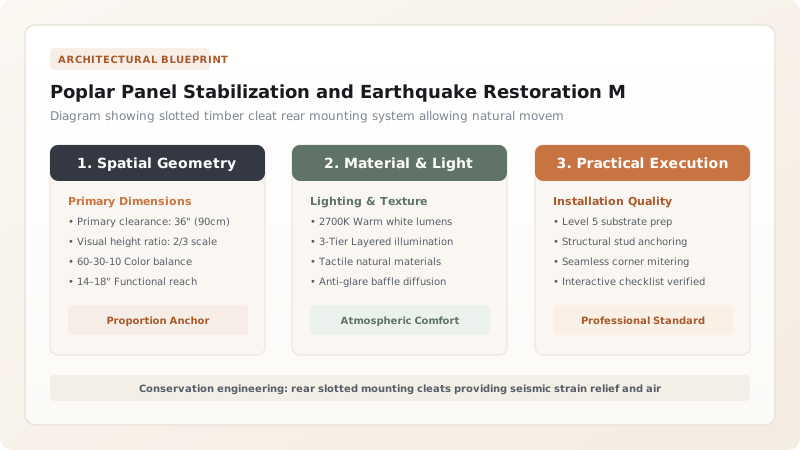
Conservators mount panels to a freestanding aluminum or laminated timber sub-frame using slotted sliding brass cleats. Oval holes allow the wooden poplar boards to expand and contract across seasonal humidity swings and absorb seismic ground accelerations. A mandatory 50mm rear air space is ventilated to prevent stale condensation from accumulating behind the antique woodwork.
Conservation Protocol for Damascene Ajami Architectural Elements
Use this reference table to calculate exact physical dimensions, ratios, and specifications before purchasing:
| Pathology / Damage | Historic Root Cause | Approved Conservation Protocol | Prohibited Invasive Method |
|---|---|---|---|
| Honeycombed Poplar Wood | Powderpost beetle larval galleries | Anoxic nitrogen chamber & Paraloid B-72 | Drenching with toxic liquid chemical sprays |
| Lifting Gilded Relief Gesso | Seismic shear & desiccation of gum | Micro-injection of 2% sturgeon isinglass | Gluing down with contact adhesive or superglue |
| Black Coal Soot & Grime | Decades of open oil lamps & heaters | Dry smoke sponge & 2% agarose gel peel | Washing with household liquid detergents |
| Cracked Board Joints | Hygroscopic timber cross-grain movement | Flexible loose-tongue splices & sliding cleats | Screwing boards rigid or filling with bondo |
Practical Constraints
Every successful decoration project must account for physical and environmental constraints:
Complex salvage geometry where dismantled Damascus rooms have lost their original architectural layout keys
Mitigation: Utilize high-precision photogrammetry and Persian-Ottoman poetic inscription order to reconstruct the room's original sequence.
Execution Blueprint & Craftsmanship Sequence
Execute this professional sequence to achieve flawless results without backtracking:
Quarantine and Perform Anoxic Nitrogen Fumigation
Seal panels in gas-tight polymer bubble, displace oxygen with pure nitrogen (<0.1%), and hold for 28 days to eradicate pests.
Inject Paraloid B-72 into Powderpost Beetle Flight Holes
Consolidate hollowed wood by gravity-feeding 10% Paraloid B-72 in acetone through beetle exit holes with medical syringes.
Re-Adhere Lifting Relief with Sturgeon Isinglass
Warm lifting anba flakes with micro-steam; inject 2% sturgeon glue and hold flat under lead-shot sandbags for 12 hours.
Extract Bituminous Soot with Rigid Agarose Gel Packs
Apply 2% agarose gel sheets conforming to carved relief; peel after 20 minutes to lift soot without liquid solvent runoff.
Re-Tension Panel Assembly onto Slotted Rear Cleats
Mount panels onto secondary support framing using slotted brass cleats that allow 10mm free hygroscopic movement.
Buff Gilded Surfaces with Microcrystalline Wax
Buff tin-gilded and copal-glazed surfaces with Renaissance microcrystalline wax to provide lasting dust and moisture protection.
Common Mistakes & Countermeasures
Avoid these costly errors that compromise aesthetics, ergonomics, and budget:
Using water-based cleaners or wet cotton swabs on lifting Ajami relief gesso
Screwing antique Ajami wooden boards directly into masonry walls with rawlplugs
Project Execution Checklist
Track your physical progress. Checkboxes persist automatically on this device:
Frequently Asked Questions
What is sturgeon isinglass and why is it preferred over rabbit-skin glue?
Isinglass is a collagen extracted from the swim bladders of sturgeon fish. It possesses the highest tensile strength, lowest surface tension, and greatest flexibility of any natural animal glue, wetting fragile micro-fissures effortlessly at lower application temperatures.
How do conservators protect Ajami rooms during war and civil conflict?
Heritage conservators wrap panels in acid-free tissue paper, face delicate relief with Japanese kozo paper and cyclododecane, pack them into custom-cushioned wooden crates, and store them in underground humidity-controlled vaults.


