
Al-anba is the specialized thixotropic relief paste of Damascene Ajami. Formulated from finely pulverized alabastrine gypsum, zinc white pigment, and natural gum tragacanth (katira) dissolved in water, the paste is piped through parchment cones or animal bladders onto primed poplar panels to create steep-sided 3D relief ornamentation up to 5mm tall that does not slump or shrink.
At a Glance: Key Takeaways
- Binder Mechanism: Natural gum tragacanth (Astragalus gummifer / katira) supplying thixotropic shear thinning.
- Mineral Pigment Matrix: 60% pulverized selenite gypsum, 30% zinc oxide (or lead white), and 10% chalk.
- Piping Cones: Traditional oiled parchment paper cones or sheep bladder bags fitted with brass tip nozzles.
- Relief Profile Height: 3.0mm to 5.0mm vertical relief holding crisp parabolic bead profiles.
- Drying Shrinkage Control: Gum tragacanth expands slightly in water, counteracting gypsum evaporation shrinkage.
- Carving / Shaving Window: Leather-hard paste can be carved and shaved with miniature scrapers 12 hours after piping.
The Chemistry of Katira: Gum Tragacanth Thixotropy
Common glues like animal hide glue or gum arabic become watery and slump when squeezed through a piping nozzle, collapsing into flat, rounded puddles. The secret of Damascene anba is gum tragacanth (locally called katira), an exudate from thorny Astragalus shrubs native to the Syrian desert and Anatolia.
Tragacanth contains tragacanthin (a water-soluble polysaccharide) and bassorin (an insoluble swelling polymer). When hydrated, it exhibits phenomenal thixotropy (shear-thinning behavior): under the extrusion pressure of the artisan's fingers, the paste flows smoothly through a 1mm brass nozzle; the instant it deposits onto the wooden board, it solidifies immediately, standing proud in crisp 4mm-tall beads without slumping or spreading.
Mineral Formulations: Gypsum, Zinc White, and Chalk
To prevent the piped paste from cracking during dryout, the mineral aggregate must be balanced. Pure gypsum shrinks as free water evaporates, while pure chalk lacks cohesive hardness.
Damascene masters mull a triple-mineral blend: 60% calcined selenite gypsum, 25% French zinc white (zinc oxide, providing stark opacity and fungal resistance), and 15% fine precipitated chalk (calcium carbonate). The dry powder is sieved through 150-mesh silk cloth and kneaded into the soaked gum tragacanth mucilage until it achieves the smooth, elastic consistency of royal icing.
Piping Disciplines and Secondary Chisel Modeling
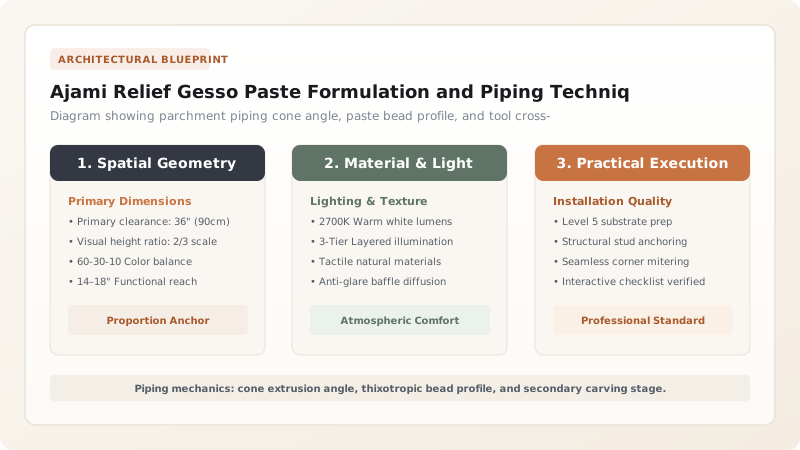
Piping is executed with oiled parchment paper cones (qartas). The artisan holds the cone at a 45° angle, keeping the tip 2mm above the panel surface so the paste bead drops onto the traced pencil layout under its own surface tension.
Master artisans pipe continuous interlaced guilloche ribbons, stylized Ottoman tulips, and carnations with steady rhythmic breathing. After drying for 12 hours to a firm cheese-like consistency, the artisan uses heated miniature scrapers and brass spatulas to carve delicate veins into the raised petals and shave the crests of geometric ribbons flat, preparing them for metal leaf gilding.
Al-Anba Relief Paste Formulations Across Damascene Workshops
Use this reference table to calculate exact physical dimensions, ratios, and specifications before purchasing:
| Component | Mass Percentage | Chemical Role | Processing Precaution |
|---|---|---|---|
| Calcined Mountain Gypsum | 55% – 60% | Primary structural mineral matrix | Must be milled sub-100 mesh |
| Zinc White (ZnO) | 25% – 30% | Dense white opacity & anti-fungal agent | Do not substitute toxic raw white lead |
| Precipitated Chalk (CaCO3) | 10% – 15% | Reduces shrinkage; adds tooth | Washed to eliminate soluble salts |
| Gum Tragacanth Mucilage | Liquid vehicle (approx. 20%) | Thixotropic binder & shear-thinning | Soak ribbon flakes in water for 48 hrs |
| Clove Essential Oil | 0.5% (few drops) | Natural biocide preventing mold growth | Add during final mortar mulling |
Practical Constraints
Every successful decoration project must account for physical and environmental constraints:
Extreme sensitivity of wet anba paste to vibration while drying
Mitigation: Store piped panels horizontally on dedicated vibration-isolated drying racks away from workshop pedestrian traffic.
Execution Blueprint & Craftsmanship Sequence
Execute this professional sequence to achieve flawless results without backtracking:
Hydrate Gum Tragacanth Ribbon Flakes for 48 Hours
Submerge 50g natural katira flakes in 1 liter distilled water; let swell into thick translucent gel and strain through linen.
Mull Gypsum and Zinc Oxide on Granite Slab
Grind calcined gypsum and zinc white together with glass muller until zero gritty particles remain.
Knead Minerals into Tragacanth Gel to Icing Consistency
Blend dry powder into gel, kneading with palette knives until paste holds stiff peaks without slumping.
Roll and Tape Oiled Parchment Piping Cones
Form conical paper cornet from oiled tracing paper; snip tip to create 1.5mm circular extrusion aperture.
Pipe Relief Arabesques onto Traced Poplar Board
Extrude continuous paste beads along layout lines, lifting tip cleanly at leaf ends to form sharp relief points.
Shave and Model Petal Veins after 12-Hour Semi-Cure
Carve fine veins into raised petals with miniature scrapers before paste achieves final stone-like hardness.
Common Mistakes & Countermeasures
Avoid these costly errors that compromise aesthetics, ergonomics, and budget:
Substituting PVA wood glue or modern caulk for gum tragacanth in anba paste
Piping paste too dry with insufficient water content
Project Execution Checklist
Track your physical progress. Checkboxes persist automatically on this device:
Frequently Asked Questions
Can al-anba paste be sanded with sandpaper?
No. Sanding rounds over crisp edges and scratches adjacent smooth panel areas. Damascene artisans always shave and model the semi-cured paste with heated brass spatulas and miniature steel scrapers.
Why is zinc oxide preferred over white lead in traditional anba?
While historic 17th-century recipes occasionally used white lead, 18th-century Damascene masters shifted to zinc white because lead reacts with atmospheric hydrogen sulfide, turning black over time, whereas zinc white stays brilliant white forever.


