
Historic Mudéjar Yesería was originally embellished with radiant mineral polychromy and pure gold leaf. Restoring these fragile painted plaster surfaces requires gentle non-contact cleaning (agarose gels or Nd:YAG laser cleaning), consolidating flaking paint with dilute Funori or sturgeon glue, and regilding lost raised strapwork using traditional Armenian red bole and water gilding with 23.75k loose gold leaf.
At a Glance: Key Takeaways
- Historic Color Palette: Lapis lazuli (blue), cinnabar (red), verdigris (green), and lead tin-yellow.
- Organic Mediums: Egg yolk tempera, animal collagen hide glue, and gum arabic binders.
- Gilding Technique: Traditional water gilding over burnished red Armenian bole (almagre clay).
- Non-Invasive Cleaning: Rigid agarose gel packs and low-energy pulsed Nd:YAG (1064nm) lasers.
- Paint Consolidation: Nebulized aerosol application of Japanese red algae extract (Funori) or fish glue.
- Ethics of Conservation: Strict reversibility and distinct differentiation between original pigment and modern fills.
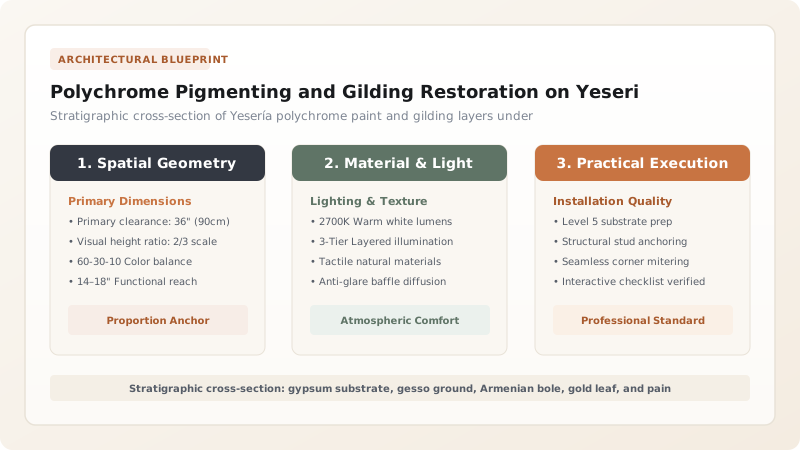
The Historic Mudéjar Palette: Mineral Chemistry and Gold Leaf
When modern visitors view Andalusian Yesería, they often perceive monochromatic white or cream plaster. In the 14th century, however, these interiors exploded with vibrant color. Plaster carvers applied a thin smoothing ground of fine gesso, followed by water gilding and saturated mineral pigments.
The color hierarchy was strictly coded: background hollows were painted in deep ultramarine blue (ground lapis lazuli) or bright cinnabar red to emphasize spatial depth. Raised strapwork ribbons and kufic inscriptions were gilded with genuine gold leaf beaten to a fraction of a micron. Under flickering oil lamps, the golden ribbons shone brilliantly against shadowy jewel-toned blue voids.
Degradation Pathologies: Candle Soot, Sulfation, and Cleaning
Centuries of exposure to olive oil lamp soot, candle smoke, bat guano, and fluctuating indoor relative humidity inflict severe damage on Yesería polychromy. Organic binders (egg tempera and animal glue) desiccate, causing paint layers to cup, blister, and flake away from the gypsum substrate.
Furthermore, sulfur dioxide in urban air converts surface calcium carbonate into black gypsum crusts (sulfation). Traditional liquid solvent washing is strictly forbidden because water dissolves the gypsum and pulls soot deeper into the porous plaster. Conservators deploy rigid agarose gel poultices or low-energy pulsed Nd:YAG lasers, which cleanly vaporize dark soot crusts without heating or altering the underlying fragile mineral pigment layer.
Consolidation with Funori and Reversible Water Gilding
Flaking polychrome flakes are consolidated using dilute solutions of Funori—a polysaccharide mucilage extracted from Japanese red algae (Gloiopeltis tenax)—or 2% sturgeon glue applied warm with a fine 000 sable brush. Unlike synthetic acrylic polymers (like Paraloid), Funori introduces zero artificial gloss and does not alter the refractive index or matte texture of the historic pigments.
Where gold leaf has been abraded or lost, conservators apply a traditional water gilding ground composed of fine Armenian bole (red iron-rich clay) mixed with rabbit-skin glue. Once dried and polished with an agate burnisher, loose 23.75-karat gold leaf is floated onto the surface using a gilder's liquor of alcohol and water, instantly snapping flat and burnishing to an authentic historic luster.
Conservation Treatment Matrix for Yesería Polychrome and Gilding
Use this reference table to calculate exact physical dimensions, ratios, and specifications before purchasing:
| Degradation State | Target Layer | Recommended Conservation Method | Prohibited Invasive Method |
|---|---|---|---|
| Superficial Smoke Soot | Surface pigment & gold | Rigid Agarose gel peel / Q-switched laser | Scrubbing with water or chemical detergents |
| Cupping / Flaking Paint | Mineral pigment layer | Micro-injection of 1.5% warm Funori | Coating with modern polyurethane or shellac |
| Chalking / Friable Gypsum | Plaster carving body | Barium hydroxide / ammonium oxalate poultice | Silicone water-repellent sprays |
| Lost Gilded Strapwork | Raised ribbon rims | Traditional Armenian bole & 23.75k gold leaf | Painting with bronze powder / gold acrylic paint |
Practical Constraints
Every successful decoration project must account for physical and environmental constraints:
Scaffolding access inside high monumental palatial rooms without anchoring into historic floors
Mitigation: Erect freestanding aluminum roll-scaffolding resting on heavy neoprene distribution pads spread over temporary plywood sub-floors.
Execution Blueprint & Craftsmanship Sequence
Execute this professional sequence to achieve flawless results without backtracking:
Perform Multispectral Imaging and Stratigraphic Cross-Section
Examine panels under UV and infrared light; take 1mm micro-core samples to document original pigment stratification.
Clean Soot Crusts Using Rigid Agarose Gel
Cast 2% agarose gel sheets conforming to carved relief; leave for 20 minutes to absorb particulate soot without liquid runoff.
Consolidate Flaking Paint with Natural Polysaccharides
Introduce 1.5% warm Funori solution beneath lifting paint scales using insulin micro-syringes; gently press flat with silicone tip.
Apply Traditional Red Armenian Bole Ground
Paint localized repair zones with three fine coats of warm Armenian red clay bole bound in rabbit-skin glue.
Water-Gild with 23.75-Karat Loose Gold Leaf
Wet bole with gilder's liquor, transfer gold leaf with gilder's tip brush, and allow capillary action to draw leaf tight.
Burnish Gold and Distinguish Conservation Fills
Burnish gold with dog-tooth agate stone. Apply subtle matte distressing to visually distinguish repairs from original 14th-century work.
Common Mistakes & Countermeasures
Avoid these costly errors that compromise aesthetics, ergonomics, and budget:
Repainting historic Yesería with modern metallic gold paint or bronze powder
Applying wet aqueous cotton swabs to unsealed historic tempera paint
Project Execution Checklist
Track your physical progress. Checkboxes persist automatically on this device:
Frequently Asked Questions
Why is Armenian bole red beneath gold leaf?
Armenian bole is a soft iron-oxide rich clay. Its red hue lends warm optical depth to translucent micro-thin gold leaf, and its fine colloidal texture allows flawless burnishing with an agate stone.
What is the primary advantage of Funori over modern synthetic glues?
Funori dries completely matte, does not discolor with age, remains completely water-reversible, and possesses very low surface tension, allowing it to penetrate micro-fissures effortlessly.


