
Formulating Mudéjar yeso muerto requires low-calcined alabastrine gypsum mixed with excess water (water-to-gypsum ratio 0.85:1) and continuously agitated for 35–45 minutes to suppress primary crystal crystallization. Organic retarders such as animal glue water or bone broth can extend the open carving window to 6 hours, allowing clean gouging of acute geometric angles without surface tearout.
At a Glance: Key Takeaways
- Calcination Temperature: Controlled 130°C–150°C converting natural selenite/alabaster to pure beta-hemihydrate.
- Water-to-Binder Ratio: High 0.80 to 0.90 ratio by weight yielding optimal plasticity without weakening final density.
- Mechanical Retardation: Continuous 40-minute rotary stirring breaking dihydrate acicular crystalline needles.
- Organic Chemical Retardation: 0.5% rabbit-skin glue or bone gelatine solution added to gauging water.
- Carving Tools: High-speed carbon gouges (fermoirs), curved scrapers (rasquetas), and bone burnishers.
- Hardened Density: Reaches 1,150–1,250 kg/m³ with a smooth, chalk-free ivory surface finish.
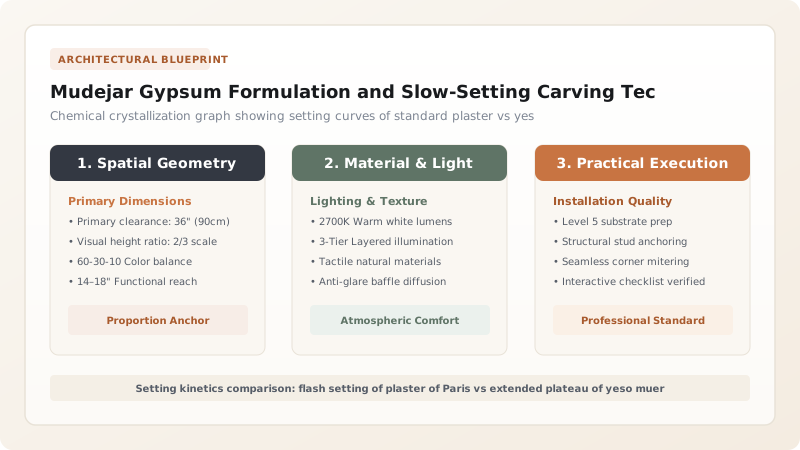
Alabastrine Rock Chemistry and Low-Temperature Calcination
The chemical foundation of historic Yesería is natural alabastrine gypsum (calcium sulfate dihydrate, CaSO4·2H2O), celebrated for its translucent, compact micro-crystalline structure. Unlike coarse agricultural gypsum, Spanish alabaster from quarries in Aragon and Granada contains less than 1% clay and iron oxide impurities.
The raw rock is roasted in wood-fired reverberatory kilns at gentle temperatures strictly maintained between 130°C and 150°C. This gently expels 75% of the bound crystalline water, yielding beta-hemihydrate (CaSO4·0.5H2O). If kiln temperatures spike above 200°C, the mineral transforms into anhydrous 'overburnt' gypsum (anhydrite), which sets sluggishly and lacks mechanical cohesion.
The Physics of Yeso Muerto: Mechanically Broken Crystals
The core secret of Mudéjar craftsmanship is the deliberate mechanical modification of crystal kinetics. When standard hemihydrate is mixed with water, gypsum crystals immediately nucleate as sharp, interlocking needle-shaped dihydrate prisms (acicular crystallization), creating a rigid lattice within minutes.
To create yeso muerto, the plasterer mixes the calcined powder into a shallow wooden trough (gamella) filled with water. As the slurry begins its initial exothermic hydration, the artisan beats and paddles the mixture continuously for 35 to 45 minutes. This continuous shear action physically snaps the microscopic needle crystals, preventing them from interlocking. When poured and smoothed onto the wall, the slurry hardens by slow, dense evaporation and secondary crystal reprecipitation, yielding a dense, butter-soft mass that cuts like chilled soap for hours.
Carving Disciplines: Skew Chisels, Undercuts, and Sebka
Carving begins when the plaster reaches the 'leather-hard' state—firm to the touch but yielding smoothly to steel without crumbling. Artisans work with razor-honed carbon steel gouges and skew chisels ground to a delicate 20° cutting bevel.
For complex sebka interlacing panels, the carver executes vertical boundary incisions along the traced lines, followed by angled relief gouging that slopes inward at 45° to 60°. Undercutting the raised ribbons creates deep shadow voids that make the plasterwork appear to float independently of the structural wall behind it.
Gypsum Slurry Mix Formulations for Yesería Layers
Use this reference table to calculate exact physical dimensions, ratios, and specifications before purchasing:
| Layer Stage | Gypsum Type | Water/Plaster Ratio | Additives / Retarders | Cured Compressive Strength |
|---|---|---|---|---|
| Rough Scratch Base | Coarse hemihydrate | 0.65 : 1 | Chopped esparto fiber (2% vol) | 14.5 MPa (structural key) |
| Leveling Float Bed | Fine alabaster plaster | 0.75 : 1 | Clean river sand (15% vol) | 11.2 MPa (medium bed) |
| Carving Finish Bed | Yeso muerto (beaten) | 0.85 : 1 | 0.5% animal hide glue water | 8.5 MPa (plastic & carveable) |
| Cast Muqarnas Units | Fast-set hemihydrate | 0.70 : 1 | None (pure water) | 16.0 MPa (rigid casting) |
Practical Constraints
Every successful decoration project must account for physical and environmental constraints:
Rapid ambient drying in hot southern Spanish summer climates dehydrating plaster before crystal knitting
Mitigation: Hang wet burlap drop-cloths in front of curing wall panels and mist ambient air with fine water vapor.
Execution Blueprint & Craftsmanship Sequence
Execute this professional sequence to achieve flawless results without backtracking:
Sift Fine Alabaster Hemihydrate Powder
Pass raw calcined gypsum through 100-mesh brass sieve to eliminate coarse lumps and unburnt rock particles.
Prepare Organic Animal Glue Retarder Water
Dissolve 50 grams of dry rabbit-skin glue granules in 10 liters of warm water; allow to cool to ambient temperature.
Slake Gypsum into Liquid Trough
Sprinkle dry gypsum powder evenly across the surface of the retarder water until small islands form; let soak 5 minutes.
Agitate and Beat Slurry to 'Kill' Initial Set
Stir and beat the slurry with a flat wooden paddle continuously for 40 minutes, breaking initial crystal needles.
Trowel Carving Bed onto Keyed Substrate
Apply smooth 20mm layer over scratch coat. Level with aluminum or boxwood straightedge to optical flatness.
Execute Deep Relief Carving During 4-Hour Window
Transfer cartoon and cut decorative motifs using skew chisels, frequently blowing away carved gypsum shavings.
Common Mistakes & Countermeasures
Avoid these costly errors that compromise aesthetics, ergonomics, and budget:
Adding extra water to stiffening plaster after it has begun its final chemical set
Carving plaster with dull tools or woodturning gouges
Project Execution Checklist
Track your physical progress. Checkboxes persist automatically on this device:
Frequently Asked Questions
Can commercial chemical plaster retarders (like citric acid) replace yeso muerto beating?
While citric acid or tartaric acid delays setting, they can cause crystalline efflorescence and reduce surface hardness, whereas mechanical crystal-breaking produces a denser, superior carving body.
What is the maximum depth a single layer of Yesería plaster can be carved?
Standard direct-carved panels range from 15mm to 25mm in relief depth. Reliefs exceeding 30mm require built-up multi-layer armatures or attached cast gypsum elements.


