
Spanish Yesería is an extraordinary architectural plastercraft perfected during the Andalusian Hispano-Moresque and Mudéjar periods (12th–16th centuries), exemplified by the Alhambra and the Alcázar of Seville. Master plasterers applied slow-setting alabastrine gypsum plaster (yeso muerto) over reed and timber armatures, carving deep geometric filigree lace (sebka), Arabic epigraphy, and three-dimensional corbelled stalactite vaults (mocárabes/muqarnas) while wet, subsequently accented with mineral polychromy and pure 24-karat gold leaf.
At a Glance: Key Takeaways
- Material Chemistry: Alabastrine hemihydrate gypsum (CaSO4·0.5H2O) slaked into slow-setting 'yeso muerto' (dead plaster).
- Architectural Typology: Pierced filigree lace friezes (sebka), epigraphic bands, and three-dimensional muqarnas vaults.
- Substrate Armature: Split chestnut or pine rib cages lashed with braided esparto grass cords and plaster dip.
- Carving Execution: Direct in-situ wet-state chiseling using gouges, iron spatulas, and wooden mallets before crystallization.
- Aesthetic Hierarchy: Smooth ivory relief fields contrasted against vibrant lapis, vermilion, and gilded background hollows.
- Historic Pinnacle: Nasrid palaces of the Alhambra in Granada and Mudéjar courtyards of the Alcázar in Seville.
In-Depth Guides in this Directory
Explore specialized subtopic blueprints, technical dimensions, and execution checklists:
Mudejar Gypsum Formulation and Slow-Setting Carving Techniques
Technical chemistry and workshop guide to formulating slow-setting yeso muerto plaster and executing deep Andalusian lace carving.
Muqarnas Stalactite Vault Geometry and Armature Framing
Architectural and mathematical guide to Mudéjar muqarnas stalactite vaults: 2D plan projection, timber rib framing, and corbelled gypsum assembly.
Polychrome Pigmenting and Gilding Restoration on Yeseria Panels
Restoration protocol for historic Mudéjar Yesería: mineral polychrome pigments, egg tempera consolidation, water gilding, and laser cleaning.
Historical Genesis and Architectural Philosophy of Yesería
In Islamic and Mudéjar architecture of the Iberian Peninsula, plaster was transformed from a humble leveling mortar into a transcendent medium of optical weightlessness. Known as yesería (from the Spanish yeso, meaning gypsum plaster), this art form dematerialized solid stone and brick walls into intricate lacework screens, dissolving the boundaries between structure and divine geometry.
Following the Christian Reconquista, Andalusian Muslim craftsmen (Mudéjares) were commissioned by Christian monarchs—most notably King Pedro I of Castile—to ornament royal palaces, cathedrals, and synagogues such as Santa María la Blanca in Toledo. Yesería blended Islamic non-representational strapwork and kufic calligraphy with Castilian heraldic shields, creating Spain's distinctive Mudéjar architectural vernacular.
Alabastrine Gypsum Chemistry and the Secret of 'Yeso Muerto'
Standard calcined plaster of Paris flash-sets within 10 to 15 minutes, making intricate artistic hand-chiseling impossible. Mudéjar plasterers resolved this through the formulation of yeso muerto ('dead' or killed plaster). High-purity alabaster gypsum rock mined from Sorbas and Zaragoza was calcinated at low kiln temperatures (130°C–160°C) into beta-hemihydrate (CaSO4·0.5H2O).
When mixing, the artisan repeatedly stirred the gypsum slurry with excess water over an extended 45-minute period, physically breaking the initial needle-like gypsum dihydrate crystal nucleations as they began to knit. This mechanical retardation produced a buttery, plastic paste that stayed workable for 4 to 6 hours, allowing master carvers to slice clean, razor-sharp architectural lace without chipping or rapid hardening.
Muqarnas Stalactite Geometry and Armature Engineering
The three-dimensional pinnacle of Yesería is the muqarnas (in Spanish, mocárabe)—honeycomb or stalactite pendentive vaults that bridge square rooms into circular domes. Muqarnas are not solid masonry; doing so would collapse the roof under immense deadweight.
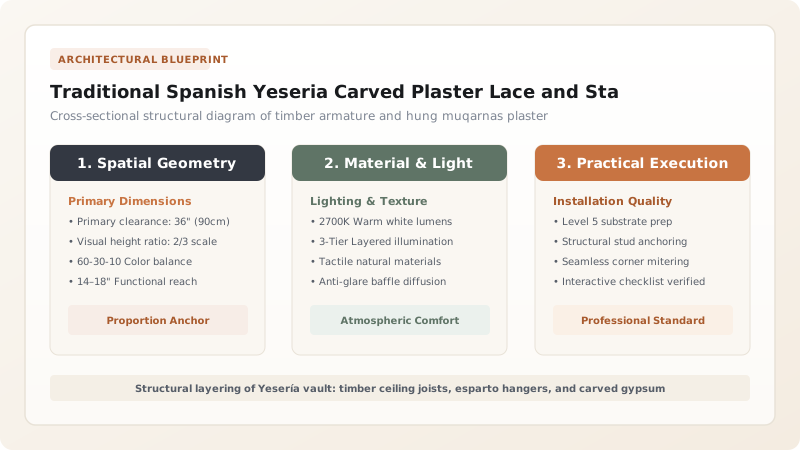
Instead, Mudéjar carpenters erected a lightweight timber ribcage suspended from overhead ceiling joists. Bundles of wild Mediterranean esparto grass (Macrochloa tenacissima) soaked in liquid gypsum slurry were wrapped around the timber ribs, forming an indestructible fiber-reinforced hanging composite. Individual hollow-cast or hand-carved prism units were then bedded in gypsum mortar onto this armature in corbelled concentric rings, cantilevered outward tier by tier.
Comparative Analysis of Spanish Plasterwork Disciplines
Use this reference table to calculate exact physical dimensions, ratios, and specifications before purchasing:
| Plaster Discipline | Binder Matrix | Workable Window | Carving / Modeling Method | Primary Architectural Zone |
|---|---|---|---|---|
| Yeso Muerto Carved | Alabastrine gypsum (CaSO4·0.5H2O) | 3 to 6 hours | Direct wet-carving with steel gouges | Sebka wall friezes, dados, door arches |
| Cast Muqarnas (Mocárabe) | Quick-setting calcined plaster & esparto | 15 to 30 minutes | Modular plaster unit molds bedded dry | Dome squinches, pendentives, stalactite vaults |
| Lime Stucco (Estuco) | Slaked non-hydraulic lime & marble dust | 24 to 48 hours | Burnished flat troweling & sgraffito | Exterior courtyards exposed to driving rain |
| Aljez Cast Lattice | Coarse impure mountain gypsum | 10 to 20 minutes | Two-part timber open matrix molds | Window jalousies and clerestory grilles |
Practical Constraints
Every successful decoration project must account for physical and environmental constraints:
Extremely brittle nature of gypsum under structural building settlement movements
Mitigation: Incorporate flexible esparto rope shock-absorbing joints between wall framing and plaster frieze armatures.
Execution Blueprint & Craftsmanship Sequence
Execute this professional sequence to achieve flawless results without backtracking:
Construct Structural Timber and Esparto Sub-Armature
Fasten cedar or pine ribs to brick walls. Tie braided esparto grass dipped in gypsum slurry to form a keyed backing matrix.
Formulate and Beat Slow-Setting Yeso Muerto
Mix alabastrine gypsum with cold spring water. Continuously agitate slurry for 40 minutes to break premature crystal lattices.
Apply Base Plaster Grounds and Leveling Bed
Trowel 25mm thick base coat over the esparto key, leveling with a straightedge and scratching surface for mechanical tooth.
Transfer Geometric Sebka and Epigraphic Grid
Pounce charcoal dust through perforated parchment cartoons or scribe geometric strapwork directly into damp plaster face.
Direct Wet-Carving with High-Carbon Gouges
Excavate negative ground to 20mm depth using skew gouges, profiling multi-tiered sebka lozenges with crisp undercuts.
Apply Mineral Polychromy and Gold Leaf
Prime carved recesses with rabbit-skin glue. Paint with lapis lazuli and vermilion tempera, laying 24k gold leaf on raised rims.
Common Mistakes & Countermeasures
Avoid these costly errors that compromise aesthetics, ergonomics, and budget:
Using modern rapid-setting plaster of Paris without retarders for carved Yesería
Applying Yesería directly onto damp exterior masonry exposed to open rain
Project Execution Checklist
Track your physical progress. Checkboxes persist automatically on this device:
Frequently Asked Questions
Why is Yesería carved wet rather than cast in molds?
Master Andalusian works were carved wet by hand to achieve dramatic undercuts, micro-textures, and site-specific geometric adjustments that rigid plaster molds cannot replicate without visible seams.
How do conservators clean centuries-old soot and dust from Yesería without dissolving the plaster?
Conservators use dry vulcanized rubber sponges (smoke sponges) and localized brush application of agar-agar or cyclododecane gel, strictly avoiding liquid water washes that dissolve gypsum.


