
The metallic splendor of Spanish Guadamecí leather begins with sumac-tanned sheepskin (badana), meticulously shaved on a convex currier's beam to a uniform 1.3 mm caliper. To prepare the supple corium for gilding without absorbing liquids, craftsmen apply multi-stage sealers of parchment gel size and whipped egg-white glair. Pure beaten silver leaf is laid across the damp mordant, pressed with velvet pads, and burnished to a mirror polish with hard agate stones. The silver is then coated with warm Corladura—a cooked linseed oil varnish infused with saffron, aloe, and mastic—optically transforming the silver into a radiant, tarnish-proof imitation of gold leaf.
At a Glance: Key Takeaways
- Gilding Mordant: Clarified egg-white glair + trace rock candy sugar
- Leaf Specification: Pure beaten silver leaf (Plata pura, 95x95mm sheets)
- Lustre Glaze (Corladura): Boiled stand oil + Greek mastic resin + Saffron & Aloe dye
- Substrate Skin: Sumac-tanned yearling Merino sheepskin (1.2–1.4mm thickness)
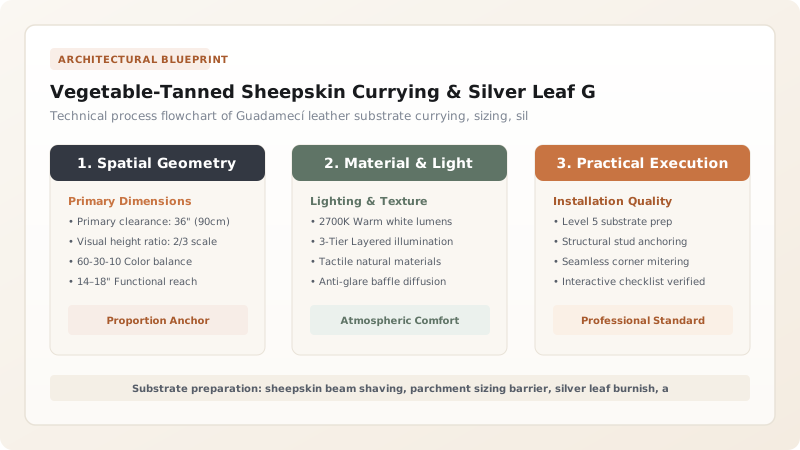
Currying the Badana: Caliper Uniformity and Beam Shaving
A successful Guadamecí wall panel requires a flawless, flat substrate. Yearling Merino sheepskins (badana) tanned in pure Sicilian sumac are soaked in clean rainwater to regain suppleness. The currier drapes the damp skin over a steeply inclined, convex wooden currying beam (banco de curtir).
Using a heavy, two-handled currier’s shaving knife with a turned micro-burr, the craftsman systematically pares down thick neck wrinkles and flank fat deposits. The goal is an absolute uniform caliper of 1.3 mm across the entire skin. Any unevenness in thickness will cause silver leaf to wrinkle or crack during subsequent matrix press embossing.
Pore Sealing: Parchment Glue and Egg Glair Priming
Tanned sheepskin is inherently porous. If varnish or gilding liquids were applied directly, they would sink into the fibrous corium, creating dark oil stains and patchy, dull spots. Spanish masters developed an impermeable barrier system.
First, the grain surface is brushed with a warm 5% solution of parchment size, made by gently simmering clean vellum clippings in distilled water for eight hours. This natural collagen broth seals the open hair follicles. Once dry, the craftsman applies two coats of egg-white glair (beaten egg whites rested for 24 hours until clarified into a liquid serum). The albumen provides an elastic, high-tack surface that bonds molecularly with both the leather collagen and the metallic leaf.
Silver Leaf Laying and Mirror Agate Burnishing
While the second coat of glair remains slightly tacky, sheets of beaten silver leaf (panes de plata, measuring 95x95 mm) are lifted from the gilder’s cushion using a badger-hair tip. The leaves are laid across the skin with a 3 mm overlap, creating a continuous metallic mantle. A soft velvet or hare's-foot pad presses the leaf firmly into the mordant.
After drying for four hours, the gilding is burnished. Using a curved, mirror-polished agate stone (or historically, a wolf’s canine tooth), the artisan rubs the silver with firm, circular strokes. The immense localized pressure compresses the microscopic crystal facets of the silver leaf, transforming the dull gray foil into a blinding, liquid mirror.
The Secret Formula: Cooking the Golden Corladura Varnish
The crowning alchemy of Spanish leatherwork is La Corladura—the secret varnish that turns silver into gold. In copper cauldrons over charcoal embers, the master cooked pure cold-pressed linseed oil with Greek mastic resin tears, sandarac, and oil of spike lavender until it formed a thick, stringing syrup.
While warm, natural colorants were infused: powdered Persian saffron for radiant golden-yellow, Socotrine aloe resin for rich amber warmth, and a hint of dragon's blood resin for deep Renaissance warmth. Applied in smooth, rapid strokes with a wide goat-hair brush, this warm lacquer covers the mirror-burnished silver. The amber glaze absorbs blue wavelengths while allowing yellow-red light to reflect off the silver, creating an optical illusion of solid 24-karat gold that resists air oxidation permanently.
Guadamecí Sizing & Gilding Formulations
Use this reference table to calculate exact physical dimensions, ratios, and specifications before purchasing:
| Formula Stage | Key Ingredients & Ratios | Application Temperature | Drying / Cure Time | Critical Function |
|---|---|---|---|---|
| Parchment Size | Simmered calf vellum scraps in rainwater (1:10) | Warm (40°C) | 6 hours air dry | Seals leather hair follicles; prevents oil penetration |
| Egg-White Glair | Clarified egg albumen + 2% rock candy sugar | Ambient (20°C) | Tacky in 10 minutes | Elastic protein mordant bonding silver leaf to skin |
| Silver Leaf Mantle | Pure 99.9% beaten silver leaf (0.2 microns) | Applied at room temp | 4 hours before burnish | Provides high-reflectivity mirror metallic substrate |
| Golden Corladura | Boiled linseed oil + mastic + saffron + aloe | Lukewarm (30°C) | 48 hours in solar oven | Optically transforms silver to gold; seals against tarnish |
Practical Constraints
Every successful decoration project must account for physical and environmental constraints:
Atmospheric Humidity Clouding Linseed Oil Corladura (Blooming)
High ambient moisture during varnishing causes microscopic water droplets to trap in oil, turning golden varnish milky. Solution: Apply corladura strictly in low-humidity workshops (under 50% RH) and infuse varnish with 5% oil of spike lavender to flash off moisture.
Brittle Cracking of Silver Leaf During Deep Embossing
If silver leaf is burnished too hard, work-hardening can cause metal foil to micro-fissure under embossing press pressure. Solution: Incorporate 2% honey or rock sugar into egg glair mordant to maintain long-term plastic elasticity in the bond line.
Execution Blueprint & Craftsmanship Sequence
Execute this professional sequence to achieve flawless results without backtracking:
Sumac Sheepskin Dampening and Slicking
Sponge sumac-tanned sheepskin with clean water; slick flesh side completely flat on marble slab with a boxwood slicker.
Beam Shaving to 1.3mm Caliper
Mount damp skin over convex currying beam; shave corium with two-handled currier's knife until caliper is uniform within 0.1mm.
Parchment Collagen Size Application
Brush warm parchment size across the grain side; allow to penetrate and cross-link with leather collagen for 6 hours.
Egg Glair Coating and Silver Leaf Transfer
Apply clarified egg-white glair; lift silver leaf with gilder's tip; lay onto tacky surface with 3mm overlapping margins.
Velvet Tamping and Agate Stone Burnishing
Tamp leaf with velvet pad; dry 4 hours; burnish silver with smooth agate stone until high-gloss optical reflection is achieved.
Corladura Varnish Coating and Solar Curing
Brush warm saffron-linseed corladura over burnished silver; cure in warm drying shed or solar oven for 48 hours until glass-hard.
Common Mistakes & Countermeasures
Avoid these costly errors that compromise aesthetics, ergonomics, and budget:
Applying Corladura Varnish Too Cold or Overly Thick
Burnishing Silver Leaf Before Glair Mordant Is Completely Dry
Project Execution Checklist
Track your physical progress. Checkboxes persist automatically on this device:
Frequently Asked Questions
Can imitation aluminum leaf be used instead of real silver leaf?
No. Aluminum leaf is too stiff, lacks the microscopic malleability of silver, and does not accept agate burnishing without scratching. More importantly, aluminum does not interact optically with the warm amber saffron corladura glaze, producing a harsh, cold metallic tint rather than authentic Renaissance gold.
Why did curriers use yearling sheepskins rather than mature sheep?
Yearling sheepskins have exceptionally fine, tight epidermal pores and minimal subsurface fat voids. Older sheep have coarse hair follicles and loose spongy collagen layers that produce uneven, pebbled surfaces unsuitable for mirror silver leaf gilding.
What is 'Glair' and why is it preferred over animal glue for gilding leather?
Glair is clarified egg white that has been whipped to a froth and allowed to liquefy over 24 hours. Unlike animal hide glue, which dries stiff and brittle, dried egg albumen remains flexible, moving naturally with the flexible leather skin without flaking or pulling the silver off.
How long does a corladura-varnished silver panel retain its golden color?
When formulated with genuine boiled linseed stand oil and mastic resin, corladura forms an airtight, polymerized barrier over the silver. Historic 16th-century panels in Spanish cathedrals remain brightly golden after more than 400 years, free of silver oxidation.


