
Scottish Harling Trowel Casting Techniques and Bell-Cast Details embody the kinetic mastery of external lime finishing. Unlike flat plastering, harling is applied entirely by throwing. Using a specialized curved banjo-shaped iron harling trowel, the mason scoops a controlled measure of lime-granite slurry and casts it against the wall with an explosive, snapping wrist action. Alongside projecting swept bell-cast drip profiles at stringcourses and foundation plinths, this roughcast geometry deflects gallons of driving rain away from historic masonry.
At a Glance: Key Takeaways
- Curved Banjo Harling Trowel: Heart-shaped or oval iron blade with raised lip designed to hold fluid granite slurry.
- The Kinetic Wrist Snap: Accelerating slurry so it splatters flat against stone under high kinetic impact.
- Overlapping Fish-Scale Pattern: Casting in rhythmic horizontal bands overlapping previous throws by 30%.
- Bell-Cast Water Shedding Flairs: Swept convex plaster projections kicking descending water sheets clear of lower walls.
- Arris and Corner Detailing: Softly rounded, hand-thrown corners that resist high-velocity wind erosion.
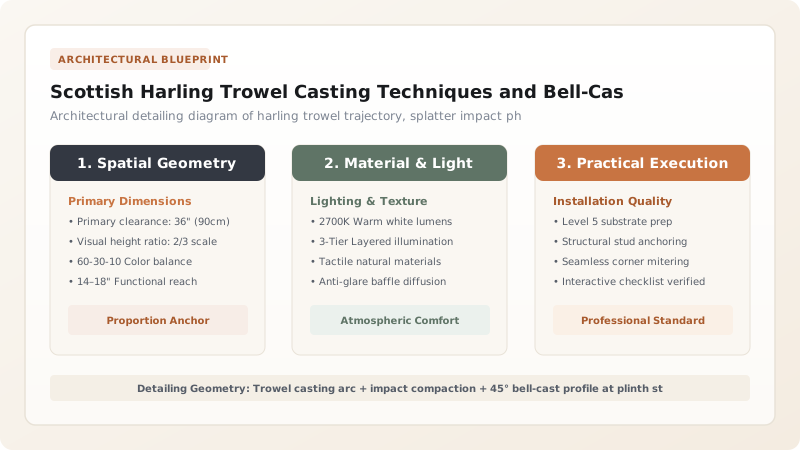
1. Tool Geometry: The Scottish Banjo Harling Trowel
Standard rectangular plastering trowels are useless for throwing harling; slurry slides off the flat edges before reaching the wall. Scottish masons designed the harling trowel (or banjo trowel).
Featuring a curved, dished oval or heart-shaped blade with rolled outer edges and an offset cranked wooden handle, the tool acts as a ladle and a catapult. The craftsman scoops approximately 300ml of slurry, holds the blade parallel to the shoulder, and casts it across a distance of 300mm to 450mm toward the wall with a sharp, downward snapping motion of the wrist.
2. Kinetic Physics: Why Casting Beats Troweling
When a wet mortar is pushed onto a wall with a flat steel trowel, the pressing action drags fine binder to the surface, creating a smooth, brittle skin prone to crazing. When harling is thrown with kinetic velocity, the physical impact drives the wet lime paste deep into microscopic crevices and stone pores.
Simultaneously, the heavier granite aggregate chips bounce slightly, remaining proud of the surface. Masons cast in horizontal sweeps from top to bottom, overlapping each trowel strike by 30% like fish scales to guarantee complete, void-free coverage.
3. Architectural Detailing: The Essential Bell-Cast
In Scotland's wind-swept terrain, massive sheets of rainwater stream down multi-story castle facades. If allowed to run down to ground level, water saturates the foundation masonry. Builders counter this with the bell-cast (or corbie bell).
Formed over projecting stone stringcourses or slate ledges at the building base, the mason builds up thick layers of lime mortar curved outward into a convex flared bell profile. Rain running down the wall hits this bell-cast curve and is thrown 100mm to 150mm outward, splashing harmlessly onto gravel perimeter drains rather than soaking the foundation stone.
Scottish Harling Application Ergonomics & Coverage Rates
Use this reference table to calculate exact physical dimensions, ratios, and specifications before purchasing:
| Application Zone | Trowel Throw Distance | Target Coat Thickness | Granite Aggregate Size | Daily Output (Crew of 2) |
|---|---|---|---|---|
| High Tower Walls (Field) | 350mm - 450mm from wall | 8mm - 10mm single cast | 5mm - 8mm Crushed Granite | 45 - 60 m² / day |
| Window & Door Reveals | 200mm - 300mm close range | 6mm - 8mm fine cast | 3mm - 5mm Crushed Quartz | 20 - 30 linear meters / day |
| Projecting Bell-Cast Plinth | Multi-pass built-up trowel | 25mm - 40mm flared base | Coarse pinning stone chips | 15 - 20 linear meters / day |
| Crow-Stepped Corbie Gables | Hand-cast angled strikes | 10mm - 12mm heavy harl | 6mm - 10mm Granite Chips | 10 - 15 gables / day |
Ergonomic & Wind Constraints
Every successful decoration project must account for physical and environmental constraints:
Severe Shoulder and Elbow Strain
Continuous repetitive casting of heavy wet granite slurry causes tendonitis; masons rotate roles hourly.
Scaffolding Bounce
Flimsy scaffolding boards absorb the mason's casting energy; scaffolds must be tied rigidly to masonry anchor bolts.
Protocol for Casting Harling and Forming a Bell-Cast Drip
Execute this professional sequence to achieve flawless results without backtracking:
Substrate Pre-Wet & Suction Control
Mist dry rubble wall with water until damp but not running; verify masonry suction pulls water in within 30 seconds.
Bell-Cast Ledger Slate Installation
Bed horizontal slate projecting tiles along foundation plinth at 15° downward tilt to form structural shelf for bell-cast.
Bell-Cast Mortar Building
Trowel stiff hot-mixed lime mortar over slate ledge; shape into sweeping convex flare using curved wooden profile template.
Harling Slurry Staging on Hawk
Ladle 1 liter of granite-lime slurry onto wooden hawk; hold hawk close to body at chest height.
Kinetic Banjo Trowel Casting
Scoop slurry with curved banjo trowel; cast with sharp snapping wrist action perpendicular to wall from 400mm distance.
Overlap Inspection & Touch-Up
Inspect wet textured roughcast under raking light; cast small supplementary dollops into sparse voids; never touch with trowel face.
Common Mistakes & Countermeasures
Avoid these costly errors that compromise aesthetics, ergonomics, and budget:
Throwing harling from too far away (> 700mm) or with a weak, sweeping arm motion
Creating razor-sharp 90° square corners on exterior window reveals
Project Execution Checklist
Track your physical progress. Checkboxes persist automatically on this device:
Frequently Asked Questions
Why is harling cast by hand rather than sprayed with modern plaster spray pumps?
Pumps require wet, high-slump mortars with rounded aggregates to avoid clogging nozzles; this produces a weak, water-diluted paste that sags. Hand casting allows the use of dense, low-water slurries packed with large, sharp, jagged granite chips that mechanical pumps cannot push.
How do you achieve a uniform texture across a huge castle wall?
By having a pair of masons work side by side across the scaffolding lift, matching their throw rhythm, distance, and slurry consistency so the individual trowel strokes blend into an unbroken, uniform roughcast blanket.


