
Hot-Mixed Quicklime and Sharp Granite Slurry forms the chemical and physical engine of authentic Scottish harling. Unlike pre-hydrated bagged lime, hot-mixed mortar is prepared by slaking calcium oxide quicklime (kibbled CaO) directly with wet, sharp crushed granite aggregates on site. The intense thermal reaction expands the lime molecules into microscopic crystals that coat each granite particle in a hot, hyper-sticky binder, providing unmatched adhesive suction onto cold, wet Scottish rubble stone.
At a Glance: Key Takeaways
- Exothermic Slaking Reaction: Temperatures reaching 150°C during slaking, breaking down quicklime into active nano-particles.
- Sharp Angular Granite Aggregate: Crushed igneous granite (3mm - 8mm) providing mechanical interlocking strength.
- Hyper-Sticky Green Cohesion: High initial suction bond adhering immediately to vertical stone masonry without sagging.
- Enhanced Vapor Permeability: Micro-porous matrix allowing damp stone walls to evaporate moisture rapidly.
- Frost-Resistant Chemistry: Natural pore structure providing micro-reservoirs that absorb freeze-thaw expansion cycles.
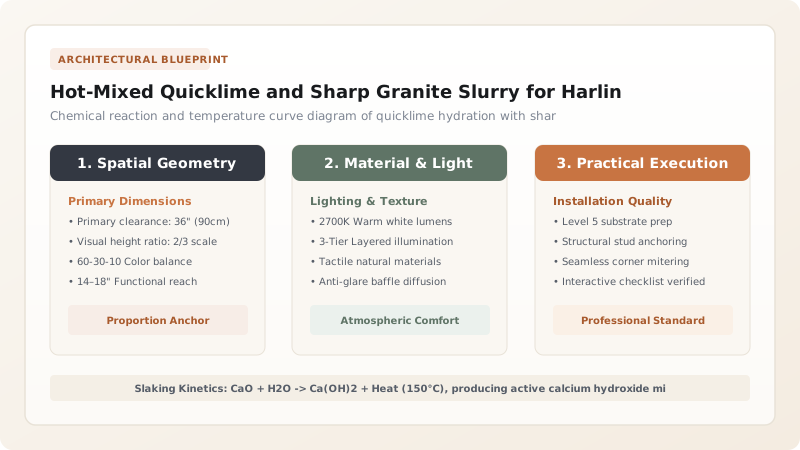
1. Exothermic Slaking Chemistry: Why Hot-Mix Outperforms Lime Putty
When high-calcium quicklime (calcium oxide, CaO) encounters water, it undergoes a violent exothermic reaction, releasing approximately 1,150 kJ/kg of heat and expanding to 2.5 times its original volume. Steam erupts as temperatures within the mixing trough reach 140°C to 160°C.
This boiling action shatters the lime into ultra-fine sub-micron crystal platelets. When sand and crushed granite are present in the box during slaking (slaking in the sand), the hot, expanding lime paste is driven under thermal pressure into the microscopic pores of the stone aggregates, creating an adhesive bond vastly superior to cold-mixed bagged lime.
3. Formulating the Slurry: Slump, Ratios, and Open Time
The traditional mix ratio for Scottish hot-mix harling is one part kibbled quicklime to three parts sharp crushed aggregate (1:3 by volume). Water is added in two stages: first to initiate the vigorous boiling slake, and second to adjust the slurry to a rich, creamy, non-segregating 'oatmeal porridge' consistency.
Unlike cement mortars that must be used within two hours, hot-mixed lime mortar can be banked (covered with damp tarpaulins) and allowed to cool. In fact, resting the cooled mortar for 24 to 48 hours allows micro-slaking to complete, increasing plasticity and reducing on-wall shrinkage cracking.
Scottish Hot-Mix Harling Mortar Formulations
Use this reference table to calculate exact physical dimensions, ratios, and specifications before purchasing:
| Mortar Layer | Quicklime (CaO) | Coarse Sharp Granite (4-8mm) | Sharp Coarse Sand (0-3mm) | Target Slump / Texture |
|---|---|---|---|---|
| Joint Pinning Mortar | 1 Part Kibbled Quicklime | 1 Part Sharp Granite Grits | 2 Parts Sharp River Sand | Stiff, dry-pack consistency |
| Dubbing Leveling Coat | 1 Part Kibbled Quicklime | None | 3 Parts Graded Sharp Sand | Plastic, buttery trowel paste |
| Casting Harl Slurry | 1 Part Kibbled Quicklime | 2 Parts Crushed Granite (5mm) | 1 Part Sharp Quartz Sand | Fluid, sticky casting slurry |
| Limewash Slake | 1 Part Quicklime (hot-slaked) | None | None (pure water slake) | Thin milky wash with natural ochre |
Safety & Chemical Constraints
Every successful decoration project must account for physical and environmental constraints:
Severe Chemical Burn Hazard
Boiling quicklime produces caustic steam (pH 12.5) and splatter that causes blindness; full PPE is legally mandated.
Water Source Purity
High-tannin peaty Scottish stream water discolors the lime and inhibits crystallization; use clean potable water.
Protocol for Slaking and Mixing Scottish Hot-Mix Harling Slurry
Execute this professional sequence to achieve flawless results without backtracking:
Safety Gear Staging & Trough Setup
Equip crew with full-face shields, gauntlets, and respirators; stage steel mortar trough with access to clean water supply.
Aggregate Bedding & Crater Formation
Spread measured sharp sand and crushed granite across trough floor; form wide central crater (hollow ring).
Quicklime Loading & Initial Water Flood
Pour measured kibbled quicklime into central crater; flood with water; hoe hot slurry until rapid boiling begins.
Folding Aggregates into Boiling Slake
Draw sand and granite aggressively into the boiling lime crater; mix continuously with mortar larry hoes for 15 minutes.
Banking & Maturation Resting
Heap the hot mortar into a mound; cover with damp burlap sheeting; allow to rest and temper for 24 hours.
Knocking-Up & Slurry Calibration
Uncover cooled mortar; paddle vigorously (knock up) without adding extra water until achieving creamy casting slurry.
Common Mistakes & Countermeasures
Avoid these costly errors that compromise aesthetics, ergonomics, and budget:
Adding too much cold water to a boiling quicklime slake
Using unwashed sea sand contaminated with marine sodium chloride salts
Project Execution Checklist
Track your physical progress. Checkboxes persist automatically on this device:
Frequently Asked Questions
What is the difference between kibbled quicklime and ground quicklime powder?
Kibbled quicklime consists of gravel-sized lumps (approx. 10-25mm) of burnt limestone, which slake steadily with controlled boiling. Ground quicklime powder slakes almost explosively in seconds, creating extreme handling hazards without improving mortar quality.
Can hot-mix lime be applied to walls while it is still boiling hot?
No. While the term 'hot-mix' refers to the exothermic slaking process, applying steaming mortar to cold stone causes rapid water flash-off and thermal shock. The mortar should be mixed hot, allowed to cool and temper overnight, and knocked up cold for application.


