The preparation of the ground in Talha Dourada is an exacting chemical craft. Artisans apply multiple coats of coarse gesso grosso and fine gesso fino bound with refined rabbit-skin glue (cola de coelho) over carved chestnut wood. This is followed by four to five micro-thin layers of levigated red Armenian bole clay (bolo arménio). The iron-rich clay provides a compressible, velvety cushion that enables high-pressure agate burnishing while imparting a warm reddish glow to genuine gold leaf.
At a Glance: Key Takeaways
- Collagen Binder: Refined Rabbit-Skin Glue (Cola de Coelho) prepared at 1:12 to 1:14 ratio
- Coarse Ground: Gesso Grosso: Calcium sulfate dihydrate / slaked plaster with coarse tooth
- Fine Ground: Gesso Fino: Triple-slaked precipitated chalk (gesso sottile)
- Clay Sizing: Bolo Arménio: Levigated iron-rich aluminosilicate clay ground in size
- Surface Honing: Polished with dry horsetail reed (Equisetum) and boar-bristle brush
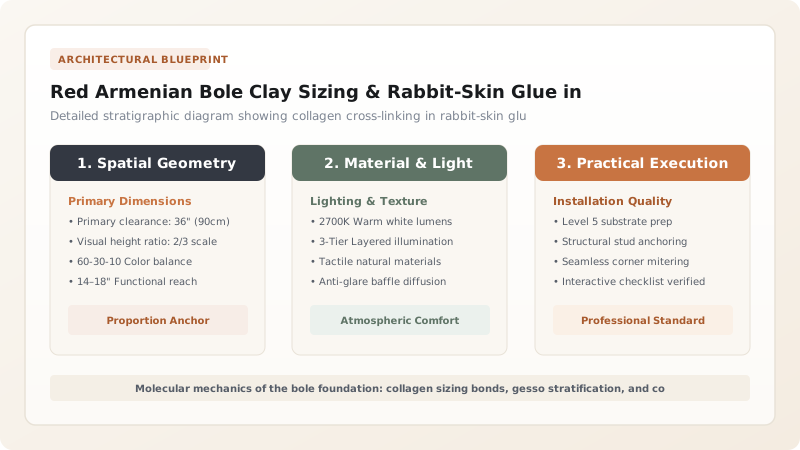
The Stratigraphic Philosophy of the Traditional Gilding Ground
In traditional Portuguese water gilding (douramento a água), gold leaf is never applied directly to bare wood. The surface of seasoned sweet chestnut—however finely scraped—is porous, coarse-grained, and structurally uneven. The triumph of Talha Dourada relies on an intricate stratigraphic sandwich: an engineered micro-foundation of animal collagen and levigated minerals that transitions smoothly from the fibrous wood substrate to a molecularly flat plane.
This ground consists of three distinct chemical zones: the initial colagem (glue sizing), the gessagem (slaked plaster ground layers), and the bolagem (bole clay sizing). Each layer performs a specialized mechanical role: sealing porosity, leveling irregularities, providing mechanical cushioning, and supplying the chromatic undertone that warms the translucent gold leaf.
The Biochemistry of Rabbit-Skin Glue (Cola de Coelho)
The universal binding agent throughout the entire ground preparation is cola de coelho (rabbit-skin glue). Extracted from the collagen-rich connective tissues of rabbit pelts, this bio-adhesive possesses properties distinctly superior to bovine hide or bone glues. It exhibits high jelly strength (measured between 250 and 350 Bloom grams), exceptional reversibility in water, and an extraordinary modulus of elasticity.
When prepared at a precise concentration of 1:12 to 1:14 in distilled water, rabbit-skin glue forms an aqueous sol that penetrates deep into the cellular lumens of the chestnut timber, creating an unbreakable mechanical key. Crucially, as the underlying timber swells and shrinks across seasonal humidity shifts in unheated Portuguese stone churches, the flexible collagen matrix stretches without fracturing, preventing catastrophic delamination of the overlying gesso and gold.
Gesso Grosso vs. Gesso Fino: Dual-Stage Leveling
Over the sized wood, artisans apply the gesso ground in two distinct phases. The first phase is gesso grosso (coarse gesso). Formulated with slaked calcium sulfate dihydrate (plaster of Paris slaked in water for a month to eliminate heat-generating crystallization), gesso grosso possesses a toothy, open aggregate structure. Brushed in two to three thick, warm coats, it fills grain pores, micro-checks, and lamination seams.
Once the gesso grosso is scraped level with steel scrapers, the craftsman applies four to six coats of gesso fino (fine gesso / gesso sottile). Formulated with triple-washed, precipitated chalk (pure calcium carbonate), gesso fino cures into a dense, velvety, porcelain-like skin. The artisan hones this ground using damp linen cloths (wet-rubbing) and dried horsetail reeds (Equisetum), carving back any blurred contours to restore the razor-sharp crispness of the underlying chestnut acanthus carving.
The Mineral Chemistry of Red Armenian Bole (Bolo Arménio)
The crowning layer of the ground is the bolo arménio (red Armenian bole). Harvested from specific geological deposits of volcanic weathering in Armenia and Venice, this is an ultra-fine, iron-rich aluminosilicate clay. Its microscopic particles are shaped like flat, hexagonal platelets that slide over one another with zero friction.
Mulled with dilute rabbit-skin glue size and a drop of egg white, the bole is brushed over the gesso in four whisper-thin, translucent coats. The bole performs two irreplaceable functions: First, its compressible, clay-platelet structure acts as a microscopic shock absorber. When the gilder later presses down with a heavy agate stone burnisher, the bole compresses without cracking, allowing the gold leaf to be polished to a mirror sheen. Second, its warm, fiery terracotta-red undertone reflects light through the microscopic crystalline gaps of the 0.1-micron-thick gold leaf, imbuing the gold with the signature deep, radiant warmth of Portuguese Baroque church interiors.
Stratigraphic Layers of the Traditional Talha Dourada Ground
Use this reference table to calculate exact physical dimensions, ratios, and specifications before purchasing:
| Stratigraphic Layer | Composition & Materials | Number of Coats | Primary Mechanical Function | Surface Quality |
|---|---|---|---|---|
| Timber Sizing (Colagem) | Pure rabbit-skin glue in water (1:10) | 1 to 2 coats | Seals wood pores; anchors subsequent gesso | Tacky, clear amber seal |
| Gesso Grosso | Coarse slaked plaster & glue size | 2 to 3 coats | Fills wood grain, checks, and joinery voids | Matte, textured, high tooth |
| Gesso Fino | Fine precipitated chalk & glue size | 4 to 6 coats | Forms porcelain-smooth carving surface | Porcelain-like; easily scraped |
| Red Armenian Bole | Aluminosilicate clay + Fe2O3 + size | 4 to 5 coats | Cushion for agate burnishing; color tone | Satin terracotta sheen; compressible |
| 24K Gold Leaf | Beaten pure gold (0.1 micron thick) | 1 to 2 layers | Optical reflection, brilliance, & incorruptibility | Specular mirror polish (when burnished) |
Practical Constraints
Every successful decoration project must account for physical and environmental constraints:
High Thermal Sensitivity of Animal Collagen in Warm Summer Workshops
Temperatures exceeding 30°C prevent rabbit-skin glue from gelling properly, causing chalky, weak grounds. Mitigation: Conduct ground preparation in climate-controlled workshops maintaining 20°C with moderate humidity.
Soluble Iron Impurities in Low-Grade Commercial Bole Pigments
Unrefined bole contains coarse quartz grit that scratches gold leaf during burnishing. Mitigation: Source certified historical Armenian bole tears and levigate repeatedly through water sedimentation tanks.
Execution Blueprint & Craftsmanship Sequence
Execute this professional sequence to achieve flawless results without backtracking:
Rabbit-Skin Glue Granule Hydration
Weigh 80 grams of pharmaceutical rabbit-skin glue granules; soak in 1000 ml of distilled water for 12 hours until fully swollen.
Controlled Thermal Melting
Warm the swollen glue in a double boiler at 55°C, stirring until completely liquid; test jelly strength after cooling.
Timber Impregnation (Colagem)
Brush hot glue size over the carved chestnut wood; allow full penetration into end-grain fibers to establish an adhesive anchor.
Gesso Grosso Application
Mix slaked coarse plaster with glue size; brush three warm coats onto the timber; allow 24 hours of drying before scraping flat.
Gesso Fino Layering and Honing
Brush five thin coats of gesso fino over the carving; rub with a damp linen cloth (wet-rubbing) to restore crisp, razor-sharp carved details.
Bole Levigation and Mulling
Mull genuine red Armenian bole clay on a porphyry slab with warm 1:20 rabbit-skin glue size and drops of egg white to an ultra-fine slurry.
Multi-Coat Bole Sizing (Bolagem)
Apply four whisper-thin coats of warm red bole with a soft badger-hair brush, feathering strokes to prevent ridges or pooling.
Dry Polishing and Buffing
Allow the bole to dry for 12 hours; buff the red surface with a natural boar-bristle brush until it glows with a satin terracotta luster.
Common Mistakes & Countermeasures
Avoid these costly errors that compromise aesthetics, ergonomics, and budget:
Overheating rabbit-skin glue above 65°C during preparation
Applying red bole clay in thick, viscous coats like house paint
Using synthetic chalk or acrylic gesso instead of traditional slaked animal-glue gesso
Project Execution Checklist
Track your physical progress. Checkboxes persist automatically on this device:
Frequently Asked Questions
What is Armenian bole (bolo arménio)?
Armenian bole is a naturally occurring, ultra-fine volcanic clay composed of hydrated aluminum silicates enriched with ferric oxide (Fe2O3). Historically mined in Armenia and Venice, its microscopic platelets are smooth, fatty, and soft, making it the ideal compressible bed for burnishing gold leaf.
Why is rabbit-skin glue used instead of bone glue or fish glue?
Rabbit-skin glue (cola de coelho) produces a uniquely elastic and flexible film with high tensile strength. Unlike brittle bone glue, it expands and contracts harmoniously with the underlying chestnut wood, preventing the gesso and gold leaf from cracking during seasonal humidity changes.
What is the purpose of "wet-rubbing" the gesso fino layer?
Applying multiple coats of gesso can soften or blur the razor-sharp carved edges of acanthus leaves. Wet-rubbing with a damp linen cloth gently dissolves surface chalk, allowing the gilder to sharpen contours and restore crisp carved undercuts before applying the bole.