Talha Dourada (gilded woodcarving) is the supreme artistic expression of Portuguese Baroque and Rococo architecture, flourishing in the 17th and 18th centuries under King João V. Characterized by monumental, deeply carved retables and entire chancel interiors encrusted with lush acanthus scrolls, cherubs, and twisted Solomonic columns, it is sculpted from Iberian sweet chestnut wood. Coated in gesso and red Armenian bole clay, it is gilded with genuine 24-karat gold leaf and burnished with agate stones to create radiant "golden churches" (igrejas de ouro).
At a Glance: Key Takeaways
- Epoch & Geography: Portuguese Baroque & Joanine Rococo (Porto, Braga, Lisbon, Coimbra)
- Primary Carving Timber: Iberian Sweet Chestnut (Castanea sativa) & Brazilian Jacaranda
- Ground Preparation: Gesso Grosso & Gesso Fino bound with refined Rabbit-Skin Glue
- Gilding Substrate: Levigated Red Armenian Bole (Bolo Arménio) Clay Size
- Gold Leaf Purity: 23.75K to 24K Pure Gold Leaf applied via traditional Water Gilding
In-Depth Guides in this Directory
Explore specialized subtopic blueprints, technical dimensions, and execution checklists:
Deep-Relief Chestnut Wood Acanthus Carving & Undercutting in Talha Dourada
Technical guide to master woodcarving in Portuguese Talha Dourada: chestnut billet lamination, gouge ergonomics, acanthus relief, and deep undercutting (esvaziamento).
Red Armenian Bole Clay Sizing & Rabbit-Skin Glue in Talha Dourada
Technical guide to preparing gesso grounds and red Armenian bole clay sizing with rabbit-skin glue in traditional Portuguese Talha Dourada water gilding.
Twenty-Four-Karat Water Gilding & Agate Stone Burnishing in Talha Dourada
Technical manual for traditional Portuguese water gilding (douramento a água): 24K gold leaf manipulation, gilder’s tip, and agate stone burnishing (brunidura).
The Golden Age of Portuguese Talha Dourada
In the late seventeenth and eighteenth centuries, the Kingdom of Portugal was swept by an artistic phenomenon without parallel in Western European art: Talha Dourada (literally "gilded woodcarving"). Propelled by the sudden influx of monumental wealth following the discovery of vast gold and diamond deposits in Minas Gerais, Brazil, during the reign of King João V (the "Portuguese Sun King"), church and aristocratic patrons embarked on an unprecedented architectural building spree.
Rather than executing frescoes or marble revetments, Portuguese master builders transformed entire ecclesiastical spaces into igrejas de ouro (golden churches)—such as the Church of São Francisco and the Church of Santa Clara in Porto, the chancel of Sé de Braga, and the chapel of São Roque in Lisbon. Every square centimeter of walls, chancel vaults, organ cases, and soaring retables was clad in deep-relief gilded timber, creating shimmering, golden architectural caverns that dazzled worshippers with mystical splendor.
Stylistic Evolution: From National Baroque to Joanine Magnificence
Talha Dourada was not a static decorative style; it underwent a profound evolutionary metamorphosis across two centuries. The earliest major expression was the Estilo Nacional (National Style, c. 1675–1710). Responding to the restoration of Portuguese independence from the Spanish crown, master entalhadores (carvers) rejected Mannerist geometric grids, inventing a purely Portuguese language of concentric Romanesque-inspired concentric arches, undulating helical Solomonic columns (colunas salomónicas), and Eucharistic iconography overflowing with grapevines, clusters of grapes, and pelicans.
By 1710, with the coronation of João V, the style exploded into the Estilo Joanino (Joanine Baroque, c. 1710–1750). Influenced by Italian Roman Baroque master Gian Lorenzo Bernini, the retables abandoned architectural compartmentalization, dissolving into monumental theatrical stage sets. Colossal sculpted angels, cascading silk-like draperies, exuberant acanthus scrolls, and sunbursts of heavenly cherubs burst forward from the walls, immersing the spectator in an emotional, incandescent golden drama.
Material Alchemy: Sweet Chestnut, Armenian Bole, and 24K Gold
The monumental presence of Talha Dourada rests upon an exacting, multi-layered alchemy of noble materials. The physical substrate is Iberian sweet chestnut (Castanea sativa), a native hardwood harvested from the mountain forests of northern Portugal. Dense, stable, and packed with insect-repelling tannins, chestnut allows master carvers to execute high-relief acanthus leaves with radical undercutting without fear of structural splitting.
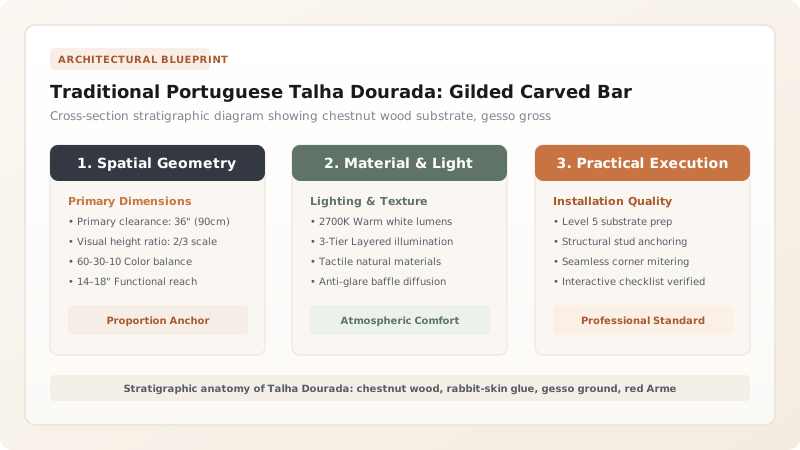
Over this sculpted wood, artisans applied the classical water-gilding foundation: multiple whisper-thin coats of refined chalk gesso bound with rabbit-skin glue (cola de coelho), scraped until smooth as marble. Over the gesso sits the bolo arménio (red Armenian bole)—a volcanic, iron-oxide-rich aluminosilicate clay that provides a flexible, compressible cushion. Onto this activated bole bed, master gilders floated tissue-thin leaves of genuine 24-karat gold, burnished with natural agate stones until the gold reflected candlelight with blinding specular brilliance.
Chiaroscuro Drama, Spatial Acoustics, and Conservation
The theatrical power of Talha Dourada was engineered to function under the soft, flickering illumination of beeswax church candles. The master carver never carved flat surfaces; every acanthus leaf, cherub cheek, and Solomonic twist was carved with steep bevels and deep undercuts. Under candle glow, the burnished gold highlights reflected blinding white sparkles, while the deep recessed undercuts absorbed light into velvety, mysterious black shadows, creating an intensely dynamic chiaroscuro effect.
Furthermore, the complex, undulating relief of timber retables acted as an extraordinary acoustic diffuser, softening reverberations of Gregorian chants and pipe organ polyphony into warm, enveloping resonance. Today, preserving these monumental golden ensembles requires sophisticated conservation protocols. Heritage teams monitor interior microclimates, consolidate beetle-damaged chestnut cores with reversible consolidants, and gently clean darkened soot from historic 24-karat gold leaf using non-polar cyclododecane gels, safeguarding Portugal’s most incandescent artistic legacy.
Stylistic Evolution of Portuguese Talha Dourada
Use this reference table to calculate exact physical dimensions, ratios, and specifications before purchasing:
| Style / Period | Historical Epoch | Architectural Forms | Foliage Motifs | Chiaroscuro & Lighting |
|---|---|---|---|---|
| Mannerist Talha | 1580–1675 (Philipian Era) | Classical architectural frames, pediments, & niches | Geometric strapwork, cartouches, & stiff rosettes | Shallow relief; uniform, restrained illumination |
| Estilo Nacional (National Baroque) | 1675–1710 (Reign of Pedro II) | Concentric Romanesque arches & Solomonic columns | Lush grapevines, bunches of grapes, & Eucharistic birds | High relief; deep undercutting and dramatic shadows |
| Estilo Joanino (Joanine Baroque) | 1710–1750 (Reign of João V) | Theatrical Italianate canopies, drapery, & cloudbursts | Voluptuous acanthus scrolls, cherubs, & cornucopias | Total architectural immersion; radiant golden caves |
| Rococo Talha (Joanino Tardio) | 1750–1780 (Reign of José I) | Asymmetrical shells (rocaille), scrolls, & light crests | Delicate ribbon garlands, trailing flowers, & C-curves | Sinuous, airborne lightness with pastel painted fields |
Practical Constraints
Every successful decoration project must account for physical and environmental constraints:
Attack by Xylophagous Wood-Boring Beetles (Anobium punctatum)
Furniture beetles burrow into soft sapwood and chestnut heartwood, hollowing out structural retables from within. Mitigation: Isolate and consolidate infested timber using non-toxic nitrogen gas anoxia fumigation and permethrin consolidation.
Microclimatic Humidity Swells from Congregational Respiration
Large crowds in historic unheated churches cause rapid humidity spikes that soften rabbit-skin glue and blister gold leaf. Mitigation: Install continuous conservation HVAC buffering systems maintaining stable 50% RH and 19°C.
Execution Blueprint & Craftsmanship Sequence
Execute this professional sequence to achieve flawless results without backtracking:
Chestnut Billet Selection and Lamination
Dimension seasoned Iberian sweet chestnut boards; face-glue boards using hot animal-hide glue under heavy clamps to create monolithic carving blocks.
Architectural Roughed-Out Gouging (Desbaste)
Transfer 1:1 master drawings onto the block face; rough out primary architectural volumes and column cylinders using heavy felling gouges and mallets.
Deep Relief Foliage and Figure Carving
Sculpt voluptuous acanthus leaves, cherub heads, and twisting Solomonic grapevines using curved spoon gouges and V-parting chisels.
Deep Undercutting (Esvaziamento)
Hollow out the wood behind carved foliage leaves to 50 mm depth, separating leaf tips completely from the backplane to cast dramatic shadows.
Gesso Ground Laydown (Gessagem)
Apply three coats of coarse gesso grosso followed by five coats of fine gesso fino bound with rabbit-skin glue, scraping each coat glass-smooth.
Red Armenian Bole Sizing (Bolagem)
Brush four coats of levigated red Armenian bole clay size over the gesso, buffing with a soft bristle brush to a warm, satin terracotta sheen.
Water Gilding (Douramento a Água)
Wet the bole with gilder’s liquor; pick up 24K gold leaves with a badger-hair gilder’s tip and float them onto the surface, allowing water suction to pull them flat.
Agate Stone Burnishing (Brunidura)
Once the bole reaches leather-hardness, burnish raised ridges and leaf margins with a curved dog-tooth agate stone to create dazzling specular highlights.
Common Mistakes & Countermeasures
Avoid these costly errors that compromise aesthetics, ergonomics, and budget:
Applying modern synthetic gold leaf (Dutch metal / brass foil) or metallic acrylic paint
Burnishing gold leaf before the underlying bole bed has reached the leather-hard stage
Carving green, unseasoned chestnut timber with moisture content above 15%
Project Execution Checklist
Track your physical progress. Checkboxes persist automatically on this device:
Frequently Asked Questions
What is an "Igreja de Ouro" (Golden Church) in Portugal?
An Igreja de Ouro is a church interior completely encrusted from floor to ceiling with gilded carved woodwork (Talha Dourada), where walls, altarpieces, organ lofts, and vaulted ceilings are entirely clad in undulating, 24-karat gilded relief, creating the illusion of entering a colossal golden cavern.
Why is Iberian sweet chestnut (Castanea sativa) the preferred wood for Talha Dourada?
Sweet chestnut combines moderate density, fine uniform texture, and low shrinkage coefficients with high concentrations of natural wood tannins that naturally deter wood-boring insects. Furthermore, its carving properties allow deep undercutting without splintering.
Why is red Armenian bole clay placed beneath gold leaf?
Armenian bole is an ultra-fine, iron-rich aluminosilicate clay. Ground in animal glue, it provides a smooth, flexible, cushion-like bed that permits high-pressure agate stone burnishing without tearing the fragile gold leaf. Furthermore, its warm terracotta-red hue imparts a rich, fiery golden warmth to the thin gold leaf.