The foundation of Talha Dourada is deep-relief master woodcarving executed in seasoned Iberian sweet chestnut (Castanea sativa). Master entalhadores assemble laminated timber billets with animal-hide glue, roughing out monumental architectural forms with heavy gouges. The signature artistry lies in deep undercutting (esvaziamento) to depths of 50–100 mm, carving behind voluptuous acanthus leaves and Solomonic column spirals to detach motifs from the background, casting dramatic chiaroscuro shadows under church lighting.
At a Glance: Key Takeaways
- Carving Wood: Seasoned Iberian Sweet Chestnut (Castanea sativa / Castanheiro)
- Moisture Content: 8% to 10% equilibrium moisture content after 4 years of air seasoning
- Primary Tools: Hand-forged curved spoon gouges, fishtail chisels, & heavy hornbeam mallets
- Undercutting Depth: Esvaziamento: 50 mm to 100 mm deep reverse hollows behind motifs
- Adhesive System: Hot reversible animal-hide glue (cola de peixe / cola de osso)
Silviculture and Material Excellence of Iberian Sweet Chestnut
The survival and physical magnificence of historic Portuguese Talha Dourada is rooted in the unique silviculture of Iberian sweet chestnut (Castanea sativa, known in Portuguese as castanheiro). Harvested from the cool, mist-shrouded mountain valleys of northern Portugal—in regions like Trás-os-Montes, Minho, and the Serra da Estrela—chestnut was recognized by the medieval guilds as the undisputed king of architectural carving woods.
Unlike dense European oak, which contains hard medullary rays that resist carving chisels and dull edge tools, sweet chestnut offers a remarkably uniform, moderately dense cellular structure. It cuts crisply in all directions, permitting carvers to execute radical curves and gossamer-thin leaf tips without splintering. Furthermore, chestnut heartwood is naturally saturated with high concentrations of ellagitannins and gallic acid. This natural chemical armor renders the wood bitter and inedible to wood-boring furniture beetles (Anobium punctatum), allowing multi-ton retables to endure for four centuries without structural decay.
Billet Lamination: Engineering Monumental Monolithic Billets
The monumental altarpieces of the Joanine Baroque—often soaring 15 to 20 meters to the sanctuary vault—could not be carved from single tree trunks. Solid massive tree logs invariably check, split, and twist radially along the medullary rays as their inner heartwood dries. Master entalhadores solved this through sophisticated billet lamination.
Carpenters carefully dimensioned quarter-sawn chestnut boards, matching grain orientations in opposing pairs to cancel out internal drying stresses. The mating surfaces were planed dead-flat and glued together using hot, reversible animal-hide glue (cola de peixe or cola de osso) under heavy forged iron screw clamps. Once cured, these laminated composite billets behaved as dimensionally stable, stress-free artificial boulders from which master carvers could liberate monumental three-dimensional figures and columns.
Gouge Ergonomics and Sculptural Acanthus Modeling
Carving the voluptuous, undulating acanthus foliage that defines the Joanine Baroque required an arsenal of hand-forged carving gouges (formões and goivas). Master carvers utilized curved spoon gouges, fishtail chisels, and back-bent gouges capable of reaching deep inside tight internal hollows without striking adjacent wood.
The carving sequence began with the desbaste (roughing out), where the entalhador drove heavy 40-millimeter No. 7 gouges with a hornbeam mallet to block out primary anatomical masses. The artist then modeled the flowing acanthus leaves, carving the central fleshy midrib, the deeply scooped side lobes, and the razor-sharp, curled serrations that seem to flutter in an unfelt breeze. All tool cuts were directed with the grain, maintaining crisp, crystalline ridge lines that would later catch and reflect gilded candlelight.
Esvaziamento: The Art of Deep Chiaroscuro Undercutting
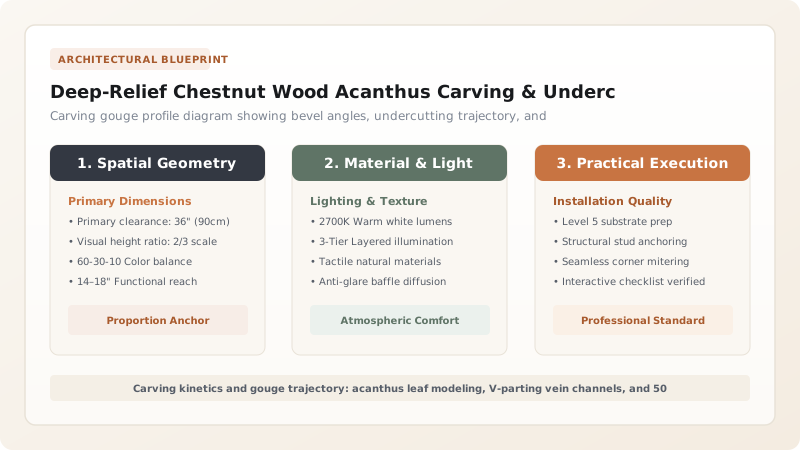
The definitive technical achievement that separates Portuguese Talha Dourada from lesser European woodwork is esvaziamento (deep undercutting). The master carver was not content to create relief that merely sat upon a backing board; he hollowed out the wood behind the motifs to depths of 50 to 100 millimeters.
Using bent spoon chisels, the artisan hollowed out the reverse of acanthus leaves, angel draperies, and grape clusters, completely severing their connection to the background plane except at narrow, hidden structural anchor points. In the dim, candlelit sanctuaries of Portuguese Baroque churches, this extreme undercutting allowed ambient light to pass completely behind the carved motifs. The resulting deep, velvety black shadow voids create the stunning optical illusion that the golden foliage is levitating in mid-air, defying the physical weight of its chestnut substrate.
Carving Timbers in Portuguese Colonial and Baroque Architecture
Use this reference table to calculate exact physical dimensions, ratios, and specifications before purchasing:
| Timber Species | Workability & Cleavage | Grain & Texture | Natural Beetle Resistance | Application in Talha Dourada |
|---|---|---|---|---|
| Iberian Sweet Chestnut (Castanheiro) | Exceptional; splits straight, cuts clean across grain | Coarse to medium; straight, fibrous grain | Very High (High natural tannin content) | Premier wood for structural retables & relief |
| Brazilian Jacaranda (Dalbergia) | Extremely dense, heavy; dulls edge tools | Interlocked grain; takes glass-like polish | Exceptional (Impervious to insects) | Used for luxury palace woodwork and chancel furniture |
| European Walnut (Nogueira) | Superb; dense, uniform, velvety cut | Fine, closed texture; dark brown hue | Moderate (Susceptible to sapwood beetles) | Used for delicate statuary faces and hands |
| Scots Pine (Pinho de Flandres) | Soft, light; tends to splinter along growth rings | Uneven texture; prominent resinous rings | Low to Moderate (Prone to woodworm) | Used strictly for concealed rear structural frames |
Practical Constraints
Every successful decoration project must account for physical and environmental constraints:
Immense Deadweight of Monumental 15-Meter Retable Assemblies
Multi-tier carved chestnut retables weigh up to 20 metric tons, exerting colossal shear stress on church sanctuary walls. Mitigation: Tie the wooden structure directly into granitic sanctuary masonry using heavy wrought-iron anchor straps (tirantes).
High End-Grain Porosity Absorbing Gesso Unevenly
Carved end-grain absorbs moisture rapidly, causing uneven gesso sinking and hollow spots beneath gold leaf. Mitigation: Apply two preliminary saturation coats of hot rabbit-skin glue size to seal all end-grain cuts prior to gessoing.
Execution Blueprint & Craftsmanship Sequence
Execute this professional sequence to achieve flawless results without backtracking:
Lumber Sourcing and Ring Density Grading
Procure old-growth sweet chestnut logs from Trás-os-Montes; grade lumber for tight growth rings and zero sapwood inclusion.
Air Seasoning and Moisture Verification
Stack boards with wooden stickers in open sheds for 4 years; verify moisture content is below 10% using a resistance moisture meter.
Billet Lamination and Clamping
True mating surfaces with a jointer plane; apply hot hide glue at 60°C and clamp billets with heavy forged screw clamps for 24 hours.
Rough Architectural Gouging (Desbaste)
Mount the laminated billet on the carving bench; chop out rough architectural massing and Solomonic column helixes using heavy framing gouges.
Acanthus Leaf Anatomical Modeling
Sculpt voluptuous acanthus leaves, defining the central vascular stem, radiating side lobes, and serrated curled tips using curved spoon gouges.
Deep Undercutting (Esvaziamento)
Drive bent fishtail chisels beneath the leaf margins, hollowing out negative voids 50 to 80 mm deep behind the foliage.
Crisping and Vein Detailing
Cut delicate central midribs and secondary leaf veins using a razor-sharp V-parting tool (buril), maintaining sharp, well-defined crests.
Cabinet Scraping and Surface Tooth Inspection
Pare away tool chatter marks with curved steel cabinet scrapers; inspect surface to ensure adequate mechanical tooth for gesso adhesion.
Common Mistakes & Countermeasures
Avoid these costly errors that compromise aesthetics, ergonomics, and budget:
Leaving sapwood (borne) along the edges of carved chestnut billets
Using modern moisture-curing polyurethane or PVA wood glues for billet lamination
Carving acanthus leaves without sufficient undercutting, leaving them flat against the backboard
Project Execution Checklist
Track your physical progress. Checkboxes persist automatically on this device:
Frequently Asked Questions
Why was sweet chestnut (Castanea sativa) preferred over oak for Talha Dourada?
While oak is hard and heavy with large medullary rays that can cause chipping across the grain, sweet chestnut possesses a more compliant, elastic cell structure with minimal ray fleck. This allows master carvers to execute radical undercutting and deep three-dimensional curves without splitting the timber.
What is "Esvaziamento" in Portuguese woodcarving?
Esvaziamento (literally "emptying" or "hollowing") is the master technique of carving away the wood behind the carved motifs. By completely detaching the tips of acanthus leaves and angel drapery from the solid background block, the carver creates deep negative air pockets that cast dramatic shadows.
What is a Solomonic column (coluna salomónica)?
A Solomonic column is a spiraling, helical architectural column inspired by the legendary columns of the Temple of Solomon in Jerusalem. In Portuguese Baroque Talha, these twisting columns were elaborately carved with climbing grapevines, bunches of grapes, and birds, symbolizing the Eucharist.