Portuguese cork oak architectural installations (revestimentos de cortiça) represent the world's most sustainable, carbon-negative vernacular surfacing tradition. Originating from the ancient agro-forestry silvicultural ecosystem of the Alentejo montado, cork bark is harvested cyclically every nine to ten years without felling a single tree. Rich in natural suberin wax, cork's microscopic honeycomb cellular matrix (over 40 million air-filled cells per cubic centimeter) delivers phenomenal thermal insulation (λ ≈ 0.038 W/mK), acoustic absorption (NRC > 0.60), and natural moisture repellency. Used in raw virgin bark panels or steam-baked black agglomerated blocks, cork forms breathable, biophilic architectural wall and ceiling installations.
At a Glance: Key Takeaways
- Botanical Origin: Quercus suber L. (Cork Oak / Sobreiro), Alentejo Montado, Portugal
- Harvest Cycle: Every 9 to 10 years without felling the living tree (Descortiçamento)
- Cellular Density: ~40 million gas-filled microscopic cells per cm³ (14-sided tetrakaidecahedrons)
- Thermal Conductivity: λ = 0.036 to 0.040 W/mK (superior natural thermal break)
- Acoustic Attenuation: NRC 0.55–0.75 (high speech clarity & impact noise dampening)
In-Depth Guides in this Directory
Explore specialized subtopic blueprints, technical dimensions, and execution checklists:
Alentejo Montado Cork Bark Sustainable Harvesting (Descortiçamento) and Boiling Curation
Silvicultural guide to Portuguese cork harvesting (descortiçamento) in the Alentejo montado: seasonal peeling axes, boiling sterilization, and plank curing.
Steam-Baked Agglomerated Cork Granule Expansion Blocks and Autoclave Bonding
Technical guide to steam-baked expanded black agglomerate cork (Aglomerado Negro): autoclave processing, natural suberin resin bonding, and acoustic wall panels.
Natural Suberin Wax Sealing, Breathable Adhesion, and Acoustic Wall Surfacing
Installation guide to cork wall surfacing: breathable solvent-free adhesion, suberin-compatible beeswax sealing, and acoustic reverberation control.
The Montado Agro-Forestry Ecosystem of the Alentejo
In the sun-baked plains and rolling hills of the Alentejo region in southern Portugal, landscape and human stewardship have co-existed in symbiotic harmony for millennia within the montado (known in Spain as the dehesa). This protected agro-silvo-pastoral ecosystem is centered upon a single miraculous tree: the cork oak (Quercus suber L.), known natively in Portuguese as the sobreiro.
Portugal is home to over 33% of the world’s cork oak forests and produces more than 50% of the planet's commercial cork. The montado is not a monoculture plantation; it is a rich biodiversity hotspot supporting endangered Iberian lynxes, imperial eagles, and black storks. Crucially, cork extraction is one of the world's few industrial harvesting systems where not a single tree is felled. Stripping the bark every nine to ten years actually extends the tree's lifespan (often exceeding 200 to 250 years) and stimulates the tree to absorb up to five times more carbon dioxide to regenerate its protective skin, making cork a champion of regenerative architectural design.
Cellular Biomimicry: The 14-Sided Tetrakaidecahedron
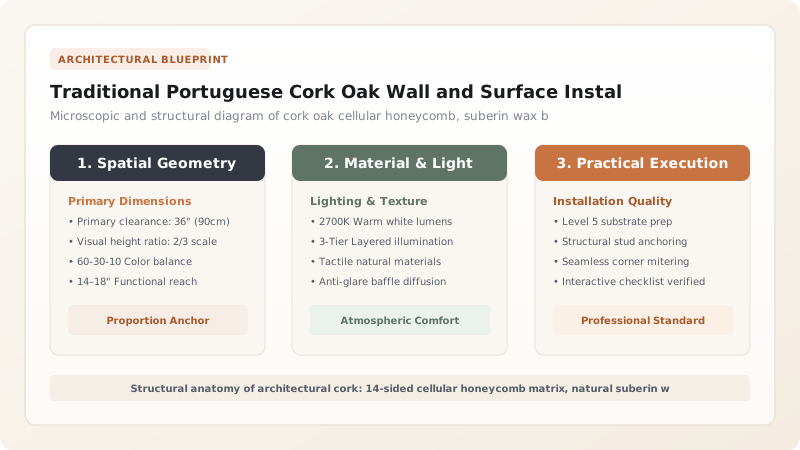
Under an electron microscope, the miraculous physical properties of cork reveal themselves as a masterpiece of natural structural engineering. In 1665, English scientist Robert Hooke examined cork under his primitive microscope and coined the word 'cell' to describe its hollow, microscopic compartments. A single cubic centimeter of cork bark contains upwards of 40 million microscopic cells arranged in a closed, 14-sided honeycomb geometry known in solid geometry as a Kelvin tetrakaidecahedron.
Each tiny cell is a sealed, hollow pressure vessel filled with a gas mixture almost identical to air, enclosed by thin, flexible cell walls impregnated with suberin. This unique cellular architecture explains cork’s physical superlatives: it is over 50% air by volume, extremely lightweight (approx. 120–180 kg/m³), compressible up to 50% without permanent deformation, and thermally non-conductive (thermal conductivity λ ≈ 0.038 W/mK), serving as one of the planet's most effective natural thermal and acoustic barriers.
Architectural Typologies: From Raw Bark to Agglomerate Blocks
In contemporary interior architecture and sustainable building design, Portuguese cork oak is deployed in three primary material typologies. The most tactile and visceral is virgin cork bark (cortiça virgem), harvested from the tree's first stripping. Featuring deeply fissured, undulating, grey-and-cinnamon crusts, raw virgin bark is mounted directly onto feature walls to create breathtaking, biophilic textural installations that connect urban interiors to ancient Mediterranean forests.
The second typology is pure expanded black agglomerate cork (aglomerado negro). Manufactured entirely without synthetic petrochemical glues, raw cork granules are heated inside closed pressure autoclaves with superheated steam at 300°C. The intense heat causes the granules to puff like popcorn, releasing the natural suberin resin which acts as a 100% natural, permanent binder. Finally, fine composition cork tiles are precision-sliced into micro-thin veneers, backed with acoustic felt, and embossed into geometric, acoustic three-dimensional wall panels.
Biophilic Wellness, Acoustics, and Circular Carbon Economy
In the era of climate crisis and indoor air quality concerns, cork represents the gold standard of architectural sustainability. Unlike synthetic foams, fiberglass, and petrochemical acoustic panels—which off-gas toxic volatile organic compounds (VOCs) and linger in landfills for millennia—natural Portuguese cork is 100% circular, biodegradable, and carbon-negative.
Inside commercial offices, hospitality suites, and residential living spaces, cork surfaces transform atmospheric health. The cellular suberin wax repels dust and micro-particulates, providing a naturally hypoallergenic environment for asthmatics. Acoustically, the millions of microscopic cell cavities dampen ambient flutter echo, reducing reverberation times (RT60) and creating an atmosphere of deep, peaceful acoustic sanctuary. By specifying authentic Portuguese cork wall installations, architects honor ancestral Mediterranean craft while building a regenerative, carbon-capturing future.
Architectural Cork Systems: Raw Bark vs Expanded Black Cork vs Granule Veneer
Use this reference table to calculate exact physical dimensions, ratios, and specifications before purchasing:
| Cork System Typology | Manufacturing Process | Acoustic Absorption (NRC) | Thermal Value (λ) | Architectural Setting |
|---|---|---|---|---|
| Raw Virgin Bark Cladding (Cortiça Virgem) | 100% unprocessed first-harvest tree bark | 0.45–0.60 (diffuse irregular surface) | 0.042 W/mK (rugged natural insulation) | Biophilic luxury accent walls, wine cellars, & spa foyers |
| Expanded Black Agglomerate (Aglomerado Negro) | Steam-baked under autoclave pressure (300°C) | 0.65–0.85 (superior sound absorption) | 0.038 W/mK (pure thermal/acoustic barrier) | Auditoriums, recording studios, cinema rooms, & facades |
| Decorative Composition Wall Tile | Fine granules bonded with food-grade resins | 0.35–0.50 (smooth decorative finish) | 0.045 W/mK (slight thermal buffering) | Modern residential living rooms, offices, & headboards |
| Synthetic Cork Mimic (Foam PVC) | Extruded petrochemical PVC with foam blowing | 0.15–0.25 (poor acoustic damping) | 0.065 W/mK (poor thermal performance) | Budget commercial retail displays; high carbon footprint |
Practical Constraints
Every successful decoration project must account for physical and environmental constraints:
Photochemical Bleaching under Intense Direct UV Sunlight
Natural suberin and lignin components oxidize under harsh UV, lightening dark chocolate tones to pale straw beige. Mitigation: Install UV-filtering window glazing or apply UV-absorbing natural plant oil stains to preserve rich earth tones.
High Surface Porosity Attracting Airborne Cooking Grease and Odors
Unsealed cork in kitchen dining zones absorbs grease aerosols, creating dark, indelible stains. Mitigation: Seal kitchen and high-traffic cork installations with two coats of breathable, wash-resistant natural hardwax oil.
Execution Blueprint & Craftsmanship Sequence
Execute this professional sequence to achieve flawless results without backtracking:
Substrate Flatness and Moisture Inspection
Verify wall substrate (drywall, masonry, or plywood) is structurally sound, clean, and flat within 3 mm over a 2-meter straightedge, with sub-surface moisture content below 4%.
Atmospheric Acclimation Protocol
Unbox cork tiles and lay them flat in the installation room for 72 hours, maintaining stable ambient conditions at 20°C and 50% relative humidity.
Wall Centerline and Layout Scribing
Snap plumb and level chalk lines intersecting at the visual focal center of the wall, establishing a balanced symmetrical tile layout that eliminates narrow sliver cuts at corners.
Adhesive Application and Trowel Sizing
Apply solvent-free waterborne contact adhesive to both the wall substrate and the reverse face of the cork tile using a short-nap roller or 2 mm V-notched trowel.
Tack-Dry Window Monitoring
Allow the contact adhesive to flash off until it changes from milky white to translucent and is completely dry to the touch (typically 20 to 40 minutes depending on ventilation).
Precision Tile Setting and Edge Compression
Align the cork tile precisely with the reference chalk lines, pressing firmly from the center outward to expel trapped air pockets without stretching the resilient cork material.
Multi-Directional Mechanical Pressure Rolling
Roll the entire installed surface thoroughly with a heavy 3-section steel hand roller or 50 kg floor roller in both crosswise and lengthwise passes to achieve 100% adhesive bond.
Protective Breathable Wax Sealing
Apply a whisper-thin coat of liquid beeswax or plant-based hardwax oil with a microfiber applicator, buffing lightly after 30 minutes to create an anti-static, velvety satin sheen.
Common Mistakes & Countermeasures
Avoid these costly errors that compromise aesthetics, ergonomics, and budget:
Installing raw or agglomerated cork panels directly out of shipping boxes without acclimation
Using solvent-based, high-VOC contact cements or polyurethane adhesives for indoor wall cladding
Applying impermeable, film-forming polyurethane varnishes over acoustic cork wall panels
Project Execution Checklist
Track your physical progress. Checkboxes persist automatically on this device:
Frequently Asked Questions
How can harvesting cork bark be considered ecologically sustainable?
Harvesting cork bark (descortiçamento) does not harm the tree. The outer bark of Quercus suber is a dead protective layer that regenerates naturally. When stripped by master descortiçadores every nine to ten years, the stripped tree actually absorbs three to five times more carbon dioxide than an unharvested tree as it rapidly synthesizes new bark, making the Portuguese montado one of the planet's greatest carbon sinks.
What is 'suberin' and why are its properties unique?
Suberin is a complex natural biopolymer composed of aliphatic fatty acids and aromatic polyphenols that impregnates cork cell walls. It makes cork naturally impermeable to water and gases, resistant to rot and termites, elastic and compressible under pressure, and inherently fire-retardant (releasing zero toxic fumes during combustion).
Can cork wall panels be installed in humid bathrooms?
Yes. Due to high natural suberin content, cork does not rot or support mold growth. When installed using waterproof dispersion adhesives and sealed with breathable natural wax or oil, cork wall installations thrive in humid bathroom environments, providing warm, condensation-free surfaces that prevent steam fogging.
How does cork provide sound insulation in interior spaces?
Cork's unique cellular structure acts as an acoustic energy absorber. When sound waves strike the 40 million air-filled microscopic cells per cubic centimeter, the acoustic vibrations enter the flexible cell cavities and are converted into minute amounts of heat through friction and cellular deflection, reducing ambient room echo (reverberation time) and stopping airborne sound transfer.