Finalizing Calçada Portuguesa requires a precise three-stage consolidation process: seating hand-knapped stone cubes dry into a 40-mm sharp sand bed, compacting the mosaic plane with a heavy 15-kg wooden block rammer (maço de calceteiro), and repeatedly sweeping a dry blend of fine limestone dust and natural hydraulic lime (NHL 2) into the joints, followed by atomized water misting to lock the stones permanently into a flexible, breathable, self-healing pavement.
At a Glance: Key Takeaways
- Bedding Material: Washed Sharp River Sand / Crushed Stone Sand (0–4 mm)
- Compaction Tool: Wooden Block Hand Rammer (Maço de Calceteiro, 12–16 kg)
- Grouting Medium: 70% Micronized Limestone Dust + 30% NHL 2 Lime
- Activation Method: Fine atomized water misting (zero high-pressure jetting)
- Pavement Drainage: High permeability (infiltrates up to 120 mm/hr rainfall)
The Permeable Engineering of the Calçada Foundation
While modern pavements rely on impermeable asphalt or concrete slabs that direct 100% of rainwater into overloaded storm sewers, Calçada Portuguesa is engineered as a continuous sustainable drainage system (SuDS).
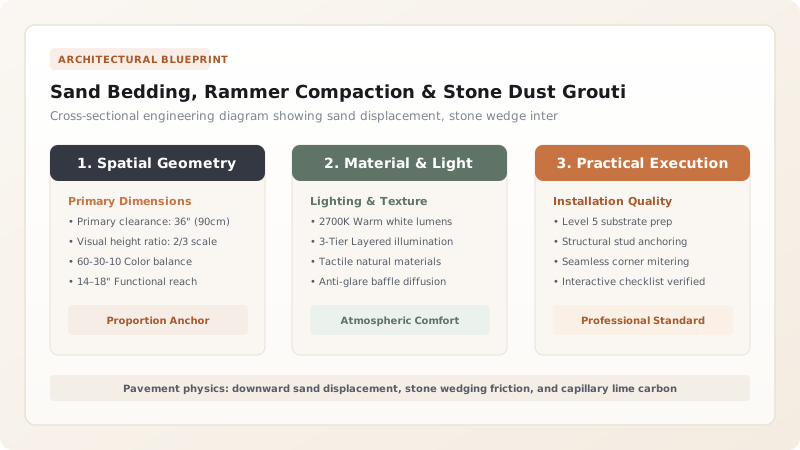
Beneath the decorative mosaic lies a tiered permeable aggregate matrix: a sub-base of open-graded crushed rock (100–150 mm) that acts as an underground retention basin, topped by a 40-mm bedding layer of sharp sand. Because the sand particles are angular rather than rounded, they pack tightly around the tapered stone tesserae under mechanical pressure, preventing horizontal displacement while permitting excess stormwater to filter smoothly through.
The Wooden Maço: Physics of Low-Frequency Ramming
Using modern high-frequency motorized vibrating plate compactors on freshly laid Calçada is a catastrophic error: the intense metallic vibration pulverizes brittle limestone corners, shatters delicate mosaic patterns, and shakes sand out of the joint voids. Authentic consolidation requires the Maço de Calceteiro.
Carved from dense eucalyptus, holm oak, or ironwood, the maço is a heavy cylindrical or rectangular wooden block (weighing 12 kg to 16 kg) fitted with an angled ash handle. The calceteiro drops the heavy wooden mass squarely onto the stones. The low-frequency, high-mass impact drives high stones down to an even plane without chipping edges, while forcing bedding sand to squeeze upward 10 mm into the tapered side joints, establishing primary mechanical interlock.
The Grouting Matrix: Limestone Powder and Hydraulic Lime
Once the mosaic is perfectly flat, the joints must be locked against foot traffic and wind erosion. The traditional infill is not cement grout; it is a dry, carefully balanced mineral blend:
- Micronized Limestone Dust (Pó de Pedra): Graded from 0.05 mm to 1.5 mm. The fine particles fill the microscopic voids between stones, creating high friction resistance that stops blocks from rocking.
- Natural Hydraulic Lime (NHL 2): Blended at 25% to 30% by volume. Lime provides a flexible, breathable chemical binder that does not turn brittle like Portland cement.
- Dry Sweeping: The dry powder is swept diagonally across the pavement with stiff piassava or broomcorn brooms until all joints are filled to the stone rims.
Atomized Water Activation and Self-Healing Carbonation
The final step is moisture activation. High-pressure water hoses must never be used, as they wash the powder straight out of the joints. The paver uses an atomized misting lance, saturating the surface with a gentle fog of clean water.
As water percolates into the joints, the hydraulic lime initiates its initial set, binding the stone dust into a firm, flexible mortar. Over the subsequent 60 days, the lime reacts with atmospheric carbon dioxide (carbonation), converting slowly into hard calcium carbonate (limestone). This unique mineral chemistry gives Calçada Portuguesa its legendary self-healing property: micro-fissures caused by heavy loads dissolve and re-crystallize naturally during subsequent rains, preserving the pavement for generations.
Grouting Methods: Traditional Lime Stone Dust vs Polymeric Sand vs Cement Slurry
Use this reference table to calculate exact physical dimensions, ratios, and specifications before purchasing:
| Grouting Material | Flexibility / Movement | Permeability | Reversibility for Utility Repair | Compatibility with Historic Stone |
|---|---|---|---|---|
| Stone Dust + NHL 2 Lime | High; ductile, self-healing under traffic | High (free-draining SuDS) | 100% Reversible; easily lifted with hand tools | Master Standard; completely authentic and safe |
| Modern Polymeric Sand | Medium; flexible synthetic polymer chains | Moderate to Low; seals after hardening | Difficult; gummy residue clings to stone faces | Poor; can leave plastic sheen and haze |
| Liquid Portland Cement Slurry | Zero; extremely brittle and rigid | Zero; completely impermeable | Impossible; requires destructive jackhammers | Catastrophic; stains stone, cracks, pops cubes out |
| Pure Dry River Sand | High; fully loose friction | Extreme permeability | 100% Reversible; easily washed away by heavy rains | Traditional rustic; requires annual re-sweeping |
Practical Constraints
Every successful decoration project must account for physical and environmental constraints:
Weed Growth in Permeable Sand Joints
Airborne seeds germinate in organic dust trapped in sand joints in shady plazas Mitigation: Incorporate natural hydraulic lime into the joint dust; high initial alkalinity (pH 12) naturally inhibits seed germination for several years
High Water Runoff Washing Away Uncured Joint Infill
A sudden torrential thunderstorm before lime carbonation can wash out swept stone dust Mitigation: Protect freshly grouted sections with breathable geotextile tarpaulins if rain is forecasted within 24 hours
Execution Blueprint & Craftsmanship Sequence
Execute this professional sequence to achieve flawless results without backtracking:
Bedding Sand Layer Screeding
Spread 40 mm of clean, washed sharp river sand (0–4 mm) over the compacted crushed stone sub-base, leveling with wooden screed rails.
Stone Mosaic Seating
Seat hand-knapped limestone and basalt cubes dry into the uncompacted sand, tapping lightly with the calceteiro hammer.
Pre-Ramming Surface Cleaning
Sweep away loose stone chips and debris from the mosaic surface before ramming to prevent pressing rogue chips into stone faces.
First-Pass Maço Ramming
Drop the 15-kg wooden block maço systematically across the stones, overlapping impacts by 50% to drive high stones to a uniform plane.
Stone Dust and Lime Formulation
Mix 70% dry crushed limestone powder (0–2 mm) with 30% Natural Hydraulic Lime (NHL 2) until uniformly blended in a dry trough.
Diagonal Broom Sweeping
Spread the dry mixture across the pavement, sweeping diagonally across joints with stiff-bristle brooms until joints are completely packed.
Atomized Water Fog Misting
Spray surface with atomized water mist until the joint powder is thoroughly moistened without generating surface runoff.
Final Post-Hydration Clean Sweep
After 24 hours of curing, lightly sweep clean damp sawdust across the stone faces to remove haze and polish the mosaic tiles.
Common Mistakes & Countermeasures
Avoid these costly errors that compromise aesthetics, ergonomics, and budget:
Compacting Calçada with heavy vibrating road rollers or plate compactors
Grouting with dark Portland cement slurry (calda de cimento)
Allowing vehicle traffic onto freshly misted pavement within 48 hours
Project Execution Checklist
Track your physical progress. Checkboxes persist automatically on this device:
Frequently Asked Questions
Can Calçada Portuguesa handle heavy delivery truck traffic?
Standard pedestrian Calçada (50–70 mm cubes on sand) is designed for foot traffic and occasional emergency vehicles. For heavy vehicular roadways, masons use 'Calçada Grossa' (larger 100–120 mm cubes) bedded on a reinforced concrete sub-slab with high-strength hydraulic lime mortar.
How do you repair a sunken spot in a Calçada sidewalk?
Restoration is remarkably simple: a calceteiro uses a pointed pry bar to lift the stones in the sunken area, adds a shovel of fresh sharp sand, levels and compacts the bed, replaces the original stones, rams them flush with the maço, and sweeps in fresh stone dust and lime.
Why is sawdust used to clean the pavement after grouting?
Damp hardwood sawdust acts as a natural, gentle abrasive sponge. Swept across the stones, it lifts away lime haze and fine rock dust from the porous surface of the limestone without scratching the stone or leaching out the fresh joint filler.
Does Calçada Portuguesa become slippery in the rain?
When newly laid or properly textured, the countless hand-knapped stone edges and sand joints provide excellent traction. However, over 50+ years of heavy pedestrian traffic, pure calcitic limestone can become polished smooth. Municipalities restore grip by light bush-hammering or applying mild mineral non-slip washes.